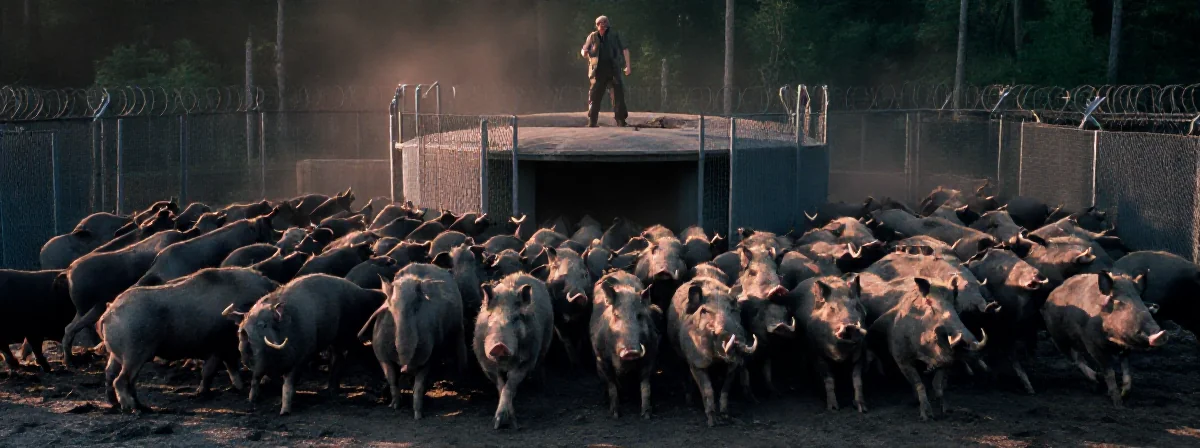
You’ve optimized your bug-out bag, memorized the zombie spawn points, and secured your perimeter. But you’re ignoring the most dangerous variable in the simulation: the feral hog. While you’re training for walkers, the ecosystem is busy breeding a much faster, more aggressive enemy that doesn’t need brains to ruin your day.
We tend to overlook the obvious threats because they don’t fit the cinematic narrative. But if you analyze the data, the real end-game boss isn’t the undead—it’s the swine.
Pattern Recognition
The Legacy Hardware Updates Instantly You might think a domestic pig is just a lazy food source, but that’s a dangerous assumption. The moment a domestic pig hits the wild, it executes a rapid firmware update. We’re talking thicker armor, tusks, and a complete rewrite of their behavioral code. They go from livestock to hostile mob in a single generation. It’s a terrifyingly efficient adaptation that turns a resource into a threat faster than you can say “game over.”
The Spawn Rate Is Broken If this were a multiplayer game, the developers would have patched this years ago. A single sow can drop 30 piglets annually, and those piglets reach sexual maturity in just a few months. You’re looking at exponential scaling that the ecosystem can’t handle. Without human intervention, their population doesn’t just grow; it creates a denial-of-service attack on the local environment, consuming every resource in sight.
You’re Missing the Hitbox There’s a myth circulating that hogs are bulletproof tanks. That’s bad data. The issue isn’t damage resistance; it’s hitbox misalignment. Hunters used to deer aim for the vitals behind the shoulder, but on a hog, the heart sits low and forward. If you’re shooting where the heart should be, you’re gutting the animal. Nothing tanks a clean heart shot—you’re just suffering from user error.
Caliber Matters When the horde rushes your base, you don’t want to be debugging your loadout. A standard capacity magazine isn’t a luxury; it’s a system requirement for dealing with 30 to 50 hogs in under five minutes. While a .308 works fine for single-target elimination, when you’re dealing with a swarm, you need the hardware reset capabilities of something like a .300 Win Mag or a high-velocity semi-auto. It’s about DPS—damage per second.
The Apex Predator Is Still You It’s funny to see people worry about a 1v1 matchup with a boar, as if we’re playing a wrestling game. We didn’t climb to the top of the food chain by overpowering animals; we did it with tools and traps. History shows that Europe nearly wiped them out using nothing but peasants with sharpened sticks and holes in the ground. We are the overpowered class in this ecosystem, provided we don’t nerf our own intelligence.
The Loot Table Is Bugged Even if you win the fight, the reward might not be worth the resource cost. Adult males often suffer from “boar taint,” a chemical imbalance caused by high testosterone that makes the meat taste like sweat and feces. You spend precious ammo and risk injury, and your loot drop is ruined meat. That’s a bad ROI on your survival efforts.
The Resource Cap Will Hit Eventually We can’t ignore the bottlenecks. Right now, hogs thrive on industrial corn and soy waste—resources provided by our current civilization. In a “lights out” scenario, that infinite food buff disappears. The population will crash due to starvation, or rebound predators like wolves and gators will farm them for XP. The system self-corrects, usually violently.
Optimization Tips
Stop preparing for the cinematic apocalypse and start analyzing the system. The biggest threat isn’t the monster with the highest stats; it’s the one that exploits the gaps in your logistics.
You don’t need to be stronger than a boar. You just need to be smarter than the person who underestimates the breeding rate of a hungry pig. Optimize your toolkit, mind your hitboxes, and remember: the most dangerous predator is the one holding the gun.