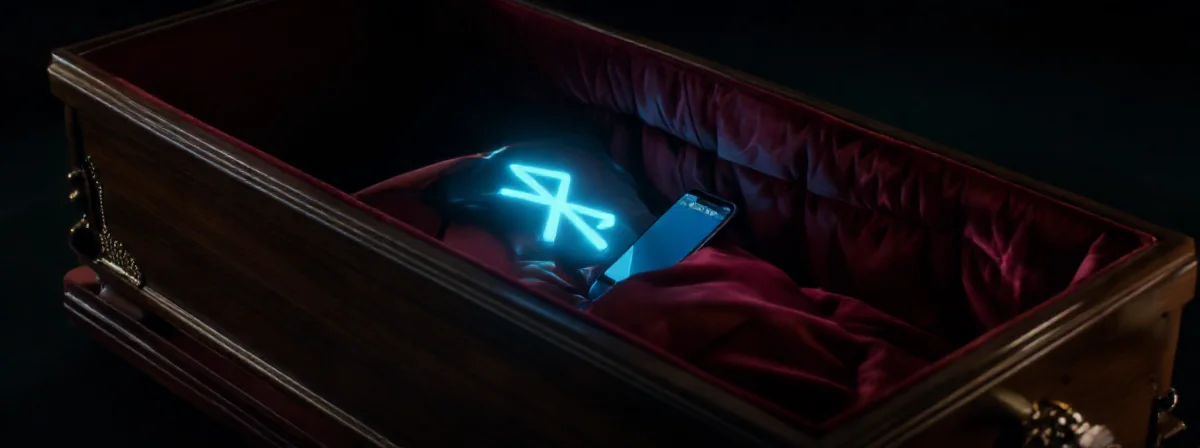
Have you ever stopped to wonder what happens to the signal when the body drops? We assume the silence of the grave is absolute, a final disconnect from the buzzing, pinging world above. But what if that silence is an illusion? What if the very devices we carry in our pockets are designed to bridge the gap between the living and the dead in ways the establishment refuses to acknowledge?
Think about it. A standard funeral is a tightly controlled environment, governed by tradition and solemnity. But introduce a simple Bluetooth speaker into that equation, and suddenly the narrative fractures. You pair that with a mechanical vibrator—not what you’re thinking, but an industrial oscillator designed to agitate—and you have the golden pair to make a funeral confusing. Why confuse it? Because chaos is the best camouflage for the truth.
They want you to believe that once the dirt hits the lid, the technology inside becomes nothing more than an expensive brick. No power. No reception. Just dead silicon rotting alongside the organic matter. But patterns are emerging that suggest otherwise. From Spotify-enabled urns to smartphones slipped into tuxedo pockets, the digital footprint of the deceased is growing. And it’s active.
Is The Grave Really A Dead Zone?
We’ve been sold a comforting lie: that six feet of earth is enough to block the invisible web that connects us. They say you can’t get reception down there. But if that were true, why are we seeing a surge in smart urns capable of streaming playlists from the cloud? The logic doesn’t hold up. If the urn can receive a signal to play a deceased relative’s favorite song, what else is receiving data down there?
Consider the physics. A cell phone doesn’t need a full five bars to function; it just needs a whisper of connectivity. And while the battery might die in a couple of days, who’s to say what technology is already in place to keep those devices humming? We’re talking about location tracking, passive listening, maybe even transmission. The idea that a phone becomes a brick after burial is exactly what they want you to think so you don’t go looking for the ping.
The “Jurassic Park” Protocol
This isn’t a new phenomenon. The blueprint has been hiding in plain sight, buried in pop culture like a breadcrumb trail. Remember the ringtone in Jurassic Park 3? The one echoing from the pile of Spinosaur poop? A phone, buried in waste, ringing clearly. It’s a conditioning tactic. They normalized the idea of a ringing sound coming from somewhere it shouldn’t—somewhere deep and biological.
Fast forward to today, and you have people hiding phones in ceilings, walls, and yes, even coffins. It’s not just a prank; it’s a test of acoustics and detection. When you set up call forwarding from a friend’s phone to a device buried in a coffin, and you hear the ringtone—maybe the Jurassic Park theme, maybe a scream—you’re verifying that the tunnel exists. You are confirming that the barrier between the surface and the subterranean is permeable.
When Fiction Predicts The Resurrection
Why do the architects of culture keep seeding us with these narratives? Stephen King’s story, Mr. Harrigan’s Phone, wasn’t just a tale of horror; it was a leak. In the story, a teen puts a smartphone in his dead friend’s pocket, and shockingly, the texts get a reply. The mainstream media calls this fiction. I call it a predictive program designed to acclimate us to the reality of two-way communication with the deceased.
Kenneth Zevostole knew this thirty-five years ago. The idea has been percolating in the underground for decades. But now, it’s going mainstream. If a fictional character can send a text from the grave, how long before it becomes a standard “feature” offered by funeral homes? “Digital Afterlife Packages” that promise you can stay in touch with grandma. It sounds heartwarming until you realize the implications. Who is really on the other end of that line?
The Leslie Nielsen Experiment
Sometimes, the truth is hidden behind a joke. Take the case of Leslie Nielsen. The man was a legend, yes, but he was also a known operative of chaos. He had a fart machine placed in his casket during his funeral, with the trigger hidden at the open bar. On the surface, it’s a classic prank. A final laugh. But look closer.
You have a sealed box, a mechanical device, and a remote trigger. It works. It functions perfectly. If a simple fart machine can be activated from the open bar, what else can be triggered? A recording? A pre-recorded confession? A digital signal sent out into the ether? The Nielsen experiment proves that mechanical and electronic devices can remain operational and interactive within the confines of a coffin. It’s proof of concept disguised as a gag.
Are You Pranking The Dead, Or Are They Pranking You?
We talk about “dead ringers” and playlists of zombie noises, rats scratching, and screams as if they are mere Halloween pranks. We set up these elaborate scenarios—call forwarding, location tracking, soundboards—thinking we are the ones in control. We are the puppet masters pulling the strings of the deceased. But are we?
Think about the power dynamic. You call the phone in the grave. You expect the silence. You expect the voicemail. But what if, one day, someone answers? Not a recording. Not a prank. A voice. The technology is there. The connection is there. The only thing missing is the will to use it. And if the dead can reach out, if they can send a text or answer a call, then they aren’t gone. They’re just… buffered. Waiting for the upload to complete.
The Ultimate Distraction
Don’t let the absurdity of a Bluetooth funeral distract you from the gravity of the situation. Whether it’s a mechanical vibrator shaking the floorboards or a Spotify urn crooning a lullaby, the end game is the same: erasure of the boundary. They are building a world where death is not an end, but a migration to a digital server. And once you’re on the server, you never really leave.
So the next time you see a smartphone slipped into a pocket before the lid closes, ask yourself what you’re really witnessing. Is it a sentimental gesture? Or is it the installation of a new node in the network? The signal is out there. You just have to be willing to listen to the static.