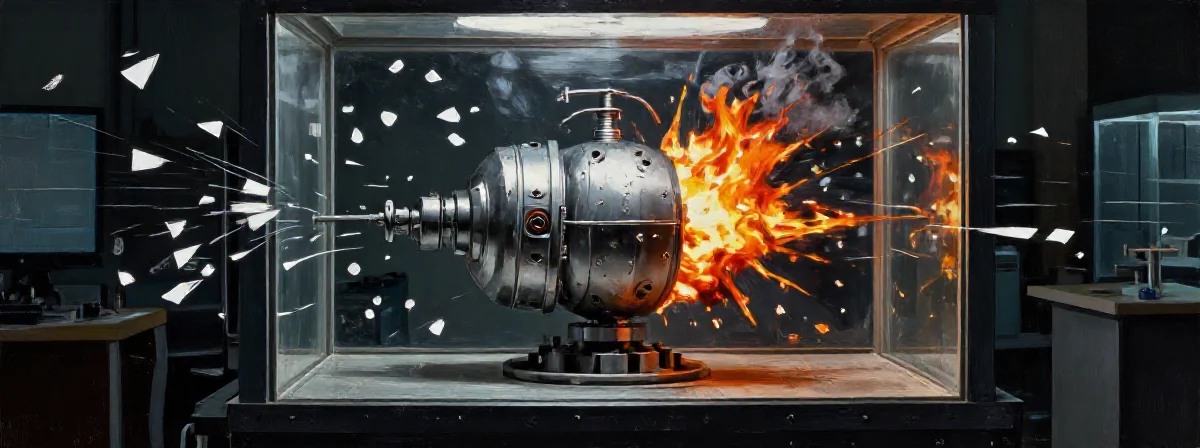
You’d think a high-explosive munition would be a binary proposition: it goes boom, or it doesn’t. Simple. Clean. But the universe, in its infinite annoyance, rarely adheres to our desire for categorization. Consider the lowly cluster bomb, or as I like to call it, the Russian nesting doll of destruction. It raises a philosophical question so irritatingly pedantic it could ruin a dinner party: can a bomb be technically exploded and unexploded at the exact same time?
We usually picture these things thanks to video games where one big bomb turns into a satisfying spray of smaller bombs, which then presumably turn into even smaller bombs until we’re just blowing up molecules with a joystick. But reality, as always, is significantly more bureaucratic and less cinematic.
Is It a Bomb or Just a Very Aggressive Delivery System?
Here is where it gets fun. If you look at the mechanics of a cluster munition, the “mother bomb”—the delivery vehicle—doesn’t actually explode in the Hollywood sense. It doesn’t disintegrate into a fireball. It just opens up. Depending on the specific flavor of chaos you’re deploying, you’re dealing with either a Ram Air setup, where the wind forces the bomblets out while the casing stays attached to the plane, or a Clamshell, where the whole unit drops away and splits open to scatter its children like a panicked piñata.
So, the primary unit opens, dispenses its payload, and drifts away. It hasn’t detonated; it’s just performed a logistical function. If those submunitions fail to go off—a statistically significant and horrifying possibility—you are left with a scenario where the delivery system has “fired” but the payload hasn’t. It’s an explosion that didn’t explode. It’s the “I came, I saw, I did nothing” of warfare.
Schrödinger’s Munition: A Quantum Problem
This brings us to the inevitable physics joke that every armchair philosopher loves to drag out. If you have a sealed, explosion-proof container containing a bomb rigged to a random subatomic decay event with a 50/50 chance of detonating, you have created Schrödinger’s Bomb. Until you open the box and observe the result, the device exists in a superposition of both exploded and unexploded states.
It sounds clever until you realize that unexploded ordnance is basically just a bomb that’s gotten really good at pretending to be a rock. An unexploded bomb is defined as something that has been triggered but failed to function. It is, in essence, a lie wrapped in steel. It promised you a crater and delivered nothing but anxiety. But is it still a bomb? Or is it now just a hazardous waste container with an attitude problem?
Your Car Is Basically a Waiting Room for Tiny Bombs
While we’re busy splitting hairs about military hardware, let’s talk about the explosives you voluntarily sit inside every day. You know that steering wheel staring you in the face? It contains a small explosive charge. So do the passenger dashboard, the A-pillars, and potentially the seats. We call them airbags, but let’s be honest: they are bombs that save your life by exploding in your face instead of letting the dashboard do it.
If the detonator charge—which is a tiny bomb setting off a bigger reaction—fails to deploy the airbag but goes off anyway, well, you’ve got a mess on your hands. Unless you’re driving a vehicle equipped with certain defective airbags we won’t name, in which case you might be driving around with shrapnel lodged in your cranium. Suddenly, the definition of “car accident” takes on a much more militaristic tone.
A Bomb Is Just a Hypothesis
When you strip away the semantics, a bomb is merely a hypothesis of an explosion. It is an object with the potential to explode, not the guarantee. Before it goes off, it’s just a heavy paperweight. After it goes off, it’s shrapnel, a crater, or an ex-bomb (it has shuffled off its mortal coil and joined the choir invisible).
So, perhaps the most accurate way to view a cluster bomb is not as a weapon, but as a cluster of hypotheses scattered across the landscape. Some theories are proven correct, others remain stubbornly unexploded, and the rest just become former bombs. It’s not physics; it’s just the universe messing with our vocabulary again.