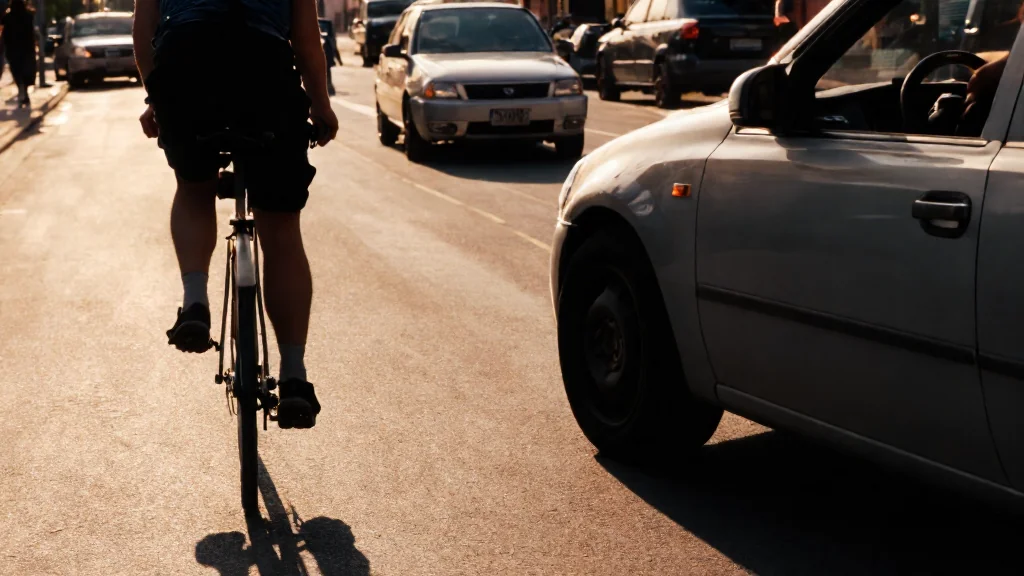
You might think the road is just a way to get from point A to point B, but look closer. It’s actually a rolling psychological evaluation, a place where our patience, our ego, and our anxiety are put on display for thousands of strangers to see. We often treat our cars as extensions of ourselves, private bubbles where we are the kings and queens of our own domains. But once that bubble touches the asphalt, your character is revealed not by how fast you go, but by how you treat the space around you.
The Insight
The phantom brake is a confession of anxiety. You see it often on open highways—a driver taps their brakes for no apparent reason, sending a shockwave of red lights rippling back through the stream of traffic. It’s rarely about safety; it’s a reaction to a loss of control, a physical manifestation of the fear that the world is moving too fast. When you drive with uncertainty, you make everyone else pay for your nerves.
A good driver knows how to admit a mistake. We’ve all been there—that sudden realization that your exit was fifty yards ago. The mature choice is simple: keep driving, take the next exit, and loop back. It costs you three minutes. The immature choice is to slam on the brakes, cut across three lanes of traffic, or hold up a turn lane while you wait for a gap to merge right. That panic maneuver screams that your time is more valuable than everyone else’s safety. A good driver misses a turn; a bad driver refuses to accept they missed it.
Unwanted kindness is still a hazard. You arrive at a four-way stop clearly second, yet the driver who got there first insists on waving you through with a flick of their headlights. It feels polite, but it actually breaks the delicate contract of the road. Now you’re both paused, uncertain, staring at each other while the line of traffic grows. True courtesy is following the rules so everyone can move with predictability, not improvising a moment of charity that creates confusion.
The left lane is not a throne. There is a particular kind of stubbornness in cruising the passing lane, refusing to move over even when a line of cars forms behind you. You might be going the speed limit, or even a bit over, but that isn’t the point. By holding your ground, you’re turning a cooperative system into a personal battleground, demanding that others bend to your pace rather than flowing with the current.
Matching speed when being passed is a small act of war. You signal, you move to the left, and suddenly the car you’re passing accelerates, closing the gap like a gate slamming shut. It is a pure play of ego, a subconscious need to dominate the space around you. You aren’t driving anymore; you’re playing a game you didn’t realize you started, and you’re willing to risk a collision just to avoid being behind someone else.
Your turn signal is a language, not a suggestion. It takes a single finger to communicate your intent to the world, yet so many treat it as an optional accessory. Whether it’s a roundabout, a merge, or a parking lot, failing to signal is an act of arrogance. It assumes that everyone around you is psychic, that they can divine your next move before you make it. A signal isn’t asking for permission; it’s granting a gift of information.
Tailgating is a failure of imagination. Sitting inches off someone’s bumper on the highway doesn’t make you go faster; it just ensures that if anything unexpected happens, there will be nowhere for you to go. It’s a blindness to the fragility of the human body and the physics of steel and glass. You are driving as if the future is guaranteed, as if the car ahead will never, ever need to stop.
The zipper merge requires trust. When lanes narrow, the goal is to take turns, flowing like the teeth of a zipper coming together. Instead, many panic, slamming on their brakes to let a car in miles early or speeding up to block someone from merging. It breaks the rhythm of traffic. Driving is a collective dance, and when you refuse to move in sync with your partner, you trip up everyone on the floor.
Driving with a snow-covered roof is negligence. It takes a few extra minutes to clear the roof of your car, yet many drivers leave a missile of ice and snow ready to fly off at highway speeds. It’s a small act of laziness that endangers strangers. It says you care more about getting warm than you do about the windshield of the person behind you.
We treat the car like a private capsule, a bubble where our mood, our music, and our schedule are the only things that matter. But the road is a shared space, a public commons where our individual flaws are magnified by speed and steel. The next time you feel your blood pressure rising or your foot hovering over the brake, remember: you aren’t just driving a car. You are showing the world who you are.