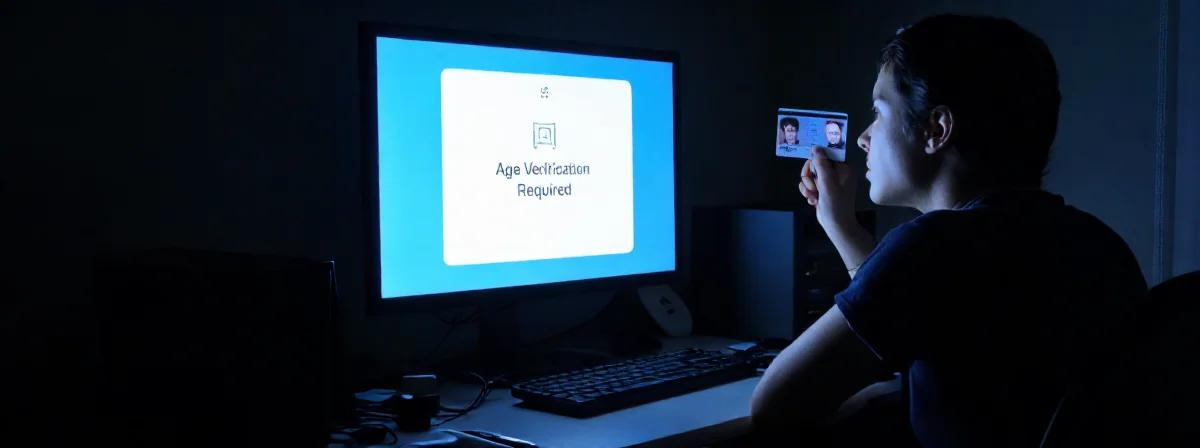
The prompt flashes on the screen, stark and demanding: Verify your age to continue. It’s a familiar annoyance on websites, but imagine it happening the moment you turn on your computer or phone. A new wave of legislation suggests that your operating system—the very foundation of your digital life—should be responsible for knowing exactly how old you are before you can do almost anything.
On the surface, it sounds like a shield for children, a way to stop data-hungry websites from harvesting personal information from minors. But scratch beneath the surface, and the picture gets murky. We are standing on the precipice of a shift in how we interact with technology, trading one set of privacy risks for another that might be far more insidious.
Do We Really Need the Operating System to Babysit Us?
The argument is seductive in its simplicity. If the operating system holds the proof of age, apps and websites wouldn’t need to collect your ID, your face scans, or your credit card details. They just ask the system: Is this person an adult? The system replies yes or no, and you move on. No more uploading driver’s licenses to dubious gambling sites, no more giving your home address to a random app.
But there is a cynical logic at play here. This is how freedom is often chipped away—not with a sledgehammer, but with a scalpel. The demand starts at an extreme, maybe a total ban or invasive surveillance, and then the lawmakers “compromise” down to this OS-level verification. We feel relieved because we avoided the catastrophe, forgetting that we started at zero. We moved from having no mandatory verification to accepting a system where our devices track our identity, and we’re told to be grateful for it.
Is This Actually About Privacy, or Just Centralized Control?
You have to wonder who really benefits. If every app and website stops collecting your data, does it just disappear? Or does the operating system—the gatekeeper—become the ultimate repository of personal information? Even if the OS only passes back a binary “yes” or “no” regarding your age, the infrastructure required to make that determination is massive.
It creates a single point of failure. If a bad actor compromises the OS, or if the OS vendor decides to monetize that verification pipeline, you haven’t saved your privacy. You’ve just consolidated it into a database that is now too big to fail. And let’s be honest: does anyone truly believe they will verify age and never track identity? The temptation to link that “adult” status to a specific profile, a specific user, and a specific habits log will be overwhelming for the corporations holding the keys.
How Do You Verify the Age of a Linux Server?
There is a profound disconnect between the people writing these laws and the reality of how technology works. Consider the system administrator setting up a server. It might run Linux, it might sit in a data center, and it might never be seen by a human pair of eyes. Yet, under a strict interpretation of these laws, that operating system needs a user age.
Do you assign a birthdate to a service account that runs automated scripts? What about a digital sign in a public square that runs on a standard OS kernel? If a child walks past it, has the law been broken? The legislation often targets “natural persons,” but the technical implementation is a blunt instrument. Trying to apply human age restrictions to non-human software entities is a recipe for absurdity—fines levied against open-source foundations because a Raspberry Pi was configured without a birthdate.
Can Anonymity Survive in a World of Mandatory Verification?
There is a longing for the days when the internet was a place you could explore without showing your papers. Some have suggested a clever workaround: verification cards bought at a grocery store for a few dollars, activated with cash, and used anonymously online. You buy the card, you prove you’re 18 at the register, and you enter a code into the site. You are verified, but you are nameless.
It’s a noble thought, but in a world pushing for OS-level verification, that kind of anonymity feels like a relic. If the OS itself is the validator, you can’t just buy a code at a 7-Eleven. You are tied to the device, and the device is tied to you. And if you try to rebel? If you decide to input a fake birthdate to preserve your privacy? You’ll be in good company. Plenty of people have been listing their birth year as 1969 or 1970 for decades, just to throw a wrench into the gears of the data machine.
Whatever Happened to Parental Responsibility?
Amidst all the technical debate, the most uncomfortable question remains: Why is this the government’s job? Every modern operating system already comes with free parental controls. They are robust, they are effective, and they are entirely optional. Parents can set limits, filter content, and monitor usage without requiring a national digital ID infrastructure.
The problem isn’t a lack of tools; it’s a lack of usage. It is easier to demand that the government and tech giants solve the problem of raising children than it is to sit down, configure the V-chip, and actually monitor what the kids are watching. We are trading our digital freedom because we don’t want to have difficult conversations at the dinner table.
Is the Law Even Technically Enforceable?
Consider the sheer logistics. The law might require that software updated after a certain date must comply. But what about the millions of devices running older versions of Windows, or the niche hobbyists running obsolete operating systems? If a teenager installs a vintage version of an OS on a laptop to bypass the checks, who is fined? The manufacturer who hasn’t updated the code in a decade? The child who installed it?
The law creates a cat-and-mouse game that the legislators can’t possibly win. There will always be a way to spoof records, to bypass the check, or to lie. The only people who get caught in the net are the law-abiding citizens who just wanted to use their computer in peace. The criminals and the determined kids will find a way around the wall, leaving the rest of us living in a fortress of our own making.
Why Freedom Is the Only Real Solution
When you strip away the technical jargon and the political posturing, the core issue is trust. Do you trust the operating system vendor with your identity? Do you trust the government to define what “verification” means tomorrow? The best implementation of age restriction is not a gatekeeper at the door, but a label on the content.
Publish machine-readable warnings. Let parents install the software they want to enforce those rules. Put the power back in the hands of the individual, not the state. Because once we normalize the idea that we cannot use a computer without proving who we are and how old we are, we have lost something fundamental. We aren’t just protecting children; we are conditioning ourselves to a life where nothing is private, and nothing is free.