There is a moment in everyone’s life when the body feels like a traitor. You are hunched over a toilet, eyes burning, throat raw, convinced that the liquid fire leaving your body must be capable of melting through the porcelain. It feels acidic because it is. In those desperate seconds, you might wonder: if this stuff is so potent, why doesn’t it burn a hole right through me on the way out? Why doesn’t my urine feel like lava?
The answer lies in one of the most sophisticated biological journeys your body undertakes every single day. It is a story of chemical warfare, microscopic filtration, and a miraculous safety net that keeps you from dissolving from the inside out.
We often take digestion for granted, assuming it’s a simple linear process. But what happens after you swallow is a high-stakes balancing act. It involves a complex redirecting of fluids and a chemical switch that turns a corrosive agent into harmless byproducts before it ever reaches your bladder.
The High Cost of Chemical Spills
To understand the protection, you first have to respect the danger. Stomach acid is not just mild indigestion; it is a potent brew of hydrochloric acid designed to break down heavy proteins and kill off pathogens. When it stays where it belongs, it’s a miracle worker. When it escapes, it leaves a trail of destruction.
Consider the physical toll of frequent vomiting. The acid doesn’t just pass through; it erodes. It can strip away the enamel on your teeth, turning a white smile into something translucent and worn. It ravages the vocal cords, leaving a voice permanently raspy. The strain alone can burst capillaries in your eyes, leaving you looking like you’ve gone ten rounds in a boxing ring.
This damage highlights exactly why the body has such rigorous fail-safes. If acid can do that to your teeth and throat on the way up, imagine the chaos if it were allowed to continue its corrosive rampage on the way down. The body knows this, and it has a plan.
The Bicarbonate Buffer: The Body’s Baking Soda
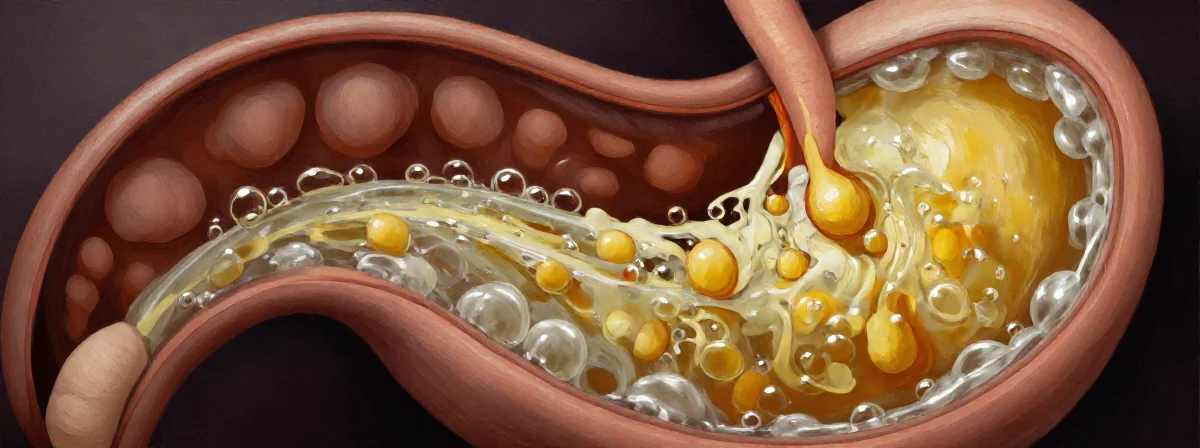
The moment the acidic slurry leaves your stomach, it enters the duodenum—the first section of your small intestine. This is the danger zone. If the acid were to continue unchecked here, it would eat right through the intestinal wall. But this is where the pancreas steps in as the hero of the story.
Think of the pancreas as a chemical fire extinguisher. As soon as acid hits the duodenum, the pancreas releases a bicarbonate buffer. If you’ve ever used baking soda to neutralize a vinegar smell, you know the reaction. It turns the volatile acid into salt, water, and carbon dioxide.
This reaction is instantaneous and absolute. It transforms the burning liquid into something safe, allowing the intestines to absorb nutrients without being chemically burned. This is the primary reason you don’t feel that burning sensation in your lower abdomen. The threat is neutralized before it can travel further.
The Great Divorce: Bloodstream vs. Intestines
Here is where the confusion usually sets in. We tend to think of the body as a simple tube—mouth to stomach to exit. But the reality is a complex separation of waste streams.
Once the food is neutralized in the intestines, the body begins the extraction process. Water and nutrients are pulled through the intestinal walls and directly into your bloodstream. Whatever is left behind—solid waste that your body simply cannot use—continues down the line to become feces. This waste never touches your blood. It stays in the tube.
Meanwhile, the liquid that was absorbed into your blood is now circulating freely. It is carrying the good stuff your cells need, but it’s also carrying the waste your cells produced. This is where the kidneys enter the story. They act as the ultimate filter for your blood, sorting the valuable from the toxic.
Why You Don’t Pee Acid
Urine is not filtered stomach contents; it is filtered blood. This is the critical distinction. Your kidneys are constantly balancing your chemistry, pulling out excess salt, potassium, and toxins to maintain the delicate pH of your body.
Because the stomach acid was neutralized in the small intestine, it never enters your blood as acid. By the time the kidneys process your fluids, that acid has been converted into harmless components or used in metabolic processes. Therefore, your bladder is never exposed to the corrosive hydrochloric acid from your stomach. It is only exposed to the waste byproducts floating in your blood.
You can see this clearly in a hospital setting. If a patient is put on an IV—bypassing the digestive system entirely—they will still need to urinate. The kidneys are filtering the hydration from the blood, even though no liquid touched the stomach. It proves that the bladder and the stomach are on two completely separate tracks.
When the System Fails: The Cellular Transformation
The system is brilliant, but it is not invincible. Sometimes, the valve at the top of the stomach—the lower esophageal sphincter—fails. This is the reality of GERD (Gastroesophageal Reflux Disease). Acid creeps up where it doesn’t belong, damaging the lining of the esophagus.
Over time, the body tries to adapt to this constant assault. In a desperate bid to protect itself, the cells of the esophagus actually change their structure to resemble the cells of the intestine, which are tougher and more resistant to acid. This condition, known as Barrett’s esophagus, is a double-edged sword. While it withstands the acid better, these altered cells carry a significantly higher risk of becoming cancerous.
It’s a stark reminder that while the body is resilient, there is a limit to how much abuse it can take. The mechanisms that protect us are designed for occasional stress, not chronic assault.
The Invisible Miracle of Balance
Every time you eat a meal, you are setting off a chain reaction of chemical neutralizations and biological filtrations that most of us will never think about. You are trusting that the pancreas will douse the fire, the intestines will absorb the water, and the kidneys will clean the blood.
It is a silent, invisible miracle that keeps us alive. We worry about the calories or the taste, rarely stopping to appreciate the fact that we are walking around with vats of acid in our bellies and coming out none the worse for wear. The next time you feel a pang of heartburn or a rumble in your gut, remember the complex machinery working tirelessly to keep the balance, ensuring that what goes in as fuel comes out as waste without burning a hole in the machinery in between.