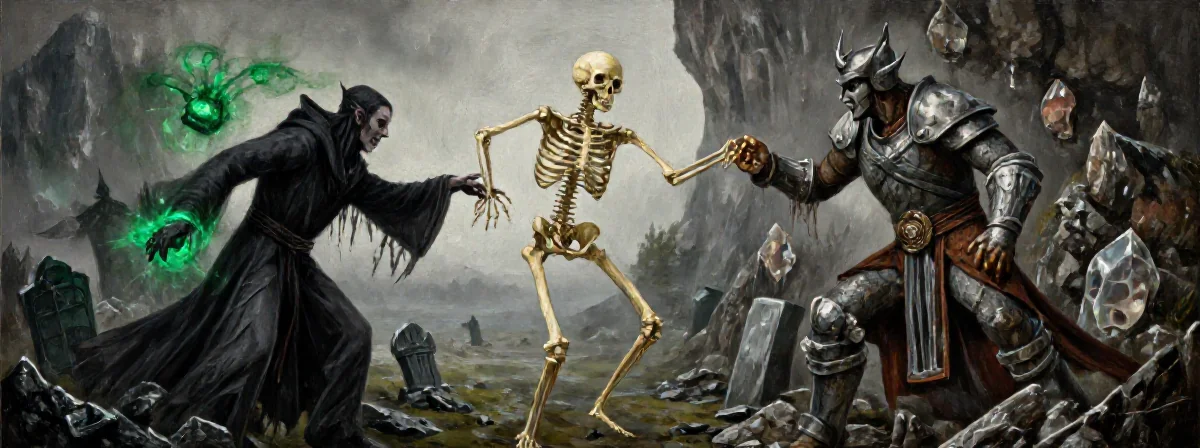
You spend your whole life cultivating a personality, building a career, and maybe perfecting a sourdough starter, but once your heart stops, the only thing that matters is your mineral content. It’s a messy handover between the guy who reanimates corpses and the lady who throws rocks, and frankly, nobody seems to know exactly when the paperwork gets filed. You assume your remains belong to you—or at least, the dirt you’re buried in—but the transition from “fleshy vessel for dark magic” to “geological plaything” is more of a gray area than you’d think.
Let’s Be Honest
It’s Basically the Ship of Theseus, But with More Calcium You’d think a fossil is just a bone that got old and decided to retire, but you’d be wrong. It’s a molecular heist. The organic material decomposes or gets replaced, mineral by mineral, until the original structure is gone and only the shape remains. If you replace every plank on a ship, is it still the same ship? If you replace every collagen fiber in your femur with silica, are you still a zombie, or are you just a very enthusiastic rock formation?
The Cambrian Explosion Ruined Everything Before the Cambrian period, life was soft, squishy, and had the structural integrity of a wet paper towel. When these things died, they just rotted away into nothingness, leaving the necromancers of the era with zero long-term prospects. But then oxygen levels spiked, Vitamin C entered the chat to help synthesize collagen, and suddenly life developed hard parts like shells and armor. This was great for the fossil record, but terrible for anyone trying to maintain a pure, organic undead army.
Trace Fossils Are Just Ghost Poop We tend to imagine fossils as skeletons, but the geological record is full of “trace fossils”—footprints, burrows, and coprolites (that’s fossilized poop, for the uninitiated). If a geomancer controls a fossilized footprint, are they controlling the memory of a step? If they animate a coprolite, are they winning the argument or just throwing it? It raises questions about the dignity of the dark arts that nobody is asking.
Jurisdiction Is a Gradient, Not a Switch You’re waiting for a specific moment where the necromancer loses control and the geomancer takes over, but nature doesn’t care about your bureaucratic boundaries. It’s a slow fade. As the bones mineralize, the necromancer’s grip gets slippery and the geomancer’s influence tightens. For a few thousand years, you’re essentially a tug-of-war rope made of calcite and regret.
A T-Rex Zombie Is Just Better Marketing There is a strong argument that older corpses make for stronger undead minions, mostly because they’ve had more time to marinate in the ether. Raise a fresh corpse, you get a shuffling mess that falls apart if you sneeze on it; raise a T-Rex from the Cretaceous period, and you have a biological weapon that levels city blocks. Sure, the geomancer might argue it’s technically a rock, but if it’s eating your livestock, does the mineral composition really matter?
Don’t Ask an Archaeologist to Dig Up a Dragon Look, we need to clear this up because it’s embarrassing for everyone. Archaeologists dig up ancient human stuff—pottery, ruins, the occasional lost city. Paleontologists dig up the deep time stuff—dinosaurs, trilobites, the ancestors of that bird currently pooping on your car. If you find a fossilized dragon and call an archaeologist, you’re wasting everyone’s time. Call the wizard who specializes in limestone.
Final Verdict
The next time you walk past a natural history museum, remember that you aren’t looking at dead animals; you’re looking at unfinished business.
Whether your remains end up as a spooky skeleton or a convenient paperweight depends entirely on how fast you get buried and what kind of chemicals are in the soil. So, choose your graveyard carefully, or better yet, just avoid dying altogether—the paperwork is a nightmare.