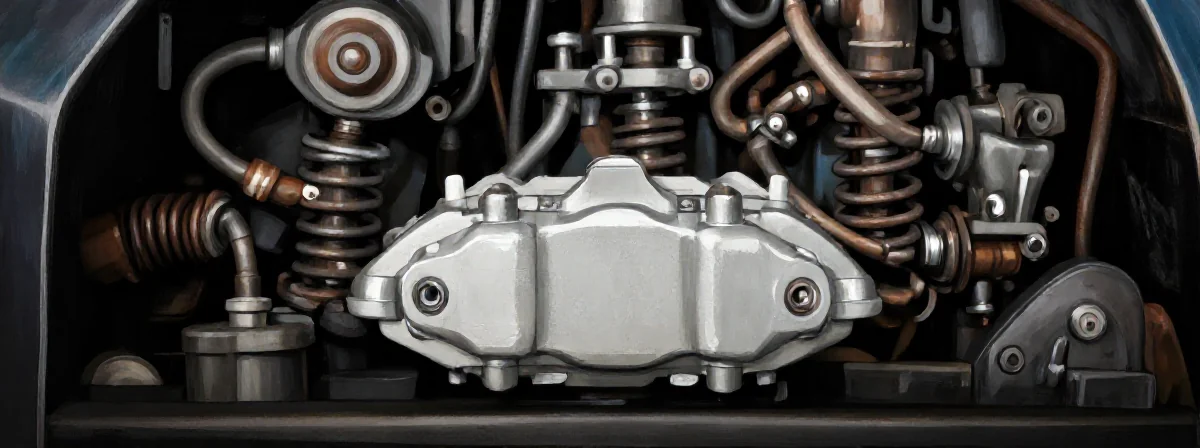
Have you ever looked at a disc brake and thought, “Ah, finally, something simple”? We’ve been sold this narrative for decades—that discs are the clean, modern solution and drum brakes are the clumsy, obsolete ancestors. But what if I told you that the “simplicity” of a disc brake is a lie? What if the move to discs wasn’t about making things easier, but about making you dependent on a system so complex it requires a master’s degree just to bleed the lines?
It’s time to peel back the rotor. The evolution of braking isn’t a story of progress; it’s a story of hidden trade-offs and engineering gatekeeping.
Down the Rabbit Hole
The Hydraulic Cage You look at a disc brake and see a clamp on a plate. Simple, right? Wrong. To make that clamp actually stop a two-ton machine, you need massive hydraulic pressure. You need seals that don’t leak, fluids that don’t boil, and tolerances so tight a human hair looks like a rope. Drum brakes might look like a chaotic mess of springs and shoes, but they can be operated by a simple cable pulled by your hand. The disc brake requires an entire, pressurized ecosystem just to function. It’s not simpler; it’s just better at hiding its own complexity.
The Secret of “Free Energy” Here is something they don’t advertise in the brochure: drum brakes are self-energizing. When the leading shoe touches the spinning drum, the friction actually drags the shoe deeper into the drum. It uses the vehicle’s own momentum against itself. You get stopping power for free—no extra pedal pressure required. Disc brakes? They are brute force. They have to generate 100% of their clamping power manually, which is why we need those complex hydraulic boosters in the first place. Why would we abandon a system that gives us free energy?
The Mini-Drum Confession If disc brakes are so superior, why do so many modern cars still hide a tiny drum brake inside the rear rotor? It’s the parking brake. Think about that. The “advanced” disc system is so bad at holding a car on a hill with a simple mechanical cable that engineers are forced to sneak the “obsolete” drum technology back into the design. It’s a ghost in the machine, a quiet admission that sometimes the old ways are the only ways that actually work.
The Material Science Gatekeeping You couldn’t build a reliable disc brake in 1920. You just couldn’t. The seals were made of rope—literally rope—and the metallurgy wasn’t there to keep a perfectly flat rotor from warping under the heat. Drum brakes were forgiving; they were cast iron chunks that could take a beating. Disc brakes demand perfection. They require ceramics and space-age polymers and machining tolerances that are measured in microns. Is it progress, or is it just a way to ensure you can’t fix the thing in your own garage?
The Bridge Blueprint This pattern is everywhere. Look at bridges from a century ago—they were trusses, intricate webs of steel. Today, we build cable-stayed bridges. They look cleaner, simpler. But they rely on tension and computer modeling that didn’t exist back then. Just like a jet engine is mechanically simpler than a piston engine but requires materials that were science fiction fifty years ago. We haven’t simplified the world; we’ve just swapped visible complexity for invisible fragility.
From Hands to Hydraulics Follow the thread back far enough and you realize we started with human hands grabbing wagon wheels to stop them. Then came mechanical arms, then cables, and finally, the sealed hydraulic system. Each step removed us further from the direct physical reality of stopping the machine. We are trapped in a box, pushing a pedal that pushes a fluid that pushes a piston. We’ve lost the connection to the machine, and maybe… that was the point all along.
They want you to believe that old technology is just junk cluttering up the history books. But the next time you see a car with drum brakes, don’t pity it. It’s a machine that still remembers how to stop itself without needing a laboratory to keep it running.
True simplicity isn’t about having fewer parts on the table. It’s about a system that works so well you forget it’s there. The problem is, we’ve traded mastery for dependency, and now we’re just along for the ride.