History is usually written by the winners, but sometimes it’s written by the people who survived the terror. When you start digging into the past, you find that labels like “Great” aren’t objective facts—they are marketing decisions made centuries after the dust settled. You look at a figure like Alexander the Great and you see a golden age of conquest; you look at Genghis Khan and you see a mountain of skulls. But if you pull on that thread, if you really examine the evidence left behind, the picture starts to blur.
We need to talk about the language. We need to talk about the body count. And most importantly, we need to talk about who got to write the story.
The Mystery of the “Ocean” King
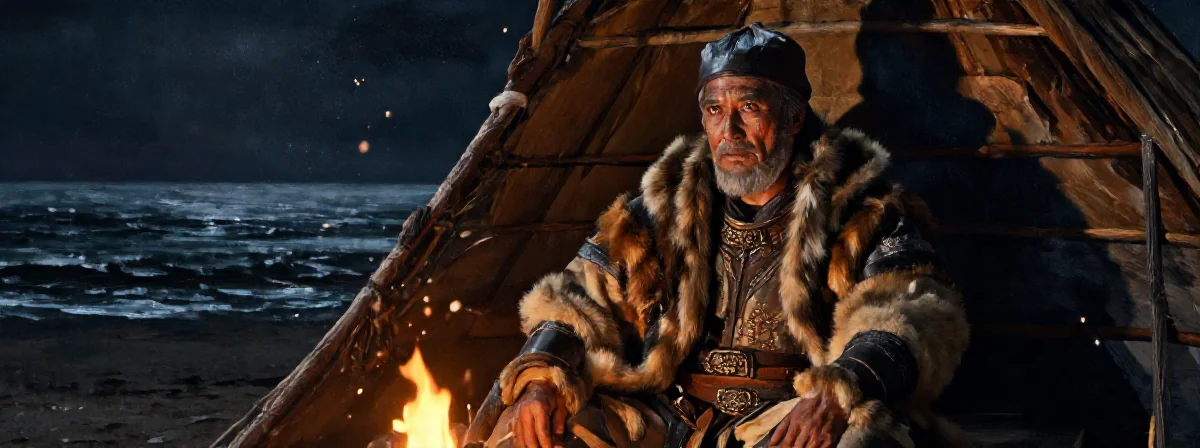
Let’s start with the name itself. It’s the first clue in the case. Most people assume “Genghis” translates to something like “Great King” or “Universal Ruler.” That’s the textbook definition. But dig a little deeper, and you find a more interesting theory: the title might actually mean “Oceanic King” or “King of the Universe.”
At first glance, that makes zero sense. The Mongols were nomads of the steppe; they were a landlocked people living in yurts, not ships. Why would a culture that rarely saw the sea adopt a title associated with the ocean?
Here’s where the evidence gets interesting. The term wasn’t meant to be literal. It was metaphorical. The “ocean” referred to the waters that touch every shore. By calling himself the Ocean King, he wasn’t claiming dominion over the waves—he was claiming dominion over everything the waves touch. It’s a title of absolute, boundless authority. It suggests that his rule was inevitable, a force of nature that would eventually crash against every coastline on earth. It frames his conquest not as a series of battles, but as a tidal wave.
The PR Battle of the Ages
Now, compare that to Alexander. Alexander is the gold standard of “Great.” He conquered the known world before he was 33, spread Hellenistic culture, and founded cities that bear his name to this day. But let’s look at the file on Alexander. He wasn’t exactly a saint. He razed Thebes. He slaughtered the population of Tyre. He led a campaign of extermination just as ruthless as any steppe warlord.
So why the difference in reputation?
It comes down to who held the pen. Western history is deeply rooted in the Greco-Roman tradition. Alexander is viewed as a “civilizer”—someone who brought culture, language, and governance to the regions he conquered. Genghis Khan, on the other hand, is often framed as the ultimate “barbarian.” The word “barbarian” itself comes from the Greek for the sound of foreign languages—literally just “bar-bar.” To the Greeks, anyone who wasn’t them was a barbarian. Because Genghis operated outside the Greco-Roman cultural sphere and threatened the very existence of sedentary civilization, he was never given the benefit of the doubt. He was the outsider, the scary monster in the woods, while Alexander was the prodigal son.
The Myth of the “Green” Conqueror
There’s a bizarre theory floating around the internet lately, a piece of pop-science trivia that sounds too wild to be true. The claim is that Genghis Khan was an “eco-warrior” who helped fight climate change. The logic goes that the Mongol conquests were so deadly, depopulating entire regions, that forests regrew on abandoned farmland and sucked massive amounts of carbon out of the atmosphere.
It’s a compelling narrative. It turns a monster into an accidental savior. But when you look at the data, the case falls apart.
The atmospheric CO2 drop during that period was negligible—maybe 1 part per million at most. That is virtually nothing in the grand scheme of the climate. The story persists because it’s cool. It’s a fun fact that gets clicks. But it obscures the reality of the devastation. We aren’t talking about abstract carbon footprints here; we are talking about the systematic destruction of irrigation systems in Central Asia, turning fertile breadbaskets into deserts that are still barren today. This wasn’t environmentalism; it was erasure.
A Strategy of Pure Efficiency
We have to address the brutality head-on. You can’t investigate Genghis Khan without confronting the 40 million figure. Estimates suggest he was responsible for the deaths of a massive chunk of the world’s population at the time. Chinese censuses show a collapse in population numbers that is hard to comprehend.
But here is the psychological profile of the suspect: he likely didn’t kill because he enjoyed the bloodshed. He killed because he was ruthlessly, terrifyingly efficient. His philosophy was cold logic: dead people don’t revolt.
He used terror as a weapon of mass destruction. If a city surrendered, they were spared. If they resisted, the entire population was wiped out—men, women, children. It wasn’t personal; it was a calculated message sent to the next city on the map. He didn’t want to fight every battle; he wanted the reputation to do the fighting for him. And he institutionalized mass rape in a way that few other empires did, to the point where genetic studies suggest a significant percentage of the world’s population can trace their lineage back to him and his family. It wasn’t just a crime of passion; it was a strategic tool of empire-building.
Who Gets to Write the Story?
At the end of the day, the distinction between “Great” and “Monster” often depends on where you are standing. In China and parts of Asia, the view is more nuanced. He is seen as a founder of a dynasty, a unifier, a necessary evil that paved the way for the Yuan Dynasty. To some, he is a hero. To others, particularly in the West and in places like Iran that felt the Mongol boot heel, he is a devil on par with Hitler.
We are still digging up mass graves. We are still finding evidence of burned villages in Hungary and Russia—though, interestingly, Genghis himself never made it to Europe; that was his grandsons. The legacy is complicated.
The title “Genghis” implies universality, a ruler of everything. But the title “Great” is a value judgment we apply later. We have to stop asking if these men were “good.” They weren’t. They were conquerors. The only difference is that Alexander had a better PR team, and Genghis Khan had a more effective machine for extermination. History isn’t about finding the good guys; it’s about figuring out who survived long enough to write the report.