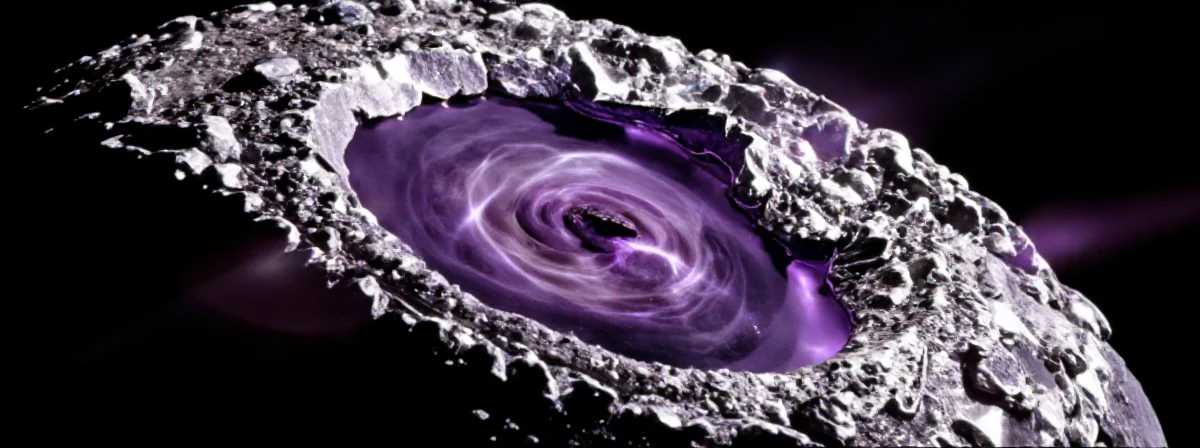
We often look for things that are solid, things we can rely on. In our daily lives, the ground beneath our feet feels firm, and the objects we hold keep their shape. We project this desire for stability onto the universe, assuming that the densest things in existence must be the hardest, the most unyielding. But the cosmos has a way of reminding us that reality is far more fluid than our minds would like to believe.
When we turn our gaze toward the remnants of a collapsed star, we encounter a substance that defies our intuition. It is matter pushed to the absolute limit, stripped of its empty space and compressed into something entirely new. We call it neutron star matter, or degenerate matter, and understanding it requires us to let go of our attachment to the idea of “solidity.” To truly grasp the nature of the universe, we must look past the surface and see the flow that exists even in the most extreme places.
Is the Densest Matter in the Universe Really a Liquid?
If you could hold a piece of a neutron star in your hand—a thought experiment that requires a deep suspension of disbelief—you might expect it to feel like a diamond or a piece of indestructible metal. However, the universe operates on principles of balance, not just hardness. The gravitational forces binding a neutron star together are so immense that they completely overwhelm the electromagnetic forces that typically give matter its rigid structure.
Think of a sandcastle on the beach. The grains of sand are heavy, and they naturally want to collapse into a flat pile. It is only the water—the “glue” between the grains—that allows the castle to hold its shape against gravity. In a neutron star, the situation is reversed. The “weight of the sand” is the star’s own crushing gravity, and the “glue” is something known as degenerate pressure or the Pauli exclusion force. This force keeps neutrons from occupying the same space, but unlike the electromagnetic bonds we are used to, it isn’t sticky. It doesn’t make the neutrons hold hands; it simply refuses to let them get any closer. Because this force isn’t sticky, the matter flows. It behaves not like a rock, but like a fluid with zero viscosity.
What Happens If You Bring a Shot Glass of It to Earth?
Let us sit with this hypothetical scenario for a moment. Imagine you possess a vessel strong enough to hold a single shot glass of neutron star matter. The weight of that liquid would be approximately 20 trillion kilograms. To put that into perspective, if you were standing ten meters away, the gravitational pull of that tiny glass would be stronger than Earth’s gravity. You wouldn’t just feel a tug; you would feel a force pulling you toward the glass with more intensity than the ground currently pulls you down.
The presence of such density would instantly disrupt the equilibrium of the room. Objects, people, and the air itself would begin to fall toward the shot glass. It is a humbling reminder of how gravity shapes our reality. We think of ourselves as anchored to the Earth, but in the presence of such concentrated mass, our anchor would snap. We would realize that our connection to the ground is gentle compared to the violent attraction of degenerate matter.
Would It Explode or Expand Without the Star’s Gravity?
Here we find a lesson on the importance of environment. Neutron star matter is not stable in our world; it only exists under the crushing pressure of the star’s own gravity. If you were to magically remove that shot glass from the star and place it on Earth, the pressure confining it would vanish. The result would not be a slow decompression. It would be a violent, instantaneous expansion of energy.
The “degenerate” neutrons, suddenly free from their crush, would revert to normal matter, releasing the pent-up energy of their compression. We are talking about an explosion in the range of trillions of megatons. To visualize this, consider the asteroid impact that ended the reign of the dinosaurs. This event would be roughly a thousand times more powerful than that. It wouldn’t just destroy the room; it would melt the surface of the planet. The energy released is so vast that it serves as a stark meditation on the forces that usually remain hidden in the dark vacuum of space.
Can You Scratch the Surface of a Neutron Star?
We often wonder if we could leave a mark on the universe, if we could scratch the surface of something so enduring. The crust of a neutron star does possess a crystalline structure, a rigid lattice formed by the immense pressures. In theory, if you could survive the environment, you might find a surface harder than anything we know.
However, this is where the observer becomes part of the observation. To scratch a neutron star, you must be there. And to be there is to be crushed. The gravity of a neutron star is so profound that it treats regular matter like a slightly polluted vacuum. The moment you—or any tool made of normal atoms—approached the surface, the very bonds holding your atoms together would shatter. You wouldn’t scratch the star; you would simply become part of it. The star would dissolve you, adding your mass to its own, teaching us that in the face of the absolute, there is no separation between the observer and the observed.
The Wisdom of Instability
There is a profound beauty in the instability of neutron star matter. It reminds us that structure is often a result of the pressure we are under. The neutron star is only a neutron star because of the immense gravity squeezing it. Remove that pressure, and it loses its identity, exploding outward in a desperate bid to return to a state of balance.
We see this reflected in our own lives. We often define ourselves by the pressures we endure—the work, the responsibilities, the struggles. But what happens when that pressure is removed? Do we remain the same? Or do we expand, transform, perhaps even violently, into something new? The neutron star shows us that our state of being is deeply dependent on our circumstances. It teaches us that solidity is often just a temporary agreement between forces, and that everything in the universe is in a constant state of negotiation between holding together and letting go.