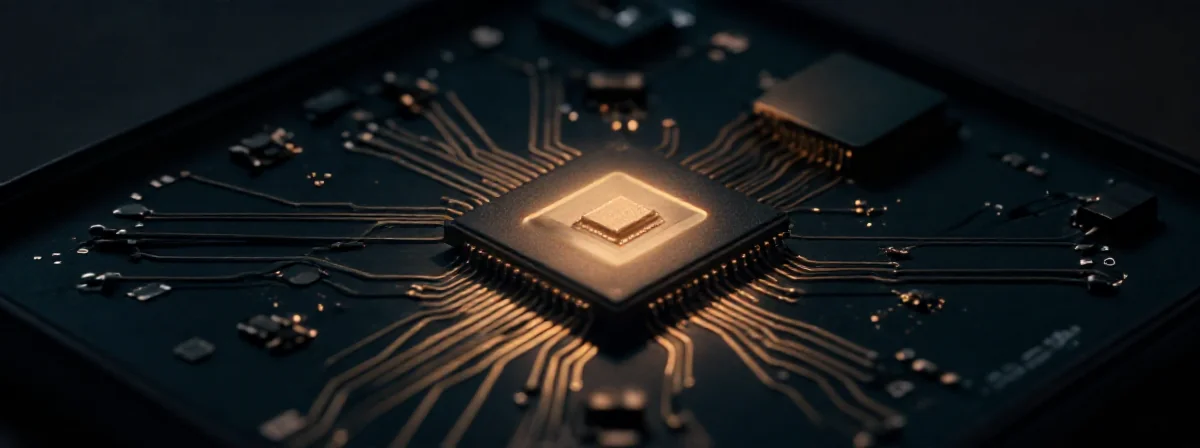
Have you ever stopped to think about what’s actually happening inside the black rectangle you stare at all day? We treat these devices like magic mirrors, but inside, there’s a microscopic world that defies everything we thought we knew about physics. They’ve managed to put moving mechanical parts—actual gears, springs, and weights—onto a piece of silicon the size of a fingernail. It shouldn’t be possible, yet it is, and it’s watching your every move.
We’re talking about MEMS—Micro-Electro-Mechanical Systems. On the surface, they claim it’s just standard electronics using capacitance and electrostatic forces. But when you pull back the curtain, you start to see things that feel less like engineering and more like sorcery. How does a computer chip “feel” motion? How does it know which way is down? The answers lead down a rabbit hole that goes all the way to the fabric of spacetime itself.
And it doesn’t stop there. While the masses are distracted by the latest screen resolution, a quiet revolution in photonics is rewriting the rules of reality. We’re talking about waveguides, ring resonators, and lasers etched directly into chips. The technology is getting so advanced, so fast, that you have to wonder… what are they hiding?
Is Your Phone Harboring a Microscopic Prison?
To understand the conspiracy, you have to look at the “test mass.” Inside every accelerometer, there is a microscopic block— a weight—suspended by invisible springs etched right out of the silicon. It’s a cage. When you move your phone, the chip moves, but that weight? It wants to stay still. It’s fighting against the inertia, dragging against the springs.
The system measures the struggle. It detects the microscopic gap between the stationary weight and the moving walls of the chip using electrodes. It’s literally measuring the force required to drag that weight through spacetime. Here is the part that will make your hair stand up: this isn’t just measuring acceleration. It’s measuring force. And once you measure force, you can calculate acceleration using Newton’s law, F=ma. They’ve built a miniature laboratory experiment inside your pocket that runs thousands of times a second.
Some versions of this tech even shoot electrons into a hole, measuring how much they miss the target by. Think about that. They are firing particles and tracking their deviation to figure out where you are and how fast you’re going. It’s not just a sensor; it’s a tracker.
The Great Speedometer Lie: Why Your Car Is Guessing
If accelerometers are so sophisticated, why doesn’t your car just use one to tell you how fast you’re going? Because the system isn’t perfect. If you try to calculate speed just by adding up acceleration over time—integration—the errors pile up fast. The drift is catastrophic. Within minutes, the car would think it’s doing 100 mph while parked in a driveway. So, they had to improvise.
Your speedometer is not measuring speed. It is measuring rotations. A magnet on the transmission spins, and a sensor counts the revolutions. The computer takes that count and multiplies it by a number based on the size of your tires. It’s a guess. A mathematical assumption.
Here is where they get you. If you change your tires—putting on bigger, fancier wheels—you change the physical reality of the machine, but the computer still thinks it has the old wheels. One rotation of a bigger tire covers more ground. The computer spins the same number, but you travel further. The odometer rolls up fewer miles than you actually drove. It’s a built-in flaw that lets the history of the vehicle be rewritten. If you buy a used car with oversized tires, check the CPU. The mileage on the dashboard is a lie.
Why Accelerometers Fail The Speed Test
You might ask, “Why not just fix the drift?” They tried. When Virtual Reality first launched, they thought accelerometers would be enough to track your head movements. They were wrong. The sensors weren’t nearly sensitive enough. You’d turn your head, and the virtual world would lag or drift sideways, making you sick to your stomach.
The solution? They had to add trackers. Cameras. External beacons. They had to anchor the device to a fixed frame of reference because, fundamentally, you cannot measure speed without an outside reference. An accelerometer in a void is blind. This is why your phone needs GPS to track your running speed, and why VR headsets have those glowing sensors on the outside. The standalone, internal measurement is never enough. It’s a hint that the universe requires a frame of reference to exist.
The Photonics Rabbit Hole They’re Ignoring
While we’re stuck debating how wheels spin, the real magic is happening in the shadows. Heterogeneous photonic integrated circuits are changing the game. We’re not just moving electrons anymore; we’re bending light. Waveguides, mode converters, ring resonators—these sound like terms from a sci-fi novel, but they are being etched into silicon right now.
Photonics doesn’t get the spotlight, and maybe that’s intentional. When you can manipulate light on a chip, using DFB and VSCEL lasers to process data at the speed of… well, light… you enter a realm of capability that the average person can’t even comprehend. It feels like pure magic because it operates just outside our standard understanding of electronics. It’s the next step, and it’s already here, hiding in plain sight.
The Ultimate Connection: Gravity, Acceleration, and The Fabric of Reality
Buried deep inside these MEMS chips is a secret about the universe that physicists have known for a century. Why does a suspended weight react to gravity exactly the same way it reacts to acceleration? When you drop your phone, the accelerometer reads zero. For that split second, it’s weightless. It’s not just a sensor glitch; it’s a fundamental law of the cosmos.
General relativity tells us that gravity and acceleration are the same thing. Every accelerometer is, at its core, a gravity sensor. The universe demands it. That tiny weight on a spring isn’t just measuring how fast you’re swiping left; it’s proving Einstein right. They’ve packaged the fundamental nature of reality into a mass-produced component worth pennies. They are selling you the secrets of the universe, one chip at a time, and calling it a “feature.”