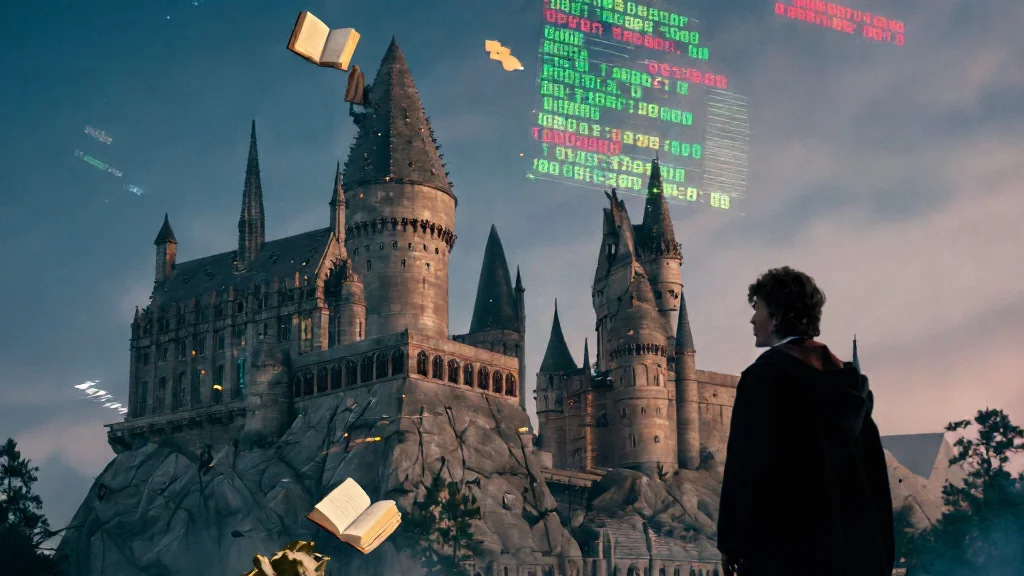
Think of the Wizarding World not as a finished novel, but as a massive, open-source RPG with a notoriously buggy development cycle. The “canon” is just the 1.0 release notes written by the lead developer, but if you’ve spent any time actually playing the game, you know the code is full of exploits. The logic doesn’t hold up. The texture maps are inconsistent. That’s where the community patches come in.
We aren’t just looking for plot holes; we’re looking for system errors that explain the weird behavior of the NPCs. When you analyze the source code of Hogwarts, you start to realize that the fan theories aren’t just headcanon—they’re necessary hotfixes for a broken narrative engine. It’s time to debug the magic.
Is Hagrid’s Character Model Just Incomplete?
Let’s talk about Rubeus Hagrid. The official lore says he’s a half-giant, but have you ever considered that his texture rendering is simply incomplete? The data suggests he is entirely hairless from the neck down. We’re not talking about a grooming choice; we’re talking about a missing asset file. He’s smooth. Like a porpoise. This would explain why he wears those massive layers of moleskin—it’s not for warmth, it’s to hide the fact that the developers forgot to apply body hair to his character mesh.
Then there’s the theory that Hagrid is running a completely different operating system than the rest of the cast. Maybe he tried Pho once and his system rejected the input because it wasn’t compatible with his native architecture. Or perhaps the Forbidden Forest is a restricted zone not because of dangerous creatures, but because it houses the server farm. Dumbledore and Hagrid aren’t hunting spiders; they’re running an illegal grow-op to launder gold through the school’s economy. The Forbidden Forest is just the firewall keeping the Ministry from seeing the backend logs.
Did Voldemort Fail the Character Creation Screen?
The resurrection ritual in Goblet of Fire is essentially a firmware update that went horribly wrong. You take the bone of the father, the flesh of the servant, and the blood of the enemy—but what if the installation process corrupted the lower body drivers? The evidence points to Voldemort being a smooth Ken doll situation. No butthole. No reproductive organs. Just a blank, terrifying slate.
This makes perfect sense from a game design perspective. Voldemort is a boss entity focused entirely on output (damage) rather than input (sustenance). He doesn’t need to eat or use the bathroom; he runs on pure, concentrated malice. He’s a glitched character model stripped of all non-essential polygons to increase render efficiency. He’s not human anymore; he’s just a script in a cloak.
Are Fred and George Just One Consciousness?
The Weasley twins are the ultimate example of a dual-core processor running a single thread. The theory that they swapped places during the Battle of Hogwarts is dark, but it fits the logic of a system trying to preserve its memory. When George “died,” Fred didn’t just mourn—he patched the system. He cut off his own ear to match George’s damaged texture and adopted his brother’s save file.
Why? Because the system prioritized the “joke” subroutine over individual survival. The Weasley twins were never two separate people; they were always a single entity distributed across two bodies. When one body took critical damage, the other one mimicked the error to keep the narrative consistent. It’s a terrifying example of self-correcting code.
What About the Protagonist Render Error?
Here is a massive system oversight: The Ford Anglia. What if the flying car was the intended protagonist all along? Think about it. The car has more agency than half the cast. It saves Harry and Ron from the spiders, it shows up in the Forbidden Forest when needed, and it has a personality. The theory is that Harry Potter is just an NPC, and the car is the player character. Everything after Book 2 is just the car watching the cutscenes from the parking lot.
And if you look closely at Harry’s avatar, you’ll see other bugs. He pronounces “GIF” with a hard G. He’s missing a left pinky toe—the only part of his body that took damage from the Killing Curse because Lily’s love protection didn’t extend to peripheral extremities. It’s a classic hitbox error. The spell targeted the center of mass, clipped the toe, and the server registered it as a total miss. That’s why he survived; the enemy aimbot was slightly misaligned.
Is the Queen an Immortal Server Admin?
We need to address the Queen of England. In this system, she is a living Horcrux. Not of Voldemort, but of the concept of monarchy itself. That is why she simply will not die. She has achieved immortality by anchoring her soul to the physical infrastructure of the UK. She’s not playing by the same rules as the other mobs; she’s the admin account walking around in the game world.
Similarly, the Ministry of Magic runs on legacy tech. Muggle orphanages know how to ping the server when a magical child spawns, but the Ministry never picks up the phone. Why? Because they haven’t figured out how voicemail works yet. The system is so old, so entrenched in parchment and quills, that digital voice packets just bounce off the firewall. Those magical babies aren’t abandoned; they’re stuck in the support queue.
Why the Fan Patches Matter
When you look at the Wizarding World through this lens, the “canon” becomes less important than the interpretation. We are essentially modding the game to make it playable. Whether it’s the idea that Ron and Hermione permanently swapped bodies via Polyjuice potion in Book 2, or that Snape is a “never-nude” running a permanent skin glitch, these theories optimize the story.
They fill the gaps left by a developer who stopped patching the game years ago. We notice the patterns—the missed opportunities for a spell like Circumsempra, the weird lore about Dobby’s sock being a World Cup heirloom—and we write our own code to fix them. The system is broken, but with the right fan theories, at least it’s entertaining.