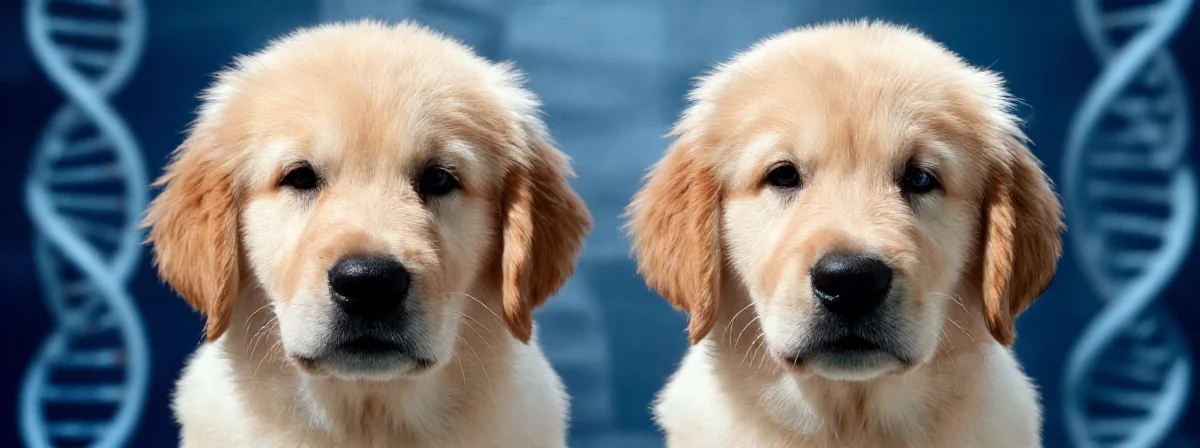
You bring home two puppies from the same litter. They look vaguely related, but as they grow, one starts to resemble a sleek Black Lab while the other takes on the stocky build of a Boxer. You assume they are just standard siblings, perhaps a classic “mixed breed” surprise. But what if I told you that biology is playing a far more complex game right under your nose? The truth about canine reproduction is wilder than most owners realize, involving rare genetic events that can turn a simple litter into a scientific puzzle.
We often look at a basket of squirming puppies and assume we understand the story: one mother, one father, a bunch of babies. It is a tidy, human-centric way to view the world. However, nature rarely adheres to our desire for tidiness. From the possibility of identical twins sharing a womb to the phenomenon of multiple fathers in a single birth, the biology of a dog litter is a lesson in genetic chaos.
To understand how rare and wonderful these events are, we first have to dismantle what we think we know about how puppies come into the world.
Are Most Puppies Actually Twins?
Here is a question that sounds simple but has a surprisingly complex answer: Are puppies in the same litter twins? Biologically speaking, the term “twin” usually refers to two offspring born at the same birth. By that definition, every pair of puppies in a litter is technically a twin, and a litter of six is sextuplets. But when we talk about twins in the way we usually think about them—identical beings sharing the same DNA—the rules change drastically.
The vast majority of puppies are fraternal multiples. Think of it like a baker putting a dozen muffins in the oven at the same time. They are baked together, but each muffin is made from its own unique mixture of ingredients. In a dog’s womb, the mother releases multiple eggs (ova), and each one is fertilized by a different sperm. They develop side-by-side in separate amniotic sacs with their own placentas. They are womb-mates, not clones.
This is why a single litter can look like a blend of five different breeds. They are sharing a “house” for nine weeks, but they are running their own distinct genetic programs.
Can One Litter Have Multiple Fathers?
If you thought fraternal multiples where the story ended, prepare to have your mind bent. It is entirely possible for a litter of puppies to have zero, one, or multiple fathers. This phenomenon is so specific and bizarre that it has one of those gloriously long scientific names that is just fun to say: heteropaternal superfecundation.
Say it out loud. It feels like a spell from Harry Potter, but it describes a very real biological strategy. Here is how it works: When a female dog is in heat, she releases multiple eggs over a period of time. If she mates with Dog A on Tuesday and Dog B on Wednesday, it is possible for some eggs to be fertilized by the first male and the remaining eggs by the second. This doesn’t just result in a diverse litter; it results in a litter where half the siblings are genetically related to one dad and the other half to a completely different dad.
This is actually quite common in the animal kingdom. It is an evolutionary bet-hedging strategy. By diversifying the genetics of her offspring, a mother increases the odds that at least some of them will survive whatever challenges the environment throws at them. It is nature’s way of not putting all her eggs in one basket—literally.
So, Can Dogs Have Identical Twins?
If fraternal twins and multiple fathers are common, what about the identical twins we see in humans? It is the holy grail of litter questions: Can two puppies come from a single egg that split in two?
The answer is yes, but it is extraordinarily rare.
For a long time, scientists believed this didn’t happen in dogs at all. The first confirmed case didn’t appear in the literature until 2016. It involved a pair of Irish Wolfhounds born via C-section in South Africa. The vets noticed something odd during the procedure: the two male puppies were sharing a single placenta. This is the tell-tale sign of monozygotic (identical) twins.
Later, DNA testing confirmed what the anatomy suggested. The dogs were genetically identical. Unlike fraternal siblings, who are just as related as any siblings, these two were clones of one another. While this is a fascinating novelty, it is also biologically risky. Sharing a placenta can lead to competition for nutrients, which is often why identical twins in dogs are so rare—they simply don’t survive the pregnancy.
Why Identical Dogs Might Still Look Different
Now, here is where things get really weird. Even if you have genetically identical animals, they might not look identical. You might assume that if two dogs share 100% of their DNA, their fur patterns must match perfectly. But biology has a few more tricks up its sleeve.
The first cloned cat, named “CC” (short for Copy Cat), looked nothing like her genetic donor. The donor was a calico with white, orange, and black patches. CC was a tabby and white. How is that possible? Because fur color in certain animals—specifically calicos and tortoiseshells—is linked to the X chromosome.
Female cats have two X chromosomes. In each cell, one X chromosome is randomly turned off. This process, called X-inactivation, happens randomly. So, one clone might shut down the chromosome for “orange fur” in a patch of skin, while the other shuts down the “black” chromosome. They are genetically identical, but the cellular decisions made during development create a different visual result.
This applies to dogs, too. Subtle variations in coat patterns, size, and even temperament can arise from environmental factors in the womb or how those genes are expressed. You could have two identical twin boxers, and one might be slightly smaller or have a different white marking on their paw simply because of how they were positioned in the uterus.
Why Cats Have It Even Wilder
If you think dogs are complex, spare a thought for cats. Cats are what biologists call “induced ovulators.” A female cat generally doesn’t release an egg until she actually mates. This triggers a hormonal surge that drops the egg. This biological quirk makes heteropaternal superfecundation even more likely and efficient in cats than in dogs.
If a stray female cat mates with five different males in a short window, she is essentially triggering a release of eggs that can be fertilized by any of those suitors. This is why a litter of kittens can look like a chaotic rainbow of colors and patterns. You might see a tuxedo male, a ginger female, and a tabby, all from the same mother. It isn’t just a mixed family; it is a genetic lottery where the numbers are drawn by multiple participants.
The Invisible Nature of Twinning
The reason most of us never think about dog twins is that they are so hard to spot. With human twins, we notice immediately because we usually have one baby at a time. But dogs have litters. If a dog has six puppies, we don’t usually stop to wonder if two of them are identical twins and the other four are fraternal. To the naked eye, they are just a pile of puppies.
Furthermore, dogs rely on scent more than sight. While we might struggle to tell identical twin boxers apart without looking at their paws, their mother—or other dogs—likely knows exactly who is who based on a unique scent signature. The visual confusion that stumps us is irrelevant to them.
This means there are likely many more identical twin dogs out there than we realize. They are living in our homes, playing in our parks, and we are none the wiser. Unless you happen to be a veterinarian performing a C-section and spot a shared placenta, or you decide to DNA test your dogs out of curiosity, the secret stays hidden in the genome.
Why This Matters More Than You Think
You might wonder why any of this matters beyond being a fun fact to share at a party. It matters because it changes how we understand animal health and behavior. If you have two dogs that look different but are from the same litter, knowing about superfecundation explains why one might be prone to hip dysplasia (inherited from Dad #1) while the other is prone to heart issues (inherited from Dad #2).
It teaches us that “family” in the animal kingdom is a flexible concept. It is not about the nuclear family unit we project onto our pets. It is about genetic diversity, survival, and the messy, incredible odds of life.
Next time you see a litter of mixed-breed puppies, don’t just see “cute.” See a biological masterpiece. You are looking at a snapshot of evolutionary strategy, a potential case of superfecundation, and perhaps, just perhaps, a pair of hidden twins sharing a secret genetic handshake. The world is more complex than it looks, especially when you’re looking at a basket of puppies.