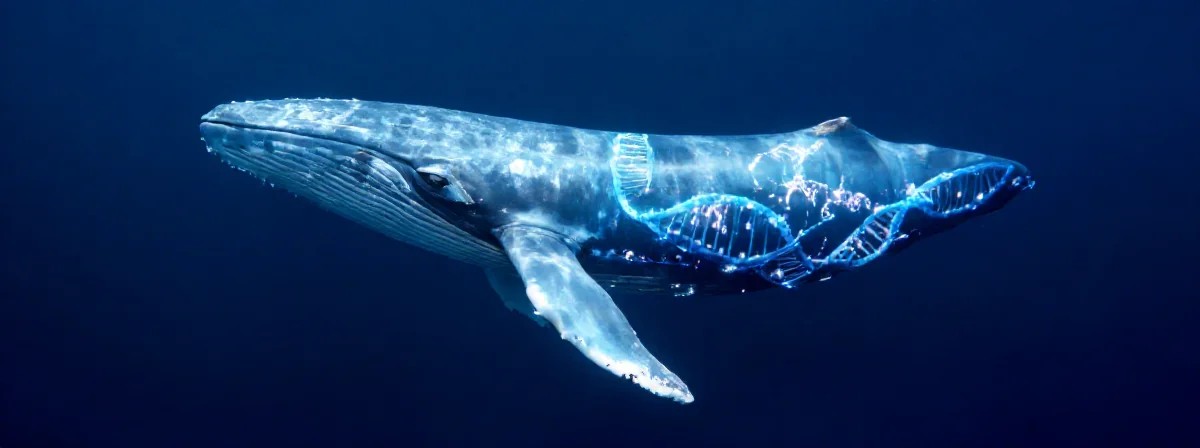
Common sense tells you that if you play a dangerous game long enough, you will eventually lose. Logic dictates that a creature with a thousand times more cells than you should get cancer a thousand times more often. Yet, nature doesn’t care about our logic. If you look at the blue whale or the elephant, they defy the odds completely. They are giants, and yet they do not crumble under the weight of their own biology.
It turns out that size isn’t a death sentence; it’s a challenge that forces evolution to become smarter. The giants of the earth have figured out secrets about survival that we are only just beginning to understand.
Going Deeper
Elephants know when to fold Imagine you are building a wall, and you notice a single brick is cracked. A careless builder might just plaster over it and hope for the best, but a wise builder removes the brick entirely. Elephants possess a gene called TP53, and they have roughly twenty copies of it compared to your measly two. When a cell shows signs of damage, this gene doesn’t try to fix it—it triggers a self-destruct sequence. It is a ruthless mercy. The elephant sacrifices the few to protect the whole, ensuring that mutated cells never get the chance to grow into something dangerous.
Slow down to live longer Whales take a different approach, one rooted in patience. Their massive bodies are supported by slower metabolisms, which means fewer cell divisions. Since cancer is essentially a mistake made during cell division, fewer divisions mean fewer rolls of the genetic dice. They are also masters of DNA repair, fixing the microscopic cracks in their foundation before they become chasms. They don’t rush through life, and because they don’t rush, they make fewer fatal errors.
Even cancer can get cancer There is a wild, theoretical idea floating around in biology that sounds almost poetic. In a body so massive, a tumor can grow so large and greedy that it starts stealing resources from its own cells. A second, “hyper-tumor” grows on the first, effectively cannibalizing the original cancer. The parasite becomes the host, and in its greed, it destroys itself. We haven’t quite caught this happening in the wild yet, but the math suggests it’s possible—a perfect example of how unchecked appetite can lead to its own demise.
Perfection is a trap You might wonder why we didn’t evolve these same superpowers. The answer lies in a difficult truth: evolution is not about perfection; it is about “good enough.” If your body is too aggressive at killing off potential mutations, you stop the very process that allows a species to adapt. You need some mistakes to ensure you can survive a changing world. If you eliminate all risk, you eliminate the possibility of growth. Nature optimizes for reproduction, not immortality, and once you have passed on your genes, the pressure to maintain perfection fades away.
Too much defense is dangerous An immune system that never sleeps is an immune system that attacks its own host. If you engineer a biological organism to be bulletproof against cancer, you risk destroying healthy tissue in the crossfire. There is a delicate balance between defense and destruction. We often wish for total safety, but in the machinery of the body, total safety usually looks like an autoimmune disorder. The goal isn’t to be invincible; it’s to be resilient.
Parting Wisdom
We often obsess over eliminating every risk in our lives, terrified of the potential for a single cell to go rogue.
But nature teaches us that safety isn’t about removing all danger—it’s about managing the trade-offs. You cannot be perfectly safe and perfectly free to grow at the same time. The goal isn’t to live forever; it’s to build a system that is strong enough to endure, and flexible enough to change.