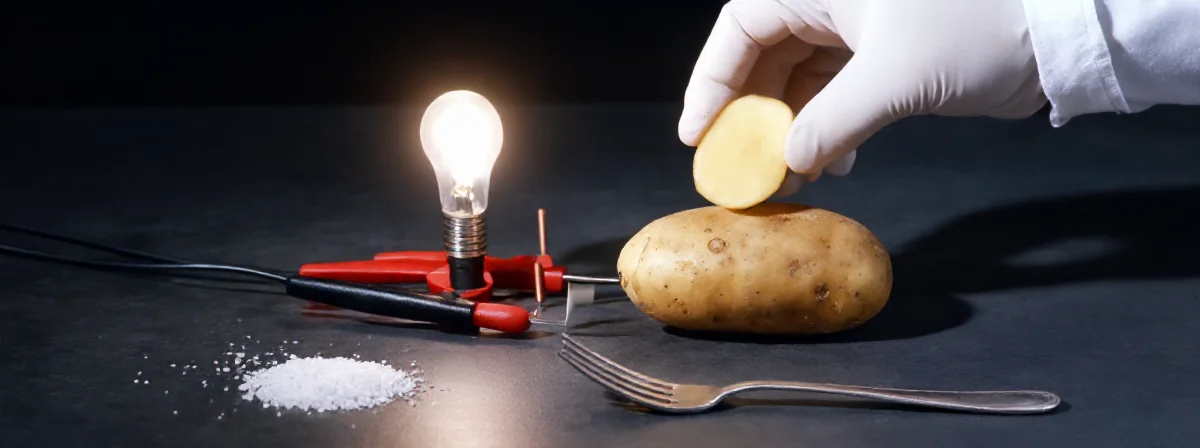
Picture the scene. You’re ten years old, holding a zinc nail and a copper penny, jamming them into a russet potato. The voltmeter needle twitches. Success. You’ve harnessed the raw power of the tuber. But hours later, when the lights go out, you’re left with a lingering question that nobody ever answered in science class: What does that potato taste like now? Is it a superfood charged with energy, or has the experiment left it hollow and flavorless?
We need to open an investigation into the humble potato battery. Most people walk away from this experiment once the LED bulb dims, assuming the potato has been “used up.” But looking at the evidence, that assumption doesn’t hold water. We’re dealing with a case of mistaken identity, where the true suspect—the chemical reaction—has been hiding in plain sight. To understand if the flavor changes, we first have to clear the potato’s name.
Is the Potato Actually “Powerless”?
Let’s start with the most popular theory: the “Powerless Potato” hypothesis. The idea suggests that by running a current through the vegetable, you are somehow extracting its vital essence or its inherent electrical charge. It sounds logical on the surface—if you take energy out, something must be lost. But when we dig into the physics, this theory falls apart.
A potato isn’t a battery in the way you think of a Duracell in a remote control. It doesn’t store electrons like a reservoir waiting to be drained. The potato is merely the crime scene—the medium where the action happens. It provides the electrolytes—the salts and acids in its moisture—that allow ions to move. If you were to hook that potato up to a charger, you wouldn’t be “refilling” it; you’d just be electrocuting a tuber. The potato itself remains chemically mostly unchanged by the mere flow of current.
The Smoking Gun: It’s the Metals, Not the Spud
If the potato isn’t the source of the power, who is? We have to look at the electrodes. The real energy in this setup comes from the metals—the zinc anode and the copper cathode. The electricity is generated by the zinc sacrificing itself, oxidizing and dissolving into the potato’s fluids to create a potential difference.
This is where the flavor profile is going to shift. The potato isn’t losing “electricity”; it’s gaining metal. As the zinc nail breaks down, it releases zinc ions (Zn2+) into the flesh of the potato. You aren’t eating a drained battery; you’re eating a potato that has been slowly marinating in heavy metal particles. That is a crucial piece of evidence for the palate.
The Zinc Clue: A Metallic Aftertaste?
So, what does a zinc-infused potato taste like? We have some anecdotal leads on this. Anyone who has ever taken zinc lozenges for a cold knows that distinctive, somewhat astringent, metallic tang. It’s not a flavor you find in nature, and it’s certainly not something you want in your mash.
However, the reaction inside the potato might be masking this evidence. Some investigators suggest that these zinc ions interact with the starches in the potato. They might bind with the carbohydrate chains, creating more complex molecules. Since complex carbohydrates often have less perceived intensity than simple sugars, the zinc might actually make the potato taste blander rather than sharply metallic. It’s a chemical camouflage.
The Starch Connection: Why It Might Taste Bland
We need to consider the structural integrity of the evidence. The chemical reaction doesn’t just deposit metal; it messes with the water content. As the battery runs its course, water molecules are broken down at the cathode, producing hydrogen gas. The potato effectively sweats. It loses moisture.
A dry potato is a bland potato. Texture is half the battle in flavor perception. If the experiment leaves the spud dehydrated and its starches cross-linked by rogue zinc ions, you’re looking at a mouthful of mealy, tasteless disappointment. It hasn’t been drained of power; it’s been dried out and chemically altered.
The Final Verdict on the “Used” Potato
Let’s review the case file. We’ve established that the potato is an electrolyte bath, not an energy source. We’ve identified the metals as the fuel source and the resulting zinc ions as the primary contaminant. We’ve seen how moisture loss affects texture. The verdict is clear: a potato used in a battery will taste different, but not because it lost its “power.”
It will likely taste worse. You’re introducing metallic salts and reducing the water content, creating a culinary experience that is at best bland and at best slightly toxic depending on how much copper you managed to leach into the mix. If you want electricity, buy a battery. If you want dinner, leave the zinc out of it.