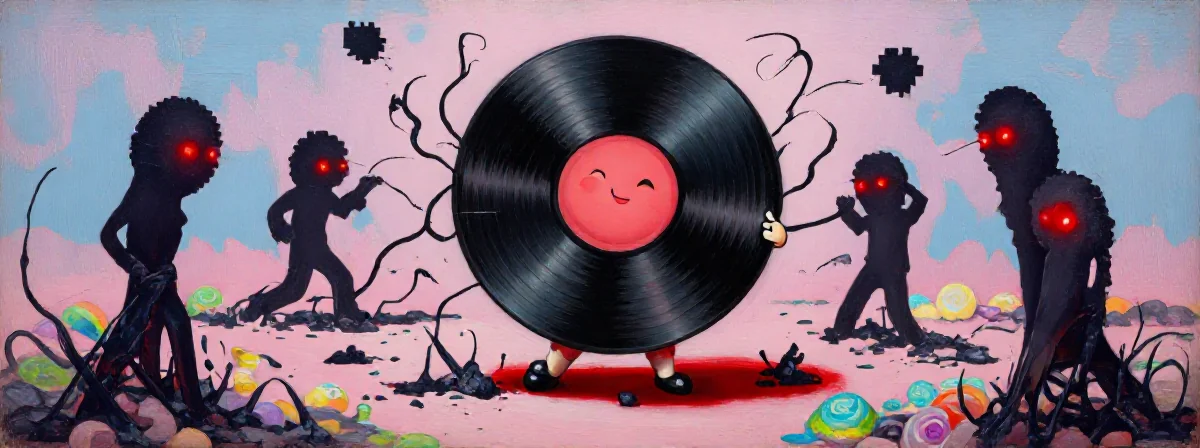
You stumble across a catchy tune on a social feed. It’s upbeat, sunny, and features a video so sugary it could give you a cavity. You tap the comments expecting discussions about the beat or the singer’s vocals, but instead, you’ve walked into a digital war zone filled with slurs, conspiracy theories, and hate speech. Congratulations, you’ve just witnessed the bizarre, illogical, and utterly exhausting phenomenon of modern internet propaganda.
It’s a special kind of cognitive dissonance. On one side, you have generic Europop about first love; on the other, you have centuries-old hatred repackaged for the algorithm. You might find yourself scratching your head, wondering if you missed a hidden lyric or a secret subliminal message. Spoiler alert: you didn’t. The connection isn’t hidden in the music; it’s manufactured in the malice of the people posting it.
The song in question? It’s a track by an Italian singer. The video features a puppy. The lyrics are about falling in love for the first time. It is, by all objective measures, harmless. Yet, here we are, watching a cute puppy video get weaponized to spread antisemitism. If that sounds like a plot point from a dystopian satire, welcome to the internet.
Why Do Bigots Choose the Most Random Things?
Here is the uncomfortable truth about online hate groups: they are lazy. Truly, profoundly lazy. You might expect there to be some method to the madness, a strategic reason why a specific piece of media gets chosen to carry a hateful message. Maybe the lyrics have a double meaning, or the artist has a controversial history. But usually, it’s just random chance.
They could have chosen a Mozart symphony, a viral TikTok sound, or a nursery rhyme. The specific content doesn’t actually matter to them. The goal isn’t artistic synergy; it’s about hijacking attention. They take a trending audio clip, slap it over a video that fits their narrative, and let the algorithm do the rest. The song is just a vehicle, and unfortunately for the artists involved, the vehicle is often chosen as arbitrarily as a pebble on the side of the road.
Thinking there is a deeper connection gives these people too much credit. You’re trying to apply logic to a group of people who think putting juice box emojis under posts about tragedies constitutes a political worldview. It’s not 4D chess; it’s barely checkers. It’s just noise.
The Mechanics of Digital Graffiti
Think of these propaganda videos like digital graffiti. A vandal doesn’t choose a specific wall because the architecture complements their spray paint; they choose it because it’s in a high-traffic area where everyone will see it. That’s all this is. The song isn’t “related” to the hateful message any more than a brick wall is “related” to a tag.
The format is almost always identical: a loaded question based on a conspiracy theory, followed by a video clip—often completely unrelated—and a soundtrack that has nothing to do with the visuals. The dissonance is the point. It confuses the algorithm, it outrages the viewer, and it spreads the message further than a coherent post ever would. They are banking on your curiosity. They want you to ask, “Why is this song here?” because that question leads you to read their hateful comments.
So, does the song itself carry the stigma? Absolutely not. To suggest that a song becomes “tainted” because a lunatic used it in a video is to let the lunatics dictate the culture. If we abandoned every piece of art, music, or media that bigots touched, we’d be left with nothing but blank walls and silence. They don’t get to own the culture just because they’re loud.
It’s Not Politics, It’s Just Spite
We often make the mistake of categorizing this behavior as “political.” We try to analyze it through the lens of ideology or discourse. But calling this “politics” is an insult to politics. This isn’t about policy, governance, or societal structure. It is pure, unadulterated hatred, wrapped in a layer of irony and sprinkled with emojis.
When you see comments about “controlling the economy” or ancient, recycled tropes that were tired a thousand years ago, you aren’t seeing political discourse. You’re seeing a script. These people are NPCs in a terrible video game, repeating the same lines over and over, hoping to get a rise out of you. They aren’t trying to make a point; they are trying to ruin your day.
Recognizing this is crucial. If you treat it as a valid political stance, you might feel the need to debate it. You can’t debate a brick wall. You can’t reason with someone whose entire personality is based on annoying strangers on the internet. The only winning move is to recognize the behavior for what it is: a desperate cry for attention from the bottom of the intellectual gene pool.
Why They Won’t Let You Have Nice Things
This brings us to the real question, the one that actually matters. Why do these people feel the need to infect innocent things? Why can’t a song about love just be a song about love? Why must a puppy video be turned into a platform for bile?
The answer is simple: they resent joy. They see the world experiencing happiness, connection, and innocence, and it burns them. If they can’t find peace, nobody gets to. It is the mindset of a toddler knocking over a block tower simply because someone else built it. They want to drag the world down into the mud with them because they lack the emotional maturity to build anything of value themselves.
It’s a question of humanity, not politics. It’s about the fundamental choice between creating and destroying. The next time you see an innocent song or video hijacked by hate, don’t look for the logic in the pairing. It doesn’t exist. Instead, recognize the sad, pathetic nature of the people doing the hijacking. They are loud, they are annoying, but ultimately, they are just throwing mud at the sun.