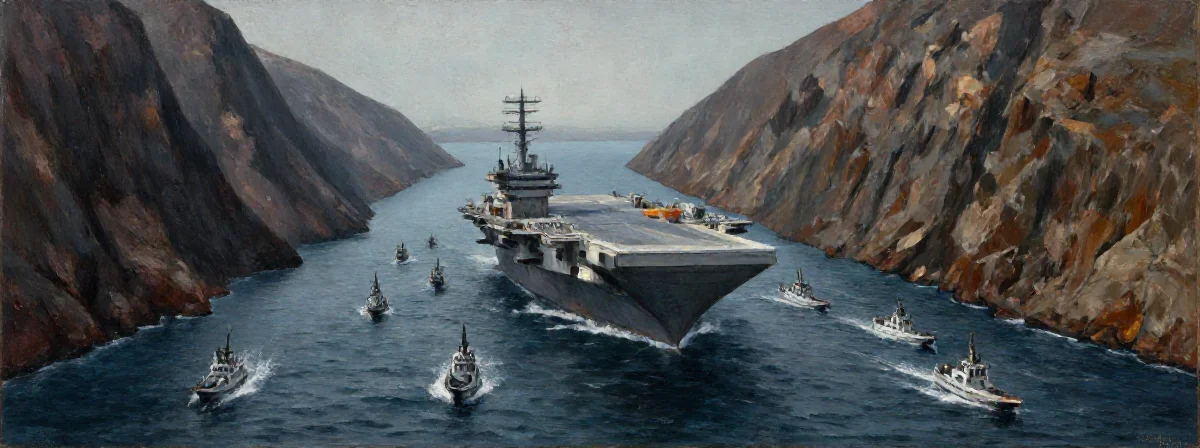
Imagine the most sophisticated naval force on Earth trying to protect a slow-moving target in a confined space. It sounds like a guaranteed win for the military, right? Now picture that space is only two miles wide, flanked by mountains, and the “target” is a massive oil tanker moving in a predictable straight line. When you look at the Strait of Hormuz through the lens of pure physics and logistics, it stops looking like a theater for naval dominance and starts looking exactly like a shooting gallery.
The bottleneck isn’t just a political border; it is a mathematical problem that modern technology hasn’t actually solved.
The Evidence
The Invisible Two-Mile Wall You might look at a map and see a strait that is 20 miles wide, which seems like plenty of room for a fleet to maneuver. But physics imposes a much stricter limit. Tankers are limited to a specific channel because they require immense depth to avoid running aground, shrinking their navigable options to a ribbon barely two miles wide. This forces the world’s largest ships—some stretching 400 meters long—into a single, predictable file. You aren’t defending a coastline; you are defending a narrow hallway where the walls are made of water depth.
A Game of Arcade Physics The targets are essentially sitting ducks. We are talking about Very Large Crude Carriers that are 330 meters long, 60 meters wide, and carry millions of barrels of oil. They are heavy, slow, and unable to dodge. From a tactical standpoint, it is less like a dogfight and more like one of those old arcade games where the targets move in a straight line and you just have to time your shot. If you are a defender on a ship, you know exactly where the incoming threat has to come from, but you also know there is nowhere to hide.
The “Donkey in a Cave” Defense This is the part that defies our high-tech expectations. We tend to assume that shutting down global trade requires hypersonic missiles or cyber warfare, but the reality is much simpler. You could effectively close the strait with technology from the 1940s. As one observer noted, all it takes is one person in a mountain cave with a towed artillery piece and a donkey to keep the Hormuz closed. If you can shut down a massive chunk of the global economy with a World War II-era howitzer, the strategic asymmetry is breathtaking.
The Insurance Veto The strait isn’t necessarily closed by a physical blockade; it is closed by Excel spreadsheets. Insurance companies are effectively vetoing transit by either refusing coverage or hiking premiums to unsustainable levels. A shipping company might technically be able to sail through, but if the cost of insurance eclipses the profit margin, the ship stays anchored. It is a fascinating example of how paper risk management can physically stop a steel ship.
The Economics of Asymmetry Warfare has always been about cost, but the math here is brutal. Anti-ship missiles and drones are relatively cheap, often expendable, and easy to hide on a truck. In contrast, a fully loaded tanker plus its cargo is worth around $300 million, and the naval destroyers protecting them are worth billions. When a $50,000 drone can threaten a $4 billion naval asset, the attacker is trading pennies for dollars. It is a volume business where the defender runs out of interceptors long before the attacker runs out of threats.
The Salvage Paradox Even if you provide a naval escort and manage to shoot down 99% of the incoming threats, the 1% that gets through creates a catastrophe that lasts for months. If a single large tanker sinks in that two-mile channel, the wreckage itself becomes the blockade. Trying to mount a salvage operation to remove a sunken supertanker while under enemy fire is a logistical nightmare that might be impossible. You can’t just “shoot back” a sunken ship; you have to move it, and that is a slow, dangerous job that requires the shooting to stop first.
Historical Echoes We aren’t guessing about this; we have the data. During the “Tanker Wars” of the 1980s, the region saw 451 ships sunk or damaged. The US Navy has been here before, executing operations like Earnest Will and Praying Mantis, dealing with mines and small boat swarms. History tells us that even with superior firepower, keeping a narrow waterway open against a determined, asymmetric adversary is a grinding, expensive, and dangerous endeavor.
We often look to technology to solve our strategic problems, assuming that a bigger ship or a better radar will keep the world moving. But the Strait of Hormuz teaches us that sometimes, geography and physics have the final say. When the path is narrow enough, the advantage shifts not to the side with the most expensive toys, but to the side willing to throw the cheapest wrench into the gears.