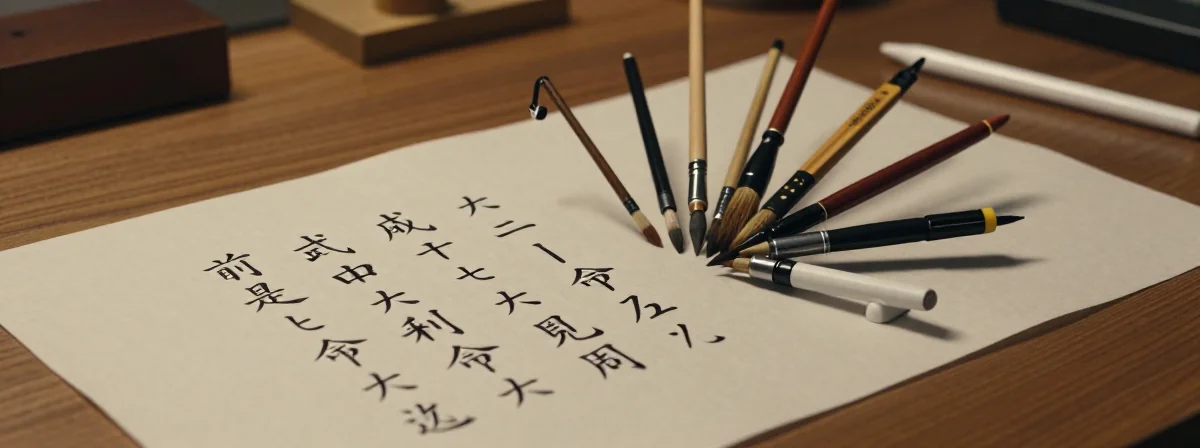
Staring down a page of Japanese text feels like hitting a wall. You see the loops of Hiragana, the sharp angles of Katakana, and the dense blocks of Kanji, and it’s easy to ask why they make it so hard on themselves. Why not just pick one system and stick to it? The answer isn’t about tradition holding them back—it’s about using the right tool for the job to maximize speed and clarity.
Here’s Your Strategy
Kanji packs a massive amount of data into a tiny space. Think of Kanji not as letters, but as zip files for meaning. One character can convey an entire concept that would take a whole sentence of phonetic letters to explain. This allows you to scan a page and grasp the core message instantly, rather than sounding out every single syllable like a first-grader. It’s efficiency in its purest form.
You need visual anchors when there are no spaces. Here is the reality check: Japanese doesn’t use spaces between words. Imagine reading English without spaces—it would look like an endless stream of gibberish that takes “infinite more brainpower” to decode. Kanji breaks up that monotony. Because the Japanese language is absolutely loaded with homophones—words that sound exactly the same but mean totally different things—writing everything phonetically would be a nightmare of ambiguity. Kanji acts as the ultimate context clue, instantly telling you “this means bridge,” not “this means persimmon,” just by looking at the symbol.
Katakana is your built-in highlighter. It doesn’t just look cool; it tells you exactly how to handle a word. If you see those sharp, angular characters, you know instantly that you’re dealing with a foreign import or a sound effect, so you better pronounce it like a native English speaker, not a Japanese one.
English is guilty of the same “complexity.” You might think having three alphabets is excessive, but look at your own keyboard. You have uppercase and lowercase letters—different shapes for the exact same sounds. We use them to signal the start of sentences or proper nouns, while Japanese uses script changes to signal foreign words or emphasis. It’s the same mechanic, just with a different paint job.
Simplicity often leads to more work. You could write Japanese using only one phonetic script, but it would be exhausting. It’s like trying to build a house with only a hammer when you also need a saw and a drill. Sure, you could make the hammer work, but it would take you ten times as long and the result would be ugly. Mixing the systems creates a rhythm that makes reading faster and writing more precise.
Stop looking for the easy way out and start looking for the efficient way. The Japanese writing system isn’t a mess; it’s a highly optimized machine that uses every gear it has to keep the gears turning smoothly. When you stop complaining about the tools you’ve been given and start mastering them, you stop seeing obstacles and start seeing opportunities.