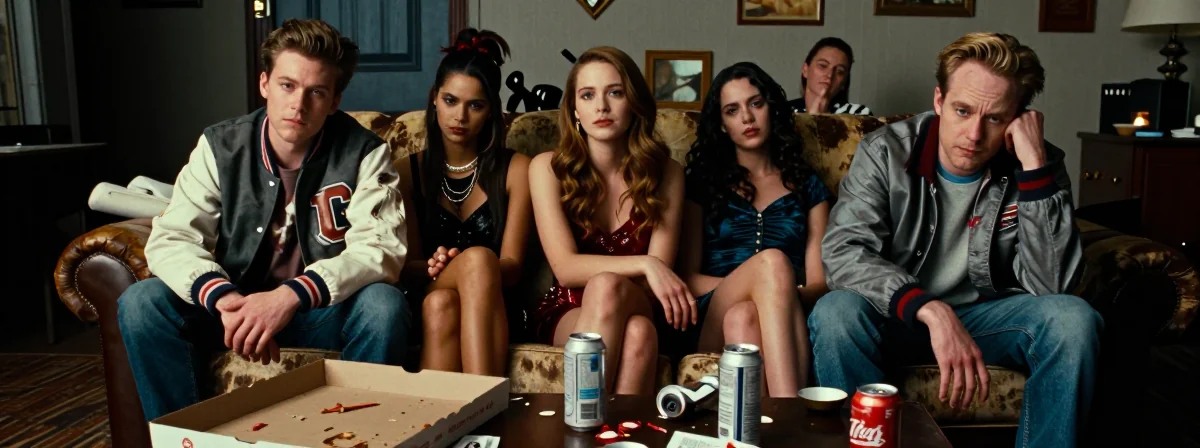
There is a specific kind of vanity that assumes the world freezes the moment we accept our diploma. We carry these mental snapshots of the people we grew up with, frozen in amber—the star quarterback with the perfect spiral, the “it” girl with the unblemished skin, the terrifying clique that ruled the hallways like a junior varsity mafia. We assume they stay that way. We assume that while we are changing, struggling, and aging, they remain somehow static, preserved in the prime of their lives.
But time is a relentless leveler. It does not care who you sat with at lunch. It turns out that the very structures that propped up the kings and queens of the cafeteria are often the first things to vanish, leaving behind people who are just as lost, confused, and human as the rest of us. The reunion isn’t just a party; it’s a reveal.
When you peel back the layers of nostalgia, you find that the trajectory of a life is rarely a straight line. It is a series of crashes, pivots, and quiet evolutions.
The Crash When the Whistle Blows
For a specific subset of the elite, the end of high school or college marks the beginning of a slow, confusing decline. Think about the athletes and the service members—the ones whose physical dominance defined their entire identity. The moment they leave that highly structured environment, the rug gets pulled out.
It is a phenomenon that repeats itself in fire stations and police departments across the country. There is a stark difference between those who train for the job and those who rely on the job to keep them fit. Without the dedicated routine, the discipline evaporates. The laziness that sets in isn’t just about skipping the gym; it’s a existential drift. When the uniform comes off and the structured practices end, the physical vessel that gave them their status begins to fail them. It is a harsh lesson: external validation cannot sustain you when the external structure disappears.
The Tragedy of Potential
Sometimes, the story doesn’t end with a beer belly or a quiet desk job; it ends with a silence that echoes through decades. We often remember the “pretty girls” or the “popular guys” as if they were invincible, protected by their social status from the fragility of life. But biology does not discriminate based on popularity.
There are the stories that stop too soon—the girl who died in a car accident senior year, or the one taken by a brain aneurysm at twenty-eight. These tragedies are devastating not just because of the loss of beauty, but because of the loss of kindness. In retrospect, the survivors often realize that the most popular person in the room was also the one sitting with the outcasts, the one whose faith drove them to care for the people everyone else ignored. When they are gone, the social hierarchy dissolves instantly, leaving only the hollow realization that status meant nothing in the face of mortality.
The Dissolution of the Clique
If you went to a typical high school, there was probably a group that seemed like a single organism. They had their own language, their own table, and sometimes, terrifyingly, their own acronym. Imagine a clique named LACES—Lisa, Andrea, Cara, Erica, and Sarah—walking through the halls like a band of Disney villains, projecting an image of unified power.
It feels like a movie set, but the reality is banal. The glue that held them together was proximity and the shared theater of adolescence. Once the diploma was handed out, the alliance fractured. They stopped speaking. They became normal people, often drifting apart so completely that the bond feels like a hallucination. The fear they instilled or the envy they commanded evaporated, proving that their power was entirely situational.
The Bizarre Twists of Fate
For every former classmate who settles into a predictable life, there is one who takes a hard left turn into a storyline nobody could have predicted. The quiet girl you knew might become a dancer and marry an NBA player, leaving you shaking hands with a man whose grip engulfs your entire forearm. Or perhaps the “hottest girl” in school, the one who seemed destined for conventional success, takes a path that reads like a soap opera.
Consider the trajectory that moves from middle school modeling to Playboy, then to a marriage with a doctor twice her age, only for him to be arrested for trafficking prescription drugs. Suddenly, she has the house, the money, and reinvents herself as a social media influencer. It sounds absurd, a series of plot points that make no sense on paper. Yet, it happens. Life is not a meritocracy; sometimes, it is just a series of chaotic events that people manage to survive.
The Mirror of Aging
Then there is the physical reality of hitting forty and fifty. We all change. Some of the women who were the “hottest” in school have aged with a glamorous elegance, still turning heads decades later. Others haven’t been so lucky—or perhaps, they made different choices.
You see the results of trying to fight time: the plastic surgery that leaves a face looking frozen and alien, a desperate attempt to cling to an image that no longer exists. You realize that getting “old” isn’t a failure; it’s just what happens if you’re lucky. The ones who let themselves age naturally, who went through the “ringer” of life like everyone else, often possess a beauty that is far more resonant than the flawless perfection of their youth.
The Final Reveal
Ultimately, the most shocking updates are often the most mundane. The girl who dated all the hot guys and seemed destined for a life of social dominance becomes a CFO with a wife. The venture capitalist and the suburban mothers are all just trying to figure out the same mortgage payments and family dramas.
The hierarchy of high school was a game played in a sandbox. Once you step out of the box, the rules don’t apply. The popular kids, the jocks, the outcasts—we all end up in the same place, just trying to navigate the years we have left. The ones who win aren’t the ones who were prom king or queen; the ones who win are the ones who figured out how to be happy when the yearbook is closed.