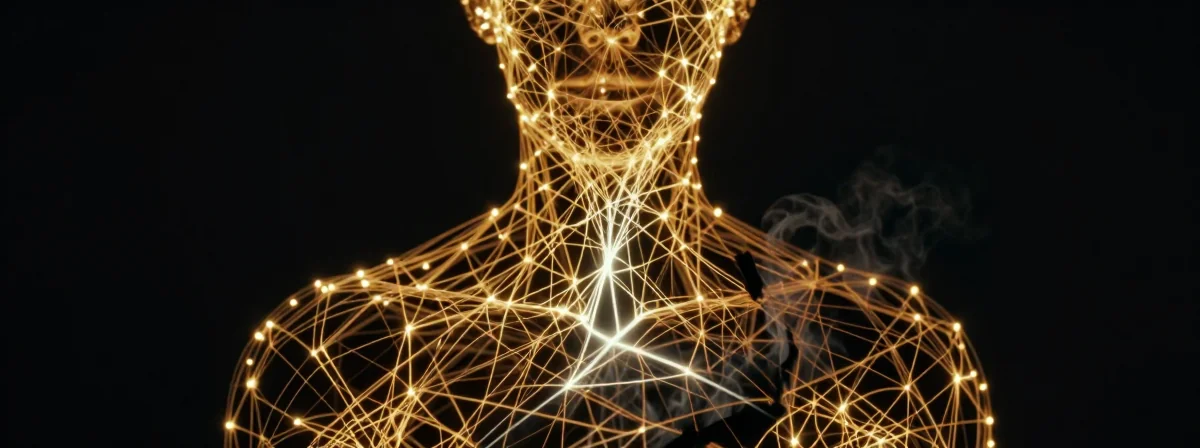
Hold a stone in your hand. Feel its weight. In that quiet moment of contact, you are not just holding a piece of the earth; you are engaging in a conversation with the universe. You are giving that stone potential energy, lifting it away from the center that demands its return. If you let it go, it falls. That is the universe exhaling, potential turning into kinetic, the stone seeking its source.
We often think of gravity as a simple force—the thing that keeps our feet on the ground. But if we look closer, if we sit with the concept long enough, we see it as a binding agent. It is the glue of existence. When we consider the grand scale of a planet or a star, this concept evolves into something profound: gravitational binding energy. It is the sum total of energy holding a massive object together against its own chaotic desire to scatter.
What Does It Mean to Be Bound?
Imagine the Earth not as a solid sphere, but as a gathering of countless dust and rocks, all reaching for each other in a silent, mutual embrace. The gravitational binding energy is the measure of that embrace. It represents the total gravitational potential energy of all the mass that makes up our world.
Every atom is attracted to every other atom. To break the planet apart—to truly shatter it so that the pieces never come back together—you would have to overcome this immense, accumulated love. You would need to inject enough energy to counteract the pull that draws every piece of matter back to the center. It is a cosmic threshold. A small explosion might throw rocks into the sky, but gravity, patient and persistent, will eventually pull them back. Only a force exceeding the binding energy can liberate them completely.
Finding Your Own Center in the Cosmos
There is often confusion between the bond we share with our own planet and the bond the planet shares with the Sun. We might wonder: if the Earth were to shatter, would the debris fly off into the void? Or would it continue to orbit the star?
Here lies a beautiful distinction. Gravitational binding energy is about the object’s own gravity—its internal integrity, its “self.” It has no bearing on the gravitational pull of another body. The Earth is bound to itself, just as we must be grounded in our own nature before we can truly relate to another. If we were to break the planet apart, overcoming its self-gravity, the scattered matter would likely remain tethered to the Sun, continuing its ancient dance as a ring of debris rather than fleeing into the dark.
The Beauty of Scattering
Picture our world, no longer a single blue marble, but a shimmering ring of dust and rock circling the Sun. It is an ominous image, perhaps, but undeniably beautiful. We see this artistry elsewhere in the solar system. Saturn’s rings are thought to be the remnants of icy moons that ventured too close, crossing the Roche limit—the point where tidal forces rip a body apart.
Even in destruction, there is creation. The debris would not remain chaotic forever; over eons, collisions would occur, and matter would coalesce once more. It is the cycle of existence, mirrored in the hypothesis of Theia—the ancient body that collided with Earth, ejecting the material that eventually formed our Moon. Destruction is often just the precursor to a new form of wholeness.
The Illusion of Absolute Measurement
In our attempt to understand these forces, we turn to mathematics. But we must remember that math is a map, not the territory. We calculate potential energy based on convenient reference points. Technically, the penny in your pocket has potential energy relative to a distant star, just as it has energy relative to the floor beneath your feet.
We choose the simplest terms to make the formulas work, to bring peace to the chaos of calculation. We focus on the drop from the hand to the ground, not the complex journey of rolling down a hill. These numbers are placeholders, tools to help us grasp the ungraspable. If two things have mass, there is attraction. There is energy to be found in that interaction, but we do not need to calculate everything to appreciate the connection.
The Energy of Letting Go
How much energy does it take to break a world? Does it depend on how the blow is struck—a tangential glance versus a direct hit? While the mechanics vary, the principle remains. The binding energy is the escape velocity for the object’s own gravity well.
If you pour more energy into a planet than its own gravity can hold, it ceases to be a planet. It becomes a cloud of independent travelers, each on its own trajectory. It is not vaporized; it is simply no longer a self-gravitating blob. It is the ultimate release. Understanding this helps us see the fragility and the resilience of the worlds around us. It reminds us that everything is held together by a delicate balance, a quiet tension that, when understood, reveals the deep, interconnected nature of the cosmos.
Returning to Stillness
We look to the stars and see violence; we look to the ground and see stillness. Yet, they are born of the same force. Gravitational binding energy is simply the universe’s way of holding on, of keeping the dust from drifting into the endless night.
When you next hold a stone, feel the weight of that concept. You are holding a piece of a greater whole, bound by invisible threads that stretch back to the beginning of time. To understand the energy required to break a planet is to appreciate the miracle that it holds together at all. In this knowledge, we find a deeper gratitude for the ground beneath our feet and the quiet, persistent gravity that allows us to simply be.