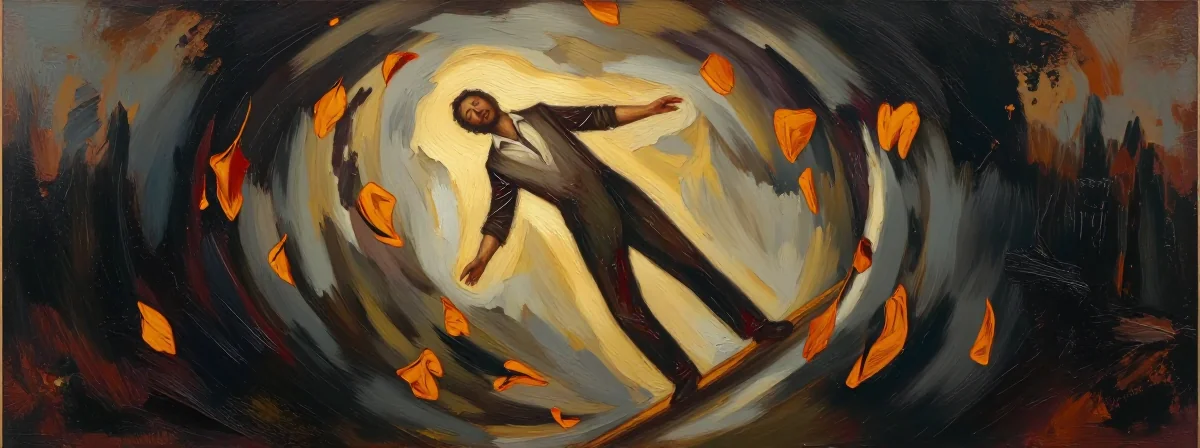
You are walking a smooth path, feeling the ground firm beneath your feet, when suddenly the earth shifts—not literally, but socially. You wave at a stranger who wasn’t waving at you, or your mouth forms a word your brain didn’t intend, and the world seems to stop spinning for a heartbeat. We treat these moments as catastrophes, as evidence that we are broken, but what if they are simply the wind rustling the leaves? They are proof that you are here, interacting with a world that is messy, unpredictable, and undeniably human.
The Perspective
The Illusion of Connection You lock eyes with someone across the room and raise your hand in a warm greeting, only to realize they were looking at the person directly behind you. The ego immediately screams to defend itself, to turn to the true recipient and say, “They were waving at me,” but that is just the frightened mind trying to build a wall. Instead, try the path of no resistance: simply offer a thumbs up to the universe. It is a small acknowledgment that says, “I see the absurdity, and I am still here.”
The Weight of Words There is a specific kind of vulnerability in mispronouncing a word with total confidence—saying “eunuch” when you meant “unique,” or reading “autopsy” as if it were a feline. You butcher the sound and keep walking, carrying the mistake like a heavy stone. But language is just a map, not the territory itself. When you realize you’ve been saying “mischievous” wrong for forty years, or that “minus” was never “min-us,” laugh at the sound of your own voice echoing in the canyon of your misunderstanding. You are learning; that is enough.
The Dance of Recovery You trip on absolutely nothing—a crack in the sidewalk, an uneven patch of air—and your body instantly performs that bizarre little jog-walk to play it off. We think this quick shuffle fools the onlookers, but everyone knows exactly what happened. It is a silent agreement we make with one another: I will pretend I meant to jog, and you will pretend to believe me. It is a clumsy, beautiful choreography of denial that we all participate in to keep the peace.
The Echo of the Body There is perhaps no greater test of surrender than the bodily function that arrives without permission. You are in a quiet place, a safe zone, and the very act of releasing tension seems to materialize a person out of thin air to witness it. Or worse, you find yourself in the only bathroom, an echo chamber next to a dining room, where the sound of your existence is amplified for all to hear. It is uncomfortable, yes, but it is the great equalizer. We all have bodies that make noise; we are all just animals trying to maintain dignity in a porcelain room.
The Glitch in the Simulation You walk into a room with purpose, crossing the threshold, and suddenly the script vanishes. You stand there in the center of the floor, frozen like a Sim with a cancelled action, staring at the walls. You turn back to where you started, and the memory floods in—you needed a glass of water. You have not lost your mind; you have simply touched the void for a moment. It is a reminder that our thoughts are as ephemeral as mist, gathering and dissipating on their own schedule.
The Performance of Intimacy In moments of closeness, the body sometimes refuses to cooperate, despite the heart’s willingness. It can be a source of deep panic, but it is also a lesson in presence. When the mechanics fail, it is an invitation to connect in a thousand other ways that don’t involve performance. If you can let go of the need to perform, you might find that the “pow-wow” was never the point—it was just the doorway to something quieter.
The Unseen Fall Sometimes, the embarrassment isn’t a quick stumble but a profound unraveling, like soiling yourself in public with no warning. It feels like the end of the world, a shame so heavy it keeps you inside for years. But even this, in the fullness of time, becomes just another scar on the landscape of your life. It is a terrifying realization of how little control we actually have, but surviving it teaches you that you are stronger than the container you inhabit.
The Locked Door You pull a handle clearly marked “Push,” realize your mistake, push it, and then immediately pretend you were checking to see if it was locked. We spend so much energy crafting these little narratives to protect our pride. If you can simply stand there and admit, “I pushed when I should have pulled,” you free yourself from the exhausting work of maintaining the façade. The door opens either way; your story about it is optional.
In Stillness
Breathe into the awkwardness. Do not try to smooth it over or push it away.
These cringeworthy moments are not interruptions to your life; they are the texture of it. When you stop fighting the embarrassment and simply observe it, you realize that everyone else is too busy worrying about their own stumbling to notice yours. Let the awkwardness be a meditation—a reminder that perfection is a myth, and the messy, glorious reality of being human is far more interesting.