We have all been there. You are watching a news segment, maybe half-listening while scrolling through your phone, and someone suggests the solution to a complex geopolitical standoff is simple: just roll in, take the land, and force the issue. It sounds great in a movie trailer. It feels decisive. Unfortunately, reality is about as cooperative as a cat in a bath, and the Strait of Hormuz is the ultimate example of why “just taking it over” is a fantasy that belongs in an action film, not the Pentagon.
Look, I am no five-star general. I am just a person who finds military hardware and geography weirdly fascinating, in the same way I find tornadoes fascinating—beautiful from a distance, but absolutely terrifying if you are actually standing in front of one. When you start pulling at the thread of what it would actually take to “secure” this narrow stretch of water, the whole sweater unravels into a nightmare of logistics, economics, and really, really big mountains.
So, let’s put down the controller and take a look at why this specific patch of ocean is arguably the most difficult neighborhood on Earth to police.
Is Iran Too Big to Actually Occupy?
Here is the thing about “invading and occupying a wide strip of land” to create a buffer zone: the range of modern weapons has made the concept of a “buffer zone” practically obsolete. To stop a missile that can fly 300 kilometers, you don’t need to secure the beach; you need to secure basically the entire country of Iran.
For context, Iran is roughly twice the size of Texas. Remember how well the whole “nation-building” thing went in Afghanistan? Afghanistan is about the size of Texas. Occupying Iran would be significantly more resource-intensive than Afghanistan, and the United States didn’t even fully occupy Afghanistan—they relied on local factions to do the heavy lifting. In Iran, there are no friendly local factions waiting to hand you the keys to the capital. You would be looking at a ground war where the U.S. does most of the work, with a human cost potentially comparable to Vietnam. That is not a “special military operation”; that is a generational commitment.
Why Is the Geography Such a Nightmare?
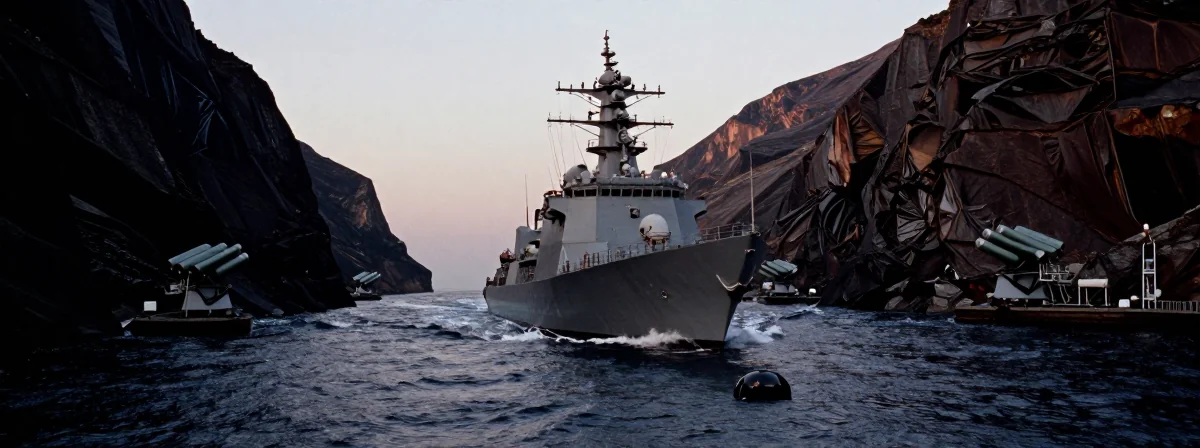
If you look at a topographic map, the problem becomes instantly clear. It is not just flat desert; it is a canyon. The Strait of Hormuz is bordered by rugged mountains that look like they were designed specifically by nature to hide missile launchers. Iran can tuck anti-ship missiles into those ridges, fire them at will, and scoot away before anyone can pinpoint where the shot came from.
To take out these launchers, you would theoretically need to send fighter jets. But they can’t fly too high, or they become sitting ducks for surface-to-air missiles (SAMs). They would have to fly low through canyons—basically reenacting the “Death Star trench run” from Star Wars—just to get close enough to drop a bunker-buster. And even if you manage to clear the coastline, you haven’t solved the problem because the missiles can be fired from hundreds of miles inland. It is a natural naval kill box, and no amount of swagger changes the geology.
Does the Math on Interception Even Work?
This is where things get depressing for the wallet. Modern warfare is increasingly an economic competition, and right now, the offense is winning. We are talking about the “cost exchange ratio.” Let’s say you want to shoot down a drone or a cheap cruise missile. You are firing an interceptor that costs at least $125,000—and often ten times that amount.
What are you shooting down? Often, it is a drone or a missile that costs between $20,000 and $50,000. They are cheap, easy to manufacture, and you can build thousands of them. If Iran launches dozens of these at once, you run out of defensive missiles in weeks or months. You are essentially trying to swat a hornet’s nest with a golden bar. You might hit a few, but you will go broke doing it, and there are always more hornets. While directed energy weapons (lasers and microwaves) are coming, they are line-of-sight weapons. In a mountainous strait, you don’t have clear lines of sight from 400 miles away.
Can You Just Ignore the Threat and Push Through?
So, what if you just say, “nuisance value be damned,” and send ships through anyway? Well, you have to deal with the insurance companies. The shipping channel is only about two miles wide in each direction. Even a single sunken supertanker doesn’t have to physically block the channel to shut it down; it just has to exist there as a warning.
If there is even a 1% chance of getting hit by a missile, a sea mine, or a suicide drone, no insurer is going to sign off on that policy. Without insurance, global shipping stops. It is like walking through a neighborhood where there is a 1% chance of getting shot every time you go to the mailbox. Sure, you might make it, but you are probably going to stay inside, order delivery, and wait for the situation to resolve itself. The U.S. Navy can escort ships, sure, but they cannot force the global economy to accept a risk profile that looks like a game of Russian Roulette.
Is There Actually a Military Solution?
When you add it all up—the sheer size of the territory you would need to occupy, the defensive advantage of the mountains, the crushing economics of cheap drones versus expensive interceptors, and the paralysis of the insurance market—you start to see the picture. The only way to guarantee the Strait functions is to completely remove the threat, which means removing the IRGC and effectively occupying the country.
That is an “all-in” bet that makes the stakes of Vegas look like penny slots. The consequences of a single failure are catastrophic, which shifts the whole calculation away from shooting and toward… well, talking. It turns out that finding a way to create mutual economic benefit might be the only strategy that doesn’t end in a fiscal and humanitarian disaster. Crazy, right? It turns out that peace is not just a moral imperative; it is the only cost-effective option on the table.