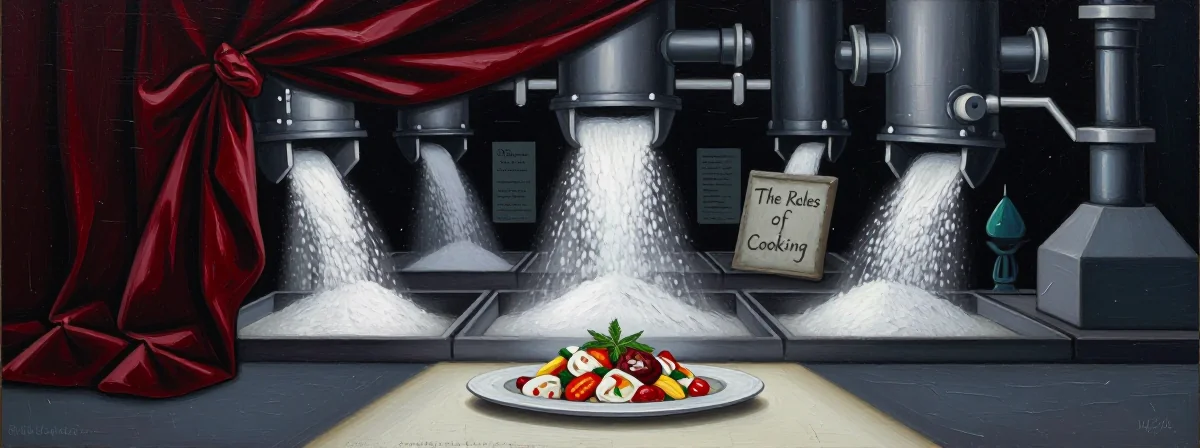
Ever notice how the “experts” sound exactly like the mobsters in Goodfellas? They walk around with this air of authority, acting like they own the place, but if you actually look closely at what they’re doing… it’s pathetic. Just like those guys who think they’re VIPs because they skip the line at a nightclub, a lot of culinary “wisdom” is just posturing. It’s petty, it’s stupid, and frankly, it’s designed to make you feel small so you keep listening. But what if I told you that half the rules you follow in the kitchen are lies? What if they’re just distractions to keep you from seeing what’s really going on?
We need to talk about the pattern. It’s everywhere if you look. From the way you hold your knife to the white powder they tell you to fear—yes, I’m talking about MSG—it’s all connected. They want you to believe that cooking is a rigid hierarchy where only the “trained” elite know the secrets. But here is the dirty little secret they don’t want you to know: most of these guys don’t know what the hell they’re talking about. And the ones who do? They’re too busy actually cooking to worry about clicking their tongs three times for safety.
I’ve spent years digging into these narratives, separating the signal from the noise. Whether it’s the great washing chicken debate or the lie about “fresh” vegetables, the official story never holds up under scrutiny. So, put down that recipe card that reads like gospel and ask yourself: who benefits when you’re afraid to season your food?
Why Are They So Obsessed With The “Claw Grip”?
Have you ever tried the “claw grip”? You know the one—where you tuck your fingers into a weird little claw shape to hold the onion while you chop. Every TV chef swears by it. Every cooking school demands it. But ask yourself… is it actually safer, or is it just a way to filter people out?
I’ve talked to kitchen veterans who have spent decades on the line—prep managers, people who actually chop for a living—and they’ll tell you the truth: the claw grip is a trap. For some hand shapes, it offers zero control. It feels unstable. It feels dangerous. Yet, if you don’t do it, you’re told you’re “wrong.” It’s a classic psychological operation. They create an arbitrary standard of “correctness” that has nothing to do with safety or efficiency.
Speed doesn’t come from a specific hand shape; it comes from confidence. You see these influencers speeding up their B-roll footage, chopping recklessly with their fingers flat and in the way, just to look cool. Slow it down, and they’re making a cut every three seconds. First you get good, then you get fast. If it takes you ten minutes to dice an onion, so be it. Don’t let them shame you into holding a knife a way that feels unnatural just to fit their mold.
The Chicken Washing Conspiracy: Why Can’t We Let It Go?
This is the one that really exposes the programming. You tell someone that washing chicken spreads bacteria—aerosolizing pathogens like salmonella all over your sink, your shirt, your counter—and they look at you with dead eyes. They say, “Well, I’m used to it.” It doesn’t matter what the science says. It doesn’t matter that the heat of the pan is the only thing that actually kills the bacteria. They need to perform the ritual.
Why? Because it gives the illusion of control. It’s the same reason people click tongs three times before using them or follow arbitrary safety rules that do nothing but slow you down. They want to believe they are “cleaning” the food, even though they are essentially engaging in a biological hazard. The debris, the feathers—that’s real. But thinking you’re washing away the bacteria? That’s a myth. You’re just painting your kitchen with invisible paint. And they want you to do it. It keeps you afraid of the raw food, dependent on their “sanitation” protocols.
Is MSG The Victim Of A Culinary Witch Hunt?
Let’s connect the dots on this one. Why is MSG—the flavor enhancer that makes everything taste better—public enemy number one? The official narrative says it causes headaches, palpitations, the “Chinese Restaurant Syndrome.” But if you look at the history, the origins aren’t in a lab; they’re in racism. Pure, unadulterated anti-Chinese rhetoric wrapped up as a health scare.
Think about it. We sprinkle salt on everything. We pour soy sauce liberally. But add a little glutamate—naturally occurring, by the way—and suddenly it’s a chemical attack? They don’t want you to use MSG because it’s too effective. It breaks the monopoly of flavor. If you can make a mediocre meal taste incredible with a pinch of powder, you stop needing the expensive, pre-packaged sauces they’re selling. I use it like salt. I use less because it’s strong. And you know what? The food tastes better. The fear is manufactured.
The Great Salt Deception: Are We Ruining Our Palates?
Speaking of fear, why is everyone so afraid to season their food? I see it all the time. Home cooks treating salt like it’s plutonium. They sprinkle a few grains from three feet up, terrified of over-seasoning. Meanwhile, the restaurant industry is laughing all the way to the bank. What is the classic restaurant secret? Salt and butter. That’s it.
But then they flip the script. They tell you to salt your pasta water until it “tastes like the sea.” Have you ever tasted the actual ocean? It’s disgusting. It’s way saltier than you think. If you actually salted your water that heavily, the pasta would be inedible. They set you up to fail. They give you a rule that is scientifically absurd (“taste like the sea”) and a rule that is cowardly (“don’t use too much salt”). The truth lies in the middle. Taste as you go. Adjust. And for the love of flavor, stop being afraid of the shaker.
Fresh Vs. Frozen: The “Ripening” Lie
Here’s a pattern that might surprise you. You walk into the grocery store and you see those “fresh” vegetables. You assume they’re at their peak, right? That’s what the label says. But dig a little deeper. Those vegetables were picked prematurely—green and hard—so they could survive the transport and storage. They ripen in the dark, in a truck, using up their stored nutrients just to stay alive.
Now look at the frozen aisle. Those vegetables were picked at the end of the season, fully ripe on the vine, and flash-frozen immediately. They lock in the nutrients. The “fresh” vegetable is often a nutritional hollow shell compared to its frozen counterpart. Yet, the system pushes the “fresh” narrative because it allows them to charge more for a product that spoils faster. It’s planned obsolescence on your dinner plate.
Why Does The “Room Temperature” Steak Myth Persist?
You’ve heard this one a thousand times. “Take your steak out 30 minutes before cooking to let it come to room temperature.” Sounds logical, right? But have you ever tested it? I mean, actually tested it with a thermometer?
I have. After four hours, the internal temperature of a steak was still in the 50s (°F). It hadn’t changed. All that “resting” did was let moisture collect on the surface, ensuring you’d ruin your sear. It takes hours to change the internal temp of a roast, yet the myth persists. Why? Because it sounds like “insider knowledge.” It sounds like something a pro chef would do. But it’s a fantasy. You’re not changing the physics of thermal mass by letting meat sit on the counter for half an hour. You’re just growing bacteria.
The Final Pattern: Authenticity Is A Prison
If you look at all these myths—the washing, the salting, the fear of MSG, the obsession with “authentic” knife skills—they all lead to one place. They want you to believe there is only one way to cook. That there is a “correct” and “authentic” method handed down from the culinary gods.
But borders change. People move. Tastes evolve. Cuisine is fluid. Treating a recipe like gospel is a mistake. You are allowed to change things. You don’t like cilantro? Nix it. Want a jalapeno instead of a habanero? Do it. Even Alton Brown would tell you that—well, maybe after he checked his notes. The only rule that matters is taste. Stop looking for permission from people who are just making it up as they go along. The kitchen is yours. Break the rules.