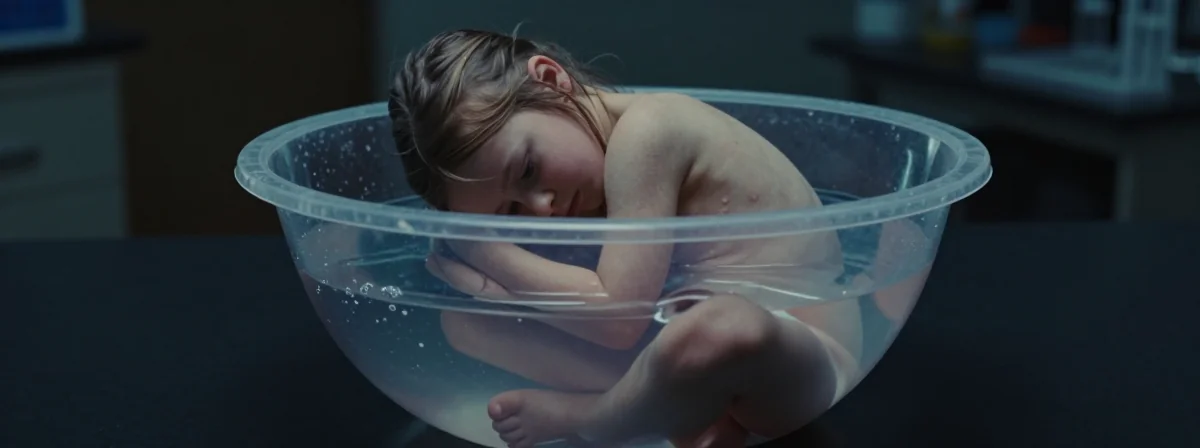
You look in the mirror and see a complete human being. Arms, legs, a face that fits. But biology is rarely that tidy. Sometimes, the genetic instruction manual gets a highlighter spilled on a crucial page, and the results are difficult to look at. You’ve probably seen the viral image of a young woman sitting in a plastic bowl. It’s jarring. It makes you look away, then look closer, forcing you to reconcile the humanity in her eyes with the extreme reality of her condition.
The Facts
Development is a series of independent timers, not a single switch. Rahma Haruna had almost no legs and only one functional arm, yet her face remained perfectly symmetrical and her head grew normally. This suggests her condition struck at a very specific moment in gestation, affecting the limb buds while sparing the cranial facial development. It’s a stark reminder that building a human is a step-by-step process, and if one step gets skipped, the rest of the assembly line keeps moving regardless.
You are a brain piloting a meat-covered exoskeleton. It sounds like a sci-fi trope, but Rahma’s life proves it in the most visceral way possible. We tend to identify with our limbs—our hands, our feet—but the “you” reading this is strictly the pilot in the cockpit. Rahma’s cognitive mind developed to a teenage level, fully intact and aware, trapped inside a vessel that failed to build the standard peripherals. We are all just brains driving a bony mech suit wrapped in meat armor; sometimes, the suit just doesn’t show up from the factory.
Necessity invents the strangest solutions. Before an anonymous donor sent a wheelchair, her family carried her. To give her some autonomy, they used a plastic bowl. It’s a brutal image that recalls the frustration of the video game Getting Over It, where you navigate a mountain with nothing but a hammer and a pot. But this wasn’t a game. It was a family adapting to catastrophic equipment failure with whatever they had on hand. When the standard tools don’t fit, you build what you can.
The unknown is terrifying, so we invent stories to survive it. Doctors in her region reportedly told her parents she had been cursed by a jinn. When humans see biological extremes that defy logic, the gap between science and understanding is often filled by mythology. It is a defense mechanism. If a condition is caused by a spirit, at least there is a reason; if it’s just random genetic chaos, that is a much heavier burden to carry.
Resilience is the only constant. Despite the physical horror of her situation, Rahma possessed gratitude, hope, and the ability to dream of a future she would never have. Those qualities aren’t physical. They don’t require legs or lungs to exist. They survived the genetic lottery, and in a way, they outlasted the body itself.
The Bottom Line
Biology isn’t moral; it’s just a mechanism that follows instructions, sometimes with catastrophic results.
We often confuse the body with the person, but Rahma’s story strips away that illusion entirely. The hardware failed, but the software—the consciousness, the love, the personality—ran perfectly until the end. It makes you wonder how much of our own identity is tied to a shell that’s essentially on loan from nature.