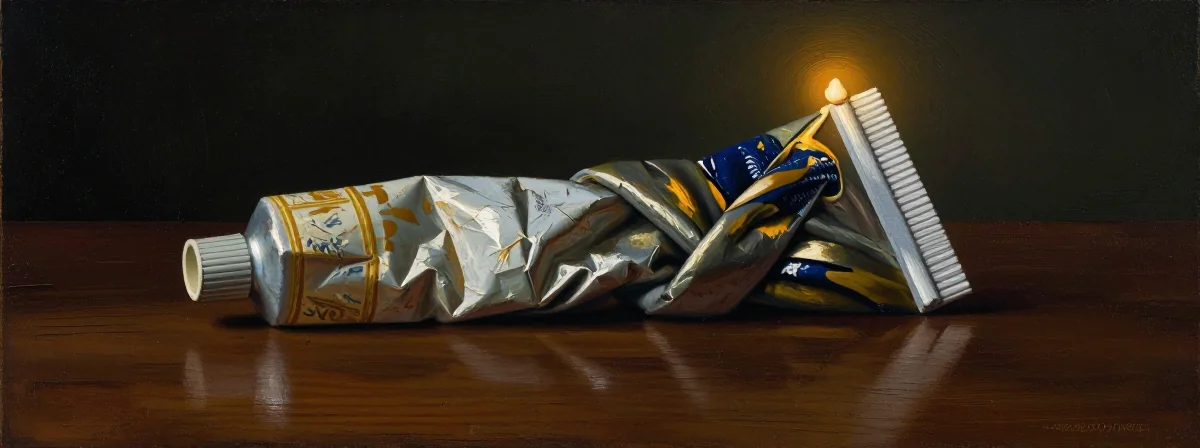
Walk into your bathroom right now and check the sink. I’m willing to bet there is a tube of toothpaste there that looks, for all intents and purposes, empty. You’ve squeezed it. You’ve rolled it. It should be done. But you know, deep down, it’s got at least another week left in it. Why? Because somewhere in a cabinet or a drawer, you have a fresh, unopened replacement waiting in the wings. It’s a classic case of contradictory evidence, and if we look closer, we find a pattern that affects almost everything you own.
We need to talk about the “Backup Tube Phenomenon.” It’s a bizarre behavioral glitch where the presence of abundance artificially extends the lifespan of a resource. When you know a replacement is within arm’s reach, that seemingly empty tube suddenly becomes infinitely resilient. The moment you remove the safety net, however, the dynamics shift instantly. The tube isn’t just empty anymore; it’s a resource to be mined. The evidence suggests this isn’t about the toothpaste at all—it’s about your perception of scarcity.
I’ve seen this play out in countless scenarios, but the bathroom sink provides the most controlled experiment. One person reports that simply having a spare tube bought and ready somehow makes the current batch last two weeks longer than expected. Another admits that when the new tube is relegated to an awkward spot in the spare room, the old tube keeps yielding paste, purely out of necessity to avoid the trek. The location of the spare changes the value of the original.
The Case of the Infinite Supply
Consider the clues. When you have a backup, you squeeze the tube with a sort of casual optimism. You get a decent amount of paste, maybe not enough for a full brush, but enough to get by. You figure, “I’ll just use the rest tomorrow.” But tomorrow, the same thing happens. The tube never seems to run dry because you aren’t applying any pressure to the situation. You are treating a finite resource as if it were infinite because the consequences of running out have been eliminated by your foresight.
This creates a false sense of security. You aren’t actually using the product more efficiently; you are just stretching the “end phase” indefinitely. The toothpaste isn’t lasting longer because of magic or some manufacturing anomaly. It’s lasting longer because your standards for what constitutes “empty” have plummeted. You are accepting 40% effort because you know you have 100% potential waiting in the drawer. It is a luxury problem disguised as an efficiency hack.
The Forensics of the “Scissors Method”
Now, let’s look at what happens when we introduce a scarcity variable. Remove the backup tube. Hide it in the garage or simply don’t buy it. Now, when that tube sputters, you have a problem to solve. The evidence shows a drastic change in behavior. People stop gently rolling the tube and start employing “resourceful measures.”
This is where the scissors come in.
I’ve found that keeping a pair of scissors specifically for this purpose changes the game entirely. When you cut a tube open, you expose a reservoir of product that would have otherwise been thrown away or lingered for weeks. It is a messy, forensic autopsy of a toiletry, but the yield is undeniable. You wouldn’t dream of doing this if a fresh tube were sitting right there, because the effort outweighs the reward when the reward is readily available elsewhere. But when it’s the only option? That plastic housing becomes a goldmine.
Location, Location, Location
The proximity of the backup supply is a key variable we often overlook. One subject noted that their new tube was stored in an awkward place—the spare room. This physical barrier acted as a deterrent. The “cost” of replacing the old tube wasn’t financial; it was the effort of walking down the hall. Because of this friction, the old tube continued to perform. It was forced to yield results because the alternative was inconvenient.
This tells us something critical about our own laziness. We will go to extraordinary lengths to avoid minor inconveniences. We will spend five minutes flattening a tube to avoid thirty seconds of walking to get a new one. The “awkward place” strategy is actually a brilliant psychological hack. By making the abundance harder to access, you artificially manufacture scarcity, forcing maximum utility out of the current resource.
The Verdict on Efficiency
So, what is the verdict here? Are you saving money by having backups, or are you just procrastinating the inevitable? The data points to the latter. The backup tube doesn’t make you efficient; it makes you complacent. It allows you to be wasteful with the last 10% of the product because you know the next 100% is already paid for.
If you want to solve this case, you have to stop hoarding the replacements. Don’t keep the backup in the bathroom. Don’t even keep it in the spare room. Wait until you are truly desperate. Wait until you are forced to cut the tube open and scrape the plastic insides. That is the only time you are truly getting your money’s worth. The abundance of the backup is the enemy of the utility of the present.
Reframing the Resource
Stop looking at the empty tube as a nuisance and start looking at it as a challenge. The reason it lasts two weeks when you have a spare isn’t because it’s full of toothpaste; it’s because you are full of hesitation. The moment you embrace the scarcity—when you throw away the scissors and decide that this is the last tube on earth—you will find it lasts exactly as long as it needs to.
The next time you think you’re running low, resist the urge to stockpile. Let the supply run dry. Force your own hand. You might be surprised to find that the tube wasn’t empty at all. You just hadn’t squeezed it hard enough yet.