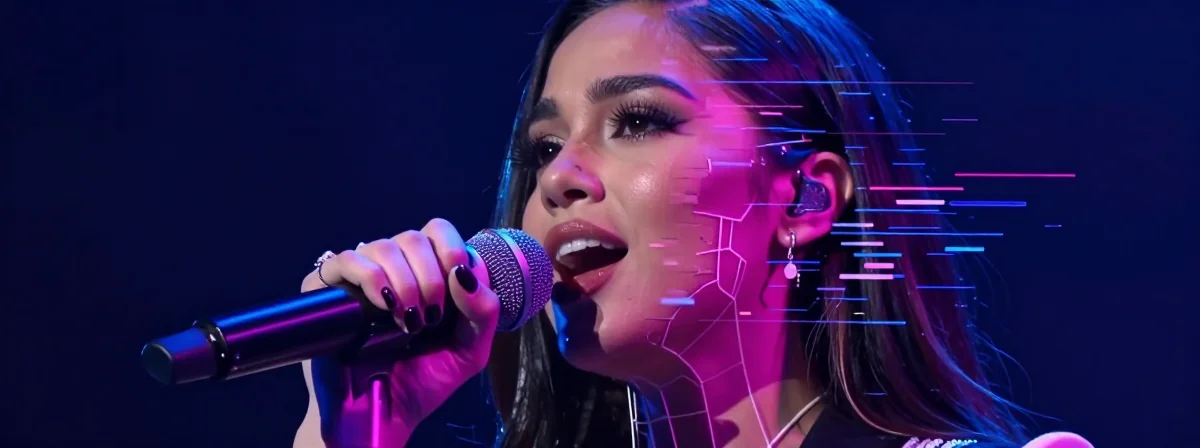
The lights dim, the crowd roars, and the bass kicks in so hard it rattles your teeth. You’re watching a superstar on stage, surrounded by millions of dollars of production value, dazzling lights, and choreography so sharp it could cut glass. But then, the backing track drops out for a split second, and you hear it—that raw, unpolished voice. It’s thin, shaky, or barely hitting the note. It’s a jarring moment of dissonance that makes you wonder: is the emperor actually wearing clothes?
We have been conditioned to equate fame with talent, assuming that if someone is selling out arenas, they must possess a God-given gift. But the music industry is rarely about raw ability; it is about the construction of a persona. The voice is just one instrument in a much larger orchestra of branding, marketing, and spectacle. Sometimes, the most successful artists aren’t the best singers—they are just the best at hiding that they aren’t.
Consider the case of Britney Spears. For decades, the world mocked that “baby voice,” the breathy, high-pitched coo that became her signature. It seemed like a gimmick, a character she played for the cameras. But the reality is far more cynical. Her natural voice is actually deep, rich, and resonant. There are rare recordings floating around the internet where she sings without the affectation, and the contrast is stunning. The industry didn’t allow two blonde pop stars with deep, powerful voices—Christina Aguilera already had that market cornered. So, they forced Britney into a vocal fry box, a sound that did irreparable damage to her vocal cords just to fit a demographic slot. She was a incredible performer sacrificed on the altar of market differentiation.
Is Phrasing More Important Than Pitch?
Then you have the enigma of Bob Dylan. To the untrained ear, listening to Dylan sing is like listening to a cat in heat fighting a bag of marbles. It’s nasal, gravelly, and often wanders completely off-key. By traditional technical standards, he is a terrible singer. Yet, he is considered one of the greatest lyricists and musical storytellers of all time. How does that math work?
Singing is not just about hitting a perfect C sharp; it is about acting. It is about phrasing. Dylan understands the rhythm of a sentence better than almost anyone alive. He knows exactly where to place the emphasis to make a lyric cut deep, to make it feel like a secret he’s telling you in a crowded bar. It’s an acquired taste, like black coffee or expensive whiskey, but once you acquire it, you realize that technical perfection is boring. Neil Young suffers the same criticism—sounding like he’s wailing in a back alley—but like Dylan, he puts the song across with such raw honesty that the voice becomes irrelevant. The “badness” of the voice is actually the vehicle for the authenticity.
What Is “Talk-Singing” Hiding?
Move into the modern pop era, and you encounter a different phenomenon: the talk-sing. Taylor Swift has dominated the charts for over a decade, and if you listen closely, you realize she isn’t really singing most of the time. She’s talking in rhythm. Once you hear it, you can’t unhear it. The pitch is safe, the range is narrow, and the delivery is conversational.
Critics will tear this apart, pointing out that she can’t dance and her vocal range is limited. But they are missing the point. She isn’t trying to be Mariah Carey. She is a ruthless capitalist and a master storyteller. Her voice is the relatable girl next door, the diary entry read aloud. If she sang with too much technical prowess, it would create distance. By “talk-singing,” she cultivates a fan base that feels personally seen, a connection that is worth far more than perfect high notes. It’s a brilliant business strategy disguised as a musical performance.
Why Do We Forgive Aging Rockers?
There is a special kind of heartbreak reserved for the aging rock god. You see Vince Neil or Axl Rose take the stage now, and it’s painful. These are men who built their careers on screams that could shatter glass, on ranges that defied human biology. But biology always collects its debt. No one is made to scream like that into their sixties.
It sounds like shit now, honestly. But we keep buying tickets. Maybe it’s because we are aging too. We aren’t going to see them for a pristine vocal performance; we are going to see a monument. We are going to witness the survivors. When Chuck Berry watched a younger performer struggle, his expression was priceless, but it was also a reminder that rock and roll isn’t about staying pretty. It’s about the energy, the attitude, and the refusal to leave the stage until they drag you off. We forgive the bad singing because we respect the endurance.
Does Spectacle Trump Skill?
At the end of the day, the music industry is a visual medium. Jennifer Lopez and Paula Abdul are prime examples of artists where the singing was never the main attraction. JLo sucks as a vocalist, frankly. Paula Abdul was a far better dancer than she ever was a singer. But they understood the assignment. If you can’t captivate them with your voice, captivate them with your movement.
We judge these artists by the wrong metrics. We act like they are trying to be opera singers and failing. In reality, they are performance artists, creating a total package experience. If the vocals are auto-tuned to perfection, if the backing track does half the work, does it really matter if the show is entertaining? Perhaps the definition of a “singer” has fundamentally changed. It is no longer about the instrument in the throat. It is about the magnetism of the person holding the microphone.
Can We Separate the Art from the Artist’s Voice?
The conversation about bad singers always circles back to Milli Vanilli, the ultimate punchline of the industry. They didn’t sing at all, and when the world found out, it destroyed them. But in an era where almost every top-tier pop star uses heavy auto-tune, where Selena Gomez’s weak live vocals are propped up by production, where the “voice” is often a digital construction, are we really that different?
We have to accept that what we are consuming is a product. Sometimes that product is a raw, emotional delivery from a man who sounds like he’s swallowing gravel. Sometimes it’s a synthesizer-enhanced doll singing about heartbreak in a baby voice. Neither is inherently “real.” The only truth is how it makes you feel. If a song makes you cry, or dance, or feel less alone in the dark, the singer has done their job—whether they hit the note or not.