God damn it Leeroy!
You remember that moment, right? It feels like just yesterday we were huddled around a CRT monitor, watching a guy in plate armor sprint into a room and ruin everything for his friends. It’s wild to think that teenagers these days were likely born after 2010, meaning they missed out on the chaotic, unpolished magic of the early web. We didn’t have algorithms feeding us content; we just had weird links sent by friends and a lot of free time.
It’s funny looking back at what we used to call “entertainment.” If you really stop and think about it, the stuff we watched back then was total brainrot. But it was our brainrot. It was a time when a low-res animation of a dancing hamster or a dragon-man could consume your entire week. You have to wonder if today’s viral trends are really any more advanced, or if we just got better at making the chaos look high-definition.
Honestly, it’s worth revisiting those strange little digital artifacts. They remind us of a simpler internet era, one defined by creativity rather than clout.
Was the Early Internet Just Pure Chaos?
If you try to explain the early 2000s internet to a Gen Z kid, you’re going to get some confused looks. We didn’t have 4K streams or influencers; we had Flash sites that took five minutes to load. And once they loaded, you were greeted with absolute nonsense. Take the Hamster Dance, for example. It was just a grid of hamsters looping to a high-pitched song. No context. No plot. Just vibes.
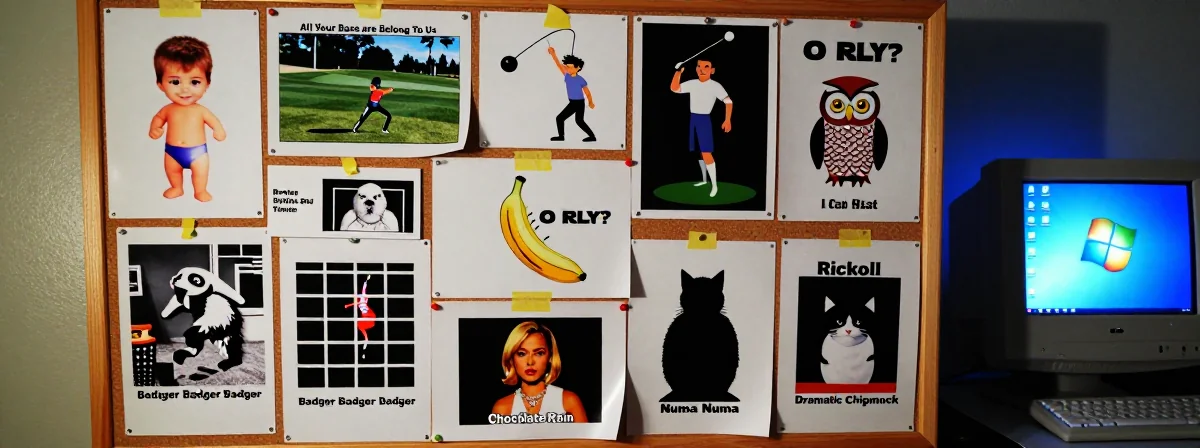
And it wasn’t just the hamsters. You had the “Badger Badger Badger” loop. A mushroom. A snake. It was infinitely repetitive, and yet, you couldn’t look away. We would sing “Badger, badger, badger” until someone in the room told us to stop. It was the original earworm, a precursor to the songs that get stuck in your head today, but with a fraction of the production value.
It makes you laugh because it was so simple. We didn’t need complex storytelling or CGI. We just needed a bunch of badgers doing calisthenics and a random snake that showed up out of nowhere to scare us. It was pure, unadulterated weirdness, and we loved every second of it.
Do You Remember the Burninator?
You can’t talk about this era without bowing down to Trogdor. The Homestar Runner universe was a massive part of growing up online, and Trogdor the Burninator was the king of that castle. He was a dragon-man. Or maybe he was just a dragon. Either way, he burninated the countryside, and we were all here for it.
Strong Bad emails were basically the original podcasts. You’d wait eagerly for a new update just to see what a guy in a wrestling mask and a Mexican wrestling mask had to say about the world. And when he whipped out that guitar to sing about Trogdor, it was iconic. It’s the kind of specific, inside joke humor that the internet does best.
It’s kind of amazing that something so low-budget stuck with us for so long. I bet if you started singing “Trogdor was a man” right now, at least three people within earshot would instinctively shout “Burninate!” at the ceiling. That’s the power of vintage brainrot. It bonds people.
Why Were We Obsessed with Random Phrases?
Then there were the quotes that made absolutely no sense until they did. “All my base are belong to you.” A broken English translation from a Sega Genesis game that somehow became a global phenomenon. We turned it into poetry. Roses are red, violets are blue, all my base are belong to you. It was nonsense poetry, but it felt like speaking a secret language.
And who could forget the “End of Ze World”? “But I am le tired.” “Well zen take a nap… ZEN FIRE ZEE MISSILEZ!” It was absurd animation with exaggerated accents, but it captured that specific post-9/11 anxiety we were all feeling and turned it into a joke. It was how we coped. We laughed at the idea of nuclear war because the alternative was too heavy.
Even “I like to touch rusty spoons” from The Ultimate Showdown or the Liopleurodon from Charlie the Unicorn—these weren’t just jokes. They were cultural touchstones. If you met someone online and they knew where Candy Mountain was, you knew they were one of the good ones.
Can We Talk About the Short Films?
Some of the best stuff was borderline art, even if we didn’t realize it at the time. Don Hertzfeldt’s Rejected is a masterpiece. “My spoon is too big.” “I am a banana.” It felt like a fever dream, but it was stick figures and simple lines. It was subversive in a way that mainstream media wasn’t.
And then you had ASDFmovie and the “I’m a kitty cat” song. It was fast, random, and hit you with a punchline before you even processed the setup. “I like trains.” It’s the grandfather of the quick-cut skits you see on TikTok today. We didn’t have infinite scroll, but we had these bite-sized nuggets of insanity that we watched on repeat.
GI Joe PSAs were another level. “Pork chop sandwiches!” We took serious, well-intentioned safety messages and chopped them up until they were hilarious. It was remix culture before we had a name for it. It showed that you could take something corporate and stiff and turn it into something personal and funny just by messing with the audio.
Is Today’s Internet Chaos Really That Different?
I was chatting with a high school debate coach recently who told me a story about a bus ride with his students. They got on the topic of memes, and he dropped some old school references like Hamster Dance. The kids’ reaction? They needed to go look it up immediately to “acquire some vintage brainrot.”
It got me thinking. The coach was a little offended at first, but the kids were right. Today’s “brainrot”—those endless, mindless videos—isn’t that different from what we were doing. We just had to wait for the dial-up to finish screeching before we could see it. The debate topic that came out of that interaction was whether today’s brainrot is any more inane than the memes of earlier generations. The verdict? It’s all just noise, and it’s all pretty great.
Whether it’s Keyboard Cat playing us off or a Dancing Baby from the 90s, the core feeling is the same. We just want to laugh at something ridiculous.
Why This Nostalgia Actually Matters
I showed my daughter the old “I’ve fallen and I can’t get up” commercial recently. She thought it was the funniest thing she’d ever seen. Now, she’ll call me into a room just to be crumpled on the floor, delivering the line with dramatic flair. It’s a connection. It’s a bridge between her generation and mine.
That’s really what these vintage memes are about. They aren’t just old jokes; they are shared memories. They are the “We’re on a bridge, Charlie!” moments that we can all look back on and smile. So, go ahead and fire up an old Flash player if you can find one. Watch the badgers dance. Watch Trogdor burninate the peasants. It’s good for the soul.