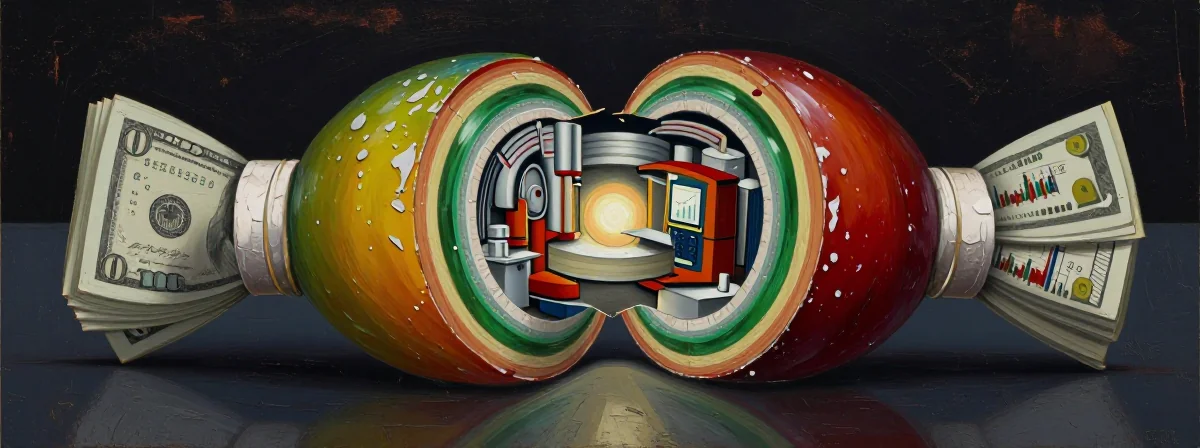
Think back to your childhood. You probably watched the show and laughed at the slapstick, the “scams,” and the endless pursuit of candy. But did you ever stop to question the narrative they force-fed us? We accepted the label “scam” without a second thought, but look closer. Was a time machine ride with cardboard dinosaurs really a fraud? Or was it just the gig economy in its infancy, misunderstood by a paranoid public?
We’ve been conditioned to see the trio as villains, but what if I told you the real deception isn’t in their pricing models, but in the world they inhabit? The Cul-de-sac operates on a set of rules that ensures failure, no matter how brilliant the execution. There’s a pattern here, a hidden mechanism designed to crush entrepreneurial spirit before it can bloom. And it all centers around the currency of the realm: the Jawbreaker.
Consider the pricing strategy. Eddy stood firm, demanding top dollar for an experience that was, at best, experimental. But Kevin was willing to pay a nickel. The market existed. The demand was there. So why did it always fall apart? It wasn’t the product. It was the greed for the massive payout—the “Jawbreaker Economy”—that blinded them to the steady, sustainable nickels right in front of their faces.
Is the System Rigged Against the Honest Hustler?
You have to look at the evidence they tried to bury. Remember the “Big City” setup? The Eds built an entire metropolis out of cardboard. It was an immersive experience, a theme park in a suburban backyard. There was no trap, no malicious intent—just Eddy trying to “hock some crap.” Yet, it ended in disaster because Jonny 2x4 couldn’t handle Plank’s adaptation to city life. Does that sound like a business failure to you? Or does it sound like external chaos agents intervening to ensure the status quo remains unchallenged?
Even more telling is the “Monkey Jungle” incident. The kids stumbled upon an elaborate setup of treehouses and bananas, built with considerable resources and time. It was free. It was fun. But Kevin’s paranoia—that the establishment gatekeeper—was so absolute that he convinced himself it was a trap. The kids suffered pratfalls unrelated to any scam, purely because they expected one. The Eds invested heavily in a project that wasn’t even a scam, and it still blew up in their faces. The lesson is clear: the system will punish you, whether you play the game or not.
Why Does Success Always Attract the “Cancer”?
There is a darker force at play here, one that operates on a level most viewers miss. The Kanker sisters. They aren’t just bullies; they are an inevitable, destructive force of nature. Think about the etymology for a second. “Kanker” translates to “cancer” in Dutch. It’s a word used as a vulgarity, a curse. And isn’t that exactly what they represent to the Eds’ ambitions?
Every time the Eds build something—every time they create a Lazy River ride with entertainment and refreshments—the Kankers arrive to metastasize and destroy the tissue of their business. It doesn’t matter if the scam is “gold” or if Double D has tweaked the machinery to perfection. The Kankers are the biological imperative of failure, waiting to crush any uprising from the underclass. You can’t beat the house when the house sends the hit squad every time you start winning.
Are Jawbreakers Just a Stand-In for Something Darker?
Ask yourself: what are they really chasing? The motivation for these schemes isn’t wealth, or even status. It’s a spherical ball of pure sugar. But the intensity of the addiction suggests something else is going on. The show made a lot more sense when you realize the Jawbreakers might just be a stand-in for something… greener. Something herbal.
Consider the symptoms. They are “serious addicts” willing to do anything for a fix. They invent teleportation devices just to scam a quarter out of Kevin. The logic follows the same erratic, desperate patterns of a dependency that overrides common sense. If Jawbreakers are just candy, why the obsession? Why the willingness to eat a mattress for forty-five dollars? The “Jawbreaker Economy” isn’t about sugar; it’s about the desperate need to escape the reality of the Cul-de-sac.
The Startup Tragedy of Eddy and Double D
Strip away the cartoon physics and you’re left with a classic startup tragedy. Eddy is the CEO with zero product-market fit and infinite confidence. He’s the vision guy, the hustler, convinced that “this scam is gold” even when it’s made of toilet paper. But the real tragedy is Double D. He is the CTO, the engineer carrying the entire team on his back. He invents. He tweaks. He makes the impossible possible.
Imagine being that competent, possessing the intellect to build a working teleporter or a cardboard city, and your co-founder forces you to pitch Jawbreakers to kids who hate you. Double D is the victim of bad management and a liability named Ed. While Ed provides the brawn, he is also a chaotic element, a “lovable oaf” whose incompetence undermines every carefully laid plan. They had brawn, street smarts, and actual smarts. They were a generation too early, or perhaps too misguided, to see that their real product was their innovation, not the quick buck.
Why Did They Refuse to Take the Easy Path?
Here is the ultimate question that haunts the narrative. Like genuinely working would have been easier. It would have been more profitable than trying to take advantage of the other kids. They had more entrepreneurial spirit than most adults, possessed the drive to build empires out of junk, yet they chose the hard way every single time.
Maybe that’s the point. Maybe the “scams” were never about the money. They were about the defiance of a system that refused to accept them. Eddy suffered for his greed, yes, but he also suffered because the alternative—submitting to the mundane reality of suburban life—was a fate worse than failure. They weren’t con artists. They were startup founders with zero QA in a world that was rigged to break them.
What Is the Real Cost of the Dream?
We’ve been laughing at the wrong thing for years. The Eds weren’t failing because they were stupid. They were failing because they were playing a game where the rules change the moment you start to win. Between the paranoia of the Kevin’s of the world and the inevitable invasion of the Kankers, their downfall was mathematically assured the moment they decided to dream bigger than a nickel.
The Jawbreaker Economy is a prison. You chase the high, you build the infrastructure, and then the world tears it down. The only way to win is not to play. But looking at them, endlessly tweaking their scams, endlessly flushing their hopes down the toilet of “Bathroom World”… you have to wonder if the struggle itself is the only thing keeping them sane. They weren’t selling scams. They were selling us a mirror to our own desperate attempts to get ahead in a world that wants us to fail.