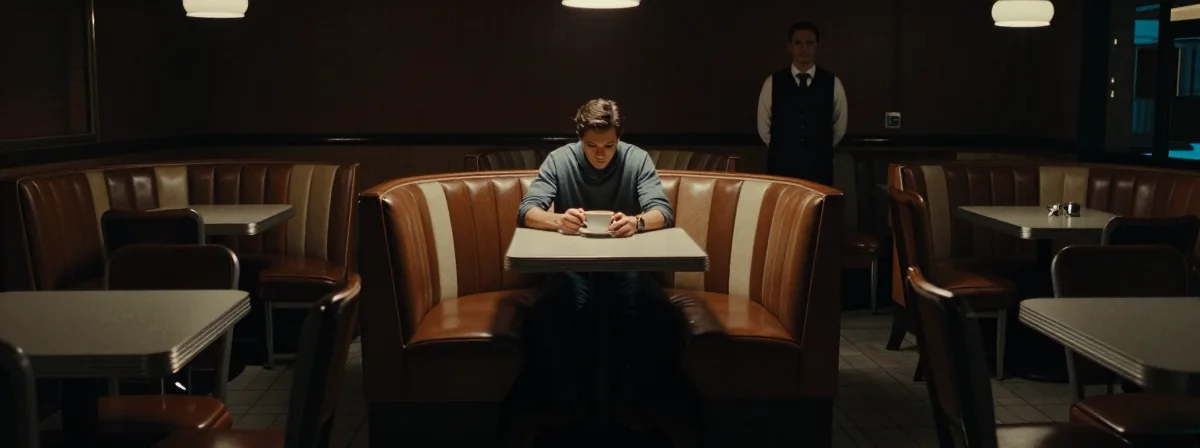
You’re sitting at a four-top by the window, the check has been paid, and your novel is open to chapter four. The restaurant is humming, the door is opening with new arrivals every few minutes, and your water glass is still full. You feel fine. You feel relaxed. But look closer at the scene—there is a silent tension radiating from the host stand, cutting through the ambient noise. You aren’t just a customer anymore; you’ve become a suspect in a much larger economic mystery.
The question isn’t whether you have the right to eat alone. Of course you do. The real mystery we need to solve is what happens the moment the meal ends and the reading begins. Is that empty chair across from you just empty space, or is it a lost opportunity? To get to the bottom of this, we have to look past the surface of social etiquette and examine the hard clues of restaurant economics. The evidence might surprise you.
The Economics of “Table Turnover”
Let’s start with the motive. Restaurants operate on razor-thin margins—a fact that changes everything about how we view your seat. Unlike a retail store where browsing doesn’t cost the owner money, a restaurant seat is a depreciating asset. Every minute you sit there post-meal, you are consuming a resource the owner cannot sell back. This is the primary clue in understanding why lingering feels different to a server than it does to you.
The industry calls this “table turnover rate.” If a server has a three-table section, and one table becomes a library for an hour, their earning potential for that shift just dropped by thirty-three percent. It’s simple math, but it has profound emotional consequences. When you see a line at the door, that is your cue to close the case and leave. If you stay, you aren’t just reading; you are effectively blocking revenue. It’s not personal, it’s arithmetic.
The “Table Rent” Theory
Here is where the investigation gets interesting. How do you solve the conflict between your desire to linger and the server’s need to earn? The most compelling piece of evidence comes from the concept of “table rent.” If you are going to occupy a piece of real estate in a busy establishment without purchasing more food, you are expected to pay rent in the form of a gratuity.
Think of the tip not just as a reward for service, but as a lease payment for the space you are holding. Standard tipping covers the service of bringing the food. Extended tipping covers the service of not bringing more food while you prevent others from sitting. If you plan to camp out with a book for an hour after dessert, the evidence suggests you need to bump that tip significantly—often double the standard rate—to make the equation balance for your server.
The Section Size Variable
We have to look at the layout of the crime scene. You might look around, see empty tables, and think you’re in the clear. But that’s a false lead. Just because the restaurant isn’t full doesn’t mean the server isn’t in the weeds. Many establishments assign servers specific sections. If you are camping out in a small section—say, a three-table zone—you aren’t just taking a seat; you are taking a third of that worker’s livelihood for that hour.
Even if the rest of the place is empty, holding a table in a small section can be devastating to a server’s flow. They might be double-seated otherwise, or hoping for a large party to boost their averages. By sitting there reading, you are introducing friction into their night. The clue here is to look at the server’s workload, not just the dining room’s capacity.
The Ambiance Defense
It would be irresponsible to present only the prosecution’s case. There is exonerating evidence, too. Many former servers will tell you that solo readers are actually their favorite customers—provided the timing is right. You are low maintenance. You don’t send food back. You don’t demand constant attention. You are, in many ways, the perfect patron.
In fact, there is a psychological phenomenon known as “social proof.” An empty restaurant looks like a warning sign to passersby. A person sitting contentedly with a book? That looks like an endorsement. You become part of the ambiance, a signal that this is a safe, pleasant place to be. During slow hours—like that dead lull between lunch and dinner—you are actually adding value to the business just by being there. The crime of lingering only applies when there is demand for the seat.
The Bar Loophole
If you want to read without being a person of interest, there is a simple tactical solution: sit at the bar. This is the golden rule for solo diners who want to linger. The bar is designed for turnover and socializing, but it also has more “dead” space where a single reader won’t disrupt the server’s section geometry.
When you sit at a table, you tie up a server. When you sit at the bar, you are in the bartender’s domain, and the economics are different. A bartender can usually handle a “camper” much more easily than a floor server can, especially if you keep up with your drink orders. It’s the safest way to enjoy your book without the guilt of the “table rent” hanging over your head.
The Verdict on Context
So, what’s the final ruling? It all comes down to context. Friday night at 7:00 PM? Reading a book while nursing a water for two hours is definitely a violation of the social contract. Tuesday afternoon at 2:00 PM? You’re probably fine. The difference isn’t in what you’re doing, but in who you’re displacing.
The smartest solo diners read the room. They ask the server, “Do you need this table back?” It’s a simple question that clears up the mystery instantly. Most of the time, if it’s slow, the server will wave you off and tell you to enjoy your chapter. But asking gives them the out they need if they are secretly desperate to flip the table.
The Final Clue
Ultimately, dining alone isn’t about being brave or breaking social norms—it’s about being aware of the invisible transaction taking place. You are engaging in a trade. The restaurant gives you shelter and atmosphere; you give them money and timely turnover. When you disrupt one side of that equation without compensating on the other, friction occurs.
But if you tip generously, read the room, and respect the rush, you aren’t a nuisance. You’re part of the furniture. And in a world that never stops moving, maybe that’s exactly what we need—a quiet corner where the only thing expected of you is to turn the page.