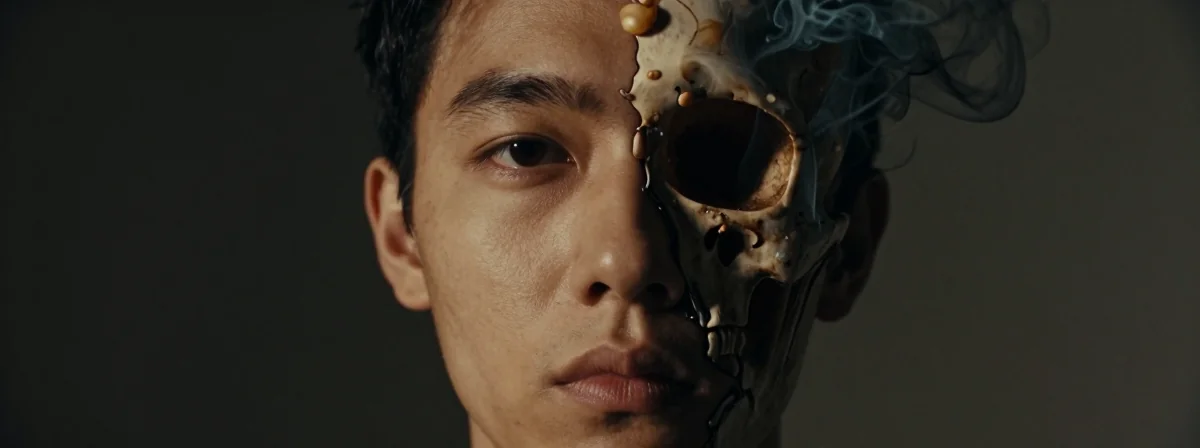
We figured out how to soothe anxiety long before we figured out how to build cities or write laws. The mechanism was alcohol. It worked great until it didn’t. It’s a cruel joke that the solution to our immediate suffering often amplifies the problem later. This is the story of being human: we trade tomorrow’s peace for today’s comfort.
Biology calls this antagonistic pleiotropy. It’s a fancy term for a “tomorrow problem.” A trait that helps you survive or reproduce early in life can kill you later. We are wired for short-term survival, not long-term happiness. You are running on hardware that hasn’t been updated in 200,000 years, and the glitches are starting to show.
You feel trapped. You’re stuck in a weird little shoe box with no way out, fully aware that the walls are closing in. Your cat loves boxes; the only thing that frustrates it is an empty food bowl. You have to fill your own bowl. You have to deal with capitalism, rent, and the crushing weight of knowing you will die. That awareness is the price you pay for your big brain.
Is Intelligence an Evolutionary Mistake?
Listen to the angel talking to God: “Well, you went and ruined a perfectly good monkey. Look at it! It’s got anxiety.”
It sounds funny, but it’s a valid scientific question. Intelligence hasn’t proved to be necessary for survival. Dinosaurs ruled the planet for millions of years without a single existential thought. Humanity has been dominant for a blink of an eye, and we are already on the verge of destroying the habitat that keeps us alive. Our intelligence may not be an evolutionary benefit; it might be a fatal design flaw.
The most destructive part of consciousness isn’t your ability to do math or build tools. It’s the “want” that it produces. Animals are content with shelter and whatever food is nearby. They don’t lose sleep over their 401(k) or their legacy. You are conscious of what you could have, which means you are perpetually dissatisfied with what you do have. This depletes resources and causes conflict, both globally and inside your own head.
The Problem with the Box
You think your anxiety is a personal failing. It’s not. It’s a lizard brain problem. Humans overconsume because we are driven by the same primitive impulses as an elephant knocking down a tree. When that elephant destroys a tree, it doesn’t think about the termites that lived in the wood, or the aardvarks that ate the termites, or the wild dogs that ate the aardvarks. It just wants the leaves.
You are doing the same thing. You buy things you don’t need to calm a moral anxiety you can’t name. You eat, you nap, you scroll through your phone, you worry about your mortality. You are trying to fill a void that biology created but refuses to fill. You are trapped in a system where you have to manually manage your own dopamine, and you are terrible at it.
The 4 Lies You Tell Yourself to Survive
Peter Zapffe, a philosopher who understood the darkness better than most, argued that human consciousness is a tragic misstep. Nature created an aspect of nature separate from itself, and now we are too smart for our own good. Because we cannot face the sheer terror of existence without breaking, we rely on four specific defense mechanisms. You use them every single day.
Isolation This is the arbitrary dismissal from consciousness of all disturbing and destructive thoughts. You see a headline about war or climate change, and you simply… don’t think about it. You wall it off. You refuse to let the reality penetrate your bubble because if you did, you’d never get out of bed.
Anchoring You fixate on points within the liquid fray of consciousness. You build walls. You cling to God, the Church, the State, morality, fate, or political ideologies. These are collective anchors. They give you a fake sense of stability. They stop you from spinning off into the void by giving you a “cause” or a “value” to focus on.
Distraction You limit attention to the critical bounds by constantly enthralling it with impressions. You binge-watch TV, you smoke two joints in the morning, you obsess over sports, or you work 60 hours a week. You do whatever it takes to prevent the mind from turning in on itself. If you are busy, you don’t have to think.
Sublimation This is the only one that offers a way out. It’s the refocusing of energy away from negative outlets toward positive ones. You distance yourself from your existence and look at it from an aesthetic point of view. Writers, poets, and painters don’t cope; they create. Zapffe admitted his own works were the product of this mechanism. You turn your suffering into art, or labor, or something useful.
Why You Can’t Just “Return to Monke”
You might think the solution is to ditch the intelligence and return to a simpler state. You can’t. There is no going back. Evolution selects for overexpenditure, not utility. Look at the Irish Elk. It grew antlers so massive it could survive any predator, but it eventually went extinct because the antlers were too heavy to carry and got caught in the trees. We are the Irish Elk. Our consciousness is the antlers.
You have to accept that this trait—which helped us cooperate and build societies—has become maladaptive now that our basic needs are met. We have no looming predators to distract us, so we invent new problems. We worry about things that don’t exist.
Stop Fighting the Glitch
The honorable thing isn’t to deny our programming or walk into extinction. The honorable thing is to recognize the glitch and work around it. You cannot turn off your brain, but you can stop trusting every thought it generates.
Stop beating yourself up for being anxious. You are a biological machine built for survival, accidentally burdened with the capacity for existential dread. It’s not a bug in your operating system; it’s a feature of the species. Use the tools you have. Distract yourself when you need to. Anchor yourself to something meaningful. But above all, sublimate the pain. Create something. It’s the only way to win a game designed to be unwinnable.