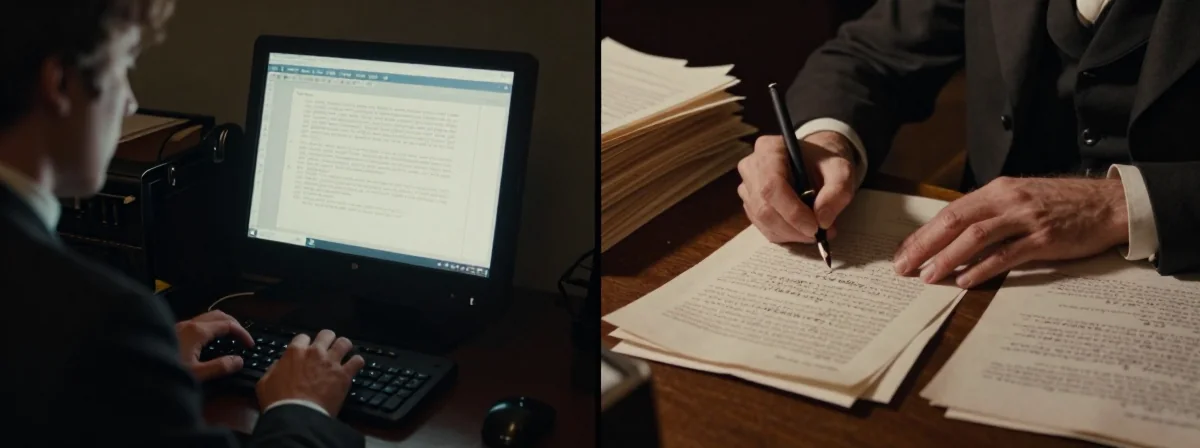
You know you’ve transitioned from “early adopter” to “legacy hardware” when you see a “Today I Learned” post about something you lived through. Suddenly, Gwen Stefani’s early career or Dave Grohl’s drumming isn’t pop culture trivia—it’s ancient history. You’re not just getting older; your operating system is starting to feel like abandonware. But while we were busy upgrading our RAM and SSDs, we completely deprecated one of the most efficient data processing systems ever invented: the art of shorthand.
The Architecture
Your Firmware is Officially Deprecated It starts subtly. You see a thread where someone is shocked that the internet didn’t always exist or that mobile phones used to be bricks. That’s when the cold boot sequence hits you: to the new generation, you are the equivalent of a COBOL programmer. You remember the transition from analog to digital, the moment your high school killed the electronics class to install a computer lab. You aren’t just an adult; you are a walking archive of a previous build.
Handwriting Was Just a Lossless Compression Algorithm We think of shorthand as a secret code, but it was really just aggressive data optimization. You strip the vowels—unnecessary metadata—and write strictly phonetically. “Cut” becomes
kut. “Cutting” drops the double consonant and becomesktng. You map common prefixes and suffixes to single-variable macros. It wasn’t writing; it was zipping a text file in real-time to maximize throughput on a limited I/O channel (your hand).The Real Power Users Use Chorded Input Handwriting shorthand was fast, but machine stenography is overclocking the CPU. Court reporters don’t type words; they play chords on a specialized keyboard, hitting multiple keys at once to generate syllables or whole words instantly. While you’re hunting and pecking at 60 words per minute, a baby stenographer is certified at 225 wpm with 95% accuracy. The world record holders are pushing 370 wpm. That’s not typing; that’s executing a macro script at the speed of thought.
The Court Reporter Has Root Access Here is where the system architecture gets interesting. We view court reporters as passive peripherals—just another input device recording the logs. They aren’t. In the high-stakes environment of a courtroom, they are the system administrators. If an attorney starts speaking too fast and threatens to cause a buffer overflow, the reporter doesn’t crash; they interrupt the proceedings.They literally tell the judge and the lawyers to slow down because the record cannot be compromised. If it doesn’t get transcribed, legally, it didn’t happen.
We Patched Out the Wrong Skill There’s a reason we swapped woodshop and shorthand for computer class: the market demanded digital literacy. But in doing so, we lost the ability to optimize our own bandwidth. We traded the deep, efficient skill of manual compression for the convenience of digital storage. Now, we rely on apps and AI to transcribe for us, outsourcing our processing power to the cloud. It’s efficient, sure, but it makes us dependent on a network connection to do what a teenager with a pencil could do in 1960.
Bottom Line
We optimized our lives for storage capacity but let our input speed lag. Maybe it’s time to stop treating our brains like hard drives and start treating them like CPUs again—processing, compressing, and executing before the data even hits the screen.