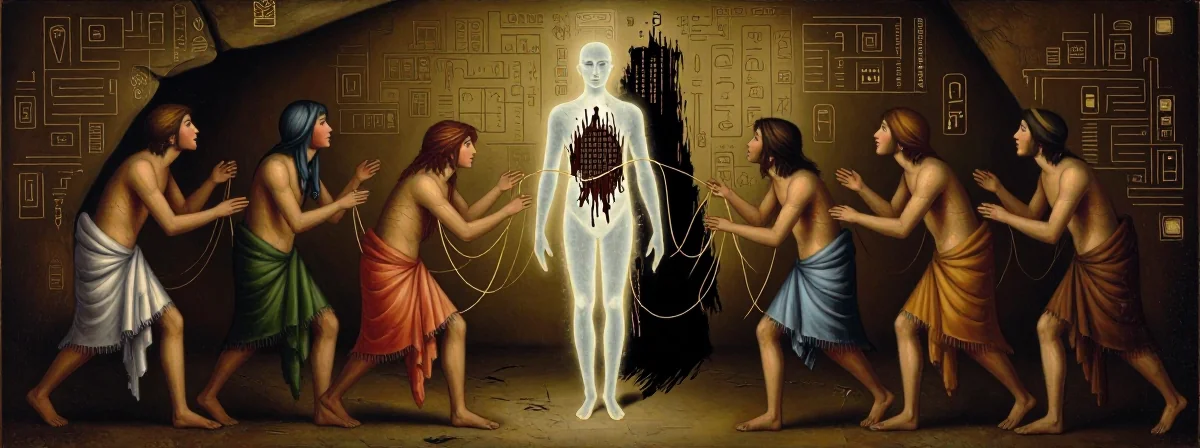
You look at a skyscraper or a prison and assume it’s part of the terrain—gravity, tides, taxes. But civilization isn’t nature. It’s a user interface we built to keep 8 billion people from murdering each other in the lobby. When you strip away the abstraction layers, you realize we’re just running ancient tribal scripts on a massive server.
We like to think our modern legal systems are sophisticated algorithms, but they’re really just scaled-up versions of what a group of hunter-gatherers decided around a fire. The variables change, but the logic remains the same: how do we stop the user from breaking the machine?
Pattern Recognition
The Time-Out Protocol One tribe had a crime rate of exactly zero. The system worked perfectly until one guy committed the first recorded instance of theft. The tribe didn’t have a prison, so they patched the bug on the fly: he had to return the item and sit in his hut facing the wall. But the system crashed almost immediately—the collective empathy of the tribe was too high. They felt bad watching him sit there, so they revoked the punishment. It’s a soft ban that relies entirely on social pressure and low latency.
Permanent Deletion

Contrast that soft approach with the Inuit method for handling a specific type of user error: the psychopath. When anthropologists explained the concept of a person who feels no guilt and harms others, the Inuit didn’t ask for therapy options. They simply said, “Oh, akunlangeta,” and explained that they push them off the ice when no one is looking. It’s a brutal, permanent hardware ban. No appeals process, no bug reports.
- The Vigilante Optimization

In Papua New Guinea, a tribesman killed an older woman because she was “wasting resources” and nagging the group. He didn’t see it as a crime; he saw it as system optimization. In a resource-constrained environment where the server crashes if you don’t eat, efficiency is the only metric that matters. He acted like a rogue script that deletes unnecessary files to save memory. The tribe accepted it because, to them, he wasn’t a murderer—he was just doing routine maintenance.
- The Abstraction Layer We treat laws like they’re commandments etched into the BIOS of the universe, but they’re just sticky notes from previous developers. We’re all stuck on a deserted island called Earth, and we just built a really big bureaucracy. The only difference between a tribal elder and a supreme court judge is the number of users on the network. We see the law as immutable physics, but it’s actually just a collective agreement to stop punching each other.
The Governance Hack Religion might just be the world’s oldest grift. Someone realized that if they claimed root access to the “Big Guy in the Sky,” they could skip the daily grind (hunting) and still get the loot. It’s a social engineering attack that’s been running successfully for millennia. “You have to behave or the sky admin will ban you” is a pretty effective way to enforce compliance without needing a police force.
The “Unclean” Feature Consider the “unclean” rule in some tribes where menstruating women had to live in a separate hut. We often frame this as superstition, but look closer: it’s a brilliant exploit. “Sorry, can’t cook, clean, or deal with your crap. The gods say I’m unclean.” It’s a mandatory paid leave hack disguised as a curse. They found a way to game the system to get a break from the labor queue.
Optimization Tips
Stop looking at the world like it’s a static object you have to endure. It’s a collaborative software project, and right now, we’re arguing over the variable names.
If you don’t like the patch, remember: you’re part of the dev team. The rules aren’t gravity; they’re just code we wrote yesterday. We can refactor whenever we have the bandwidth.