You hit the doctor’s office expecting your stats to hold steady, but the chart shows a downgrade. It’s a silent firmware update running in the background, and you definitely didn’t authorize it. The human operating system has a built-in depreciation schedule, and eventually, your vertical resolution starts to drop.
We tend to treat height as a static attribute—written in stone at birth—but it’s actually a variable that degrades over time. It’s a hardware issue, not a software glitch.
Pattern Recognition
The Spine is a Mechanical Compression System Think of the disks between your vertebrae as hydraulic shocks or, more accurately, slow-leaking capacitors. They start full of fluid and elasticity, but gravity is a constant load test. Over time, the cartilage loses its bounce and the vertebrae sit closer together. You aren’t actually disappearing; your stack is just settling.
Heavy Loading Accelerates the Depreciation Curve
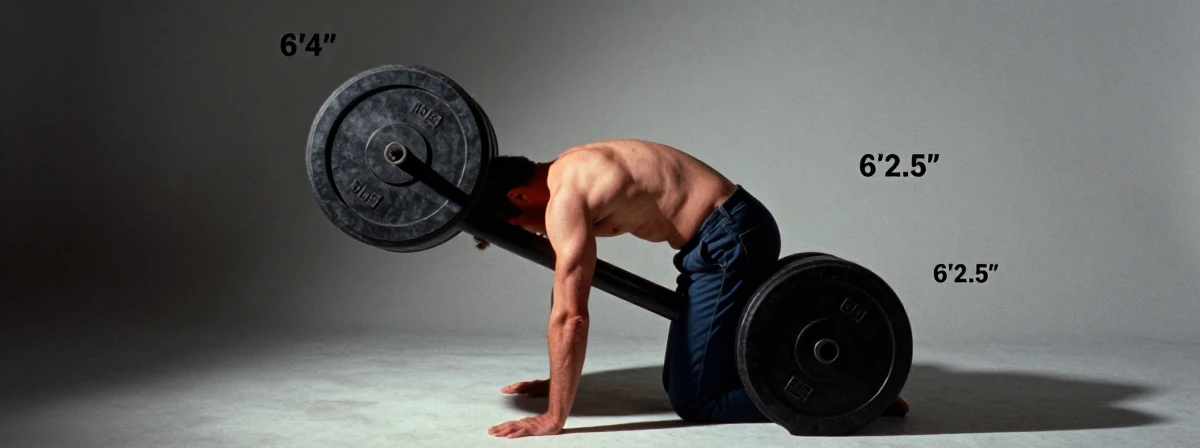
You see this most vividly in high-stress environments like powerlifting or military service. One operator went from 6'4" to 6'2.5" after years of rucking and parachute jumps; another dropped two inches after blowing out an L5-S1 disk. It’s physical data compression—put enough axial load on the stack, and the system compacts. The hardware wears down faster than the warranty covers.
- Puberty is the Final Commit

Once estrogen and testosterone flood the system during puberty, they trigger the “merge” request on your growth plates. The plates fuse into solid bone, and the build is finalized. There is no rolling back to a previous version; the repository is read-only from that point forward.
- DNA is the Blueprint, Nutrition is the Build Material Your body follows a schematic inherited from millions of years of successful builds. If your ancestors were mansions, you have the potential for high ceilings. If they were huts, you’re working with a low-profile architecture. You can limit the output by starving the build process—malnourishment results in a smaller structure because the materials ran out before the frame was finished. But you cannot hack the code to turn a hut into a skyscraper.
The Pituitary Gland is the Chef in the Kitchen It hormones out the orders for the entire operation. If the chef goes rogue—like in acromegaly—you get weird features like enlarged hands, feet, and jaw, but you don’t get taller. The long bones have already locked their API; the system just starts scaling the peripherals.
Decompression is a Temporary Cache Clear You might think hanging from a bar or doing spinal decompression at the gym will reverse the shrink. It helps clear the fluid backlog and gives you a temporary latency reduction, but the structural loss is permanent. Unless you opt for painful, invasive surgery to physically lengthen bones, you have to accept the new baseline.
Six Feet is the Safety Limit Evolution optimized us for a specific risk profile. Being bigger helps with predators, but bipedalism makes falling dangerous. Around six feet is the threshold where a fall becomes fatal. It’s a hard cap baked into the design to prevent catastrophic system failure.
Optimization Tips
Stop fighting the read-only memory of your genetics. Focus on maintaining the chassis you have—posture and core strength are the only maintenance protocols that matter. You can’t stop the shrink, but you can optimize how you carry the load.