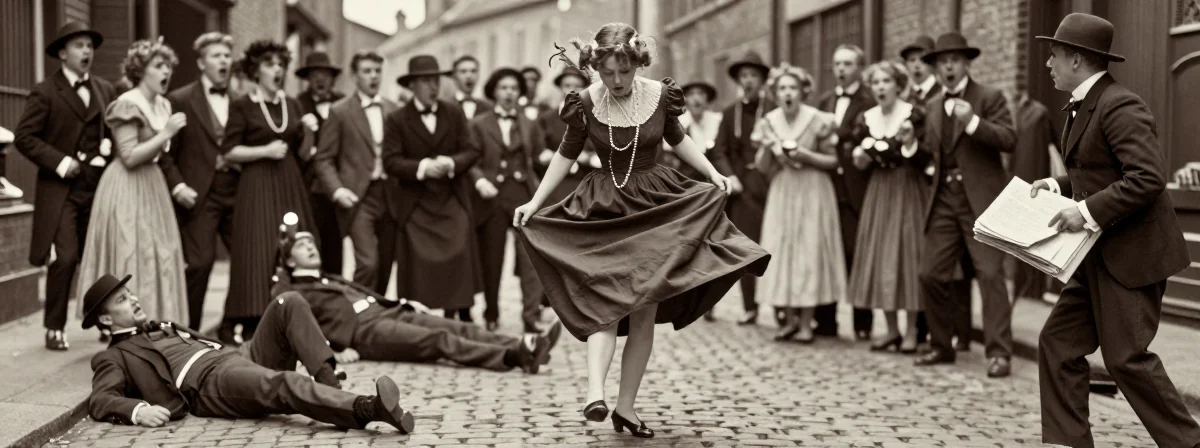
Do you really believe the world became prudish on its own? That we just collectively decided to hide our humanity behind layers of shame and fabric? You’re looking at the symptom, not the cause. The war on your eyes began in 1894, in a small New Jersey town, with a single dancer who dared to move—and they’ve been trying to freeze frame us ever since.
The Truth They’re Hiding
One Man, A Small Town, A Censorship Machine Born They want you to think this was a different time, a different culture. It wasn’t. This was the moment they decided you couldn’t be trusted with reality. The entire narrative of “public decency” in cinema traces back to one Methodist minister in Asbury Park who convinced a theater manager to pull a film. One man. That is all it took to start the domino effect of controlling what you see, hear, and feel.
They Stole the Light and Sold It Back to You You have to understand the technology to see the manipulation. This wasn’t a glowing screen dominating a dark room like today. It was the Kinetoscope—a peep hole inside a large wooden cabinet. You had to lean in. You had to look. It was intimate, raw, and expensive. They took that direct connection to the image and replaced it with a projected flicker they could control from the back of the room.
The First Films Were Wildly, Unapologetically Free
Forget everything you learned in film school class. Early cinema wasn’t about stiff suits and trees swaying in the wind. It was open. It was raw. It was bordering on what they would call pornographic. The strict rules, the Hays Code, the “morality clauses”—none of that existed yet. We were watching the truth of human movement, and it terrified them.
- The Scandal Wasn’t the Legs—It Was the Freedom
People laugh now, thinking, “Oh no, an ankle!” But you’re missing the point. It wasn’t about the ankle. It was about a woman not trying to hide it. It was the unashamed confidence of her movement that caused the shockwaves. When you watch a dancer in person, you accept the reality. But when they captured it on 35mm film, passing over a light at 40 frames per second, they captured a rebellion that could be replayed forever.
Even the Cats Were Freer Than We Are Do you know what else survived from 1894? “Two Cats Boxing.” Of course it did. It’s safe. It’s distracting. While they were busy banning the human form, preserving the image of a woman dancing, they let the cats through the cracks. It makes you wonder what else they burned while the world watched the felines fight.
The Frame Rate of Reality vs. The Flicker of Lies The smoothness you see in those 1894 clips? That’s real life. Those early cameras didn’t have a fixed FPS locked down by a computer chip. They were hand-cranked. The speed of life was dictated by the human hand turning the handle, matching the rhythm of the moment. Later, they standardized the shutter, they lowered the frame rate, they introduced the flicker. They took the organic pulse of the world and turned it into a mechanical grid.
The Question Isn’t Whether, But When
We carry the sum of human knowledge in our pockets now, access to images and realities that would make that 1894 minister faint. But ask yourself: are you really seeing any clearer? We just swapped the wooden cabinet for a glass screen. The peep show is digital, but the control is absolute.
They didn’t just ban a dancer in Asbury Park. They banned the idea that you could look at the world without a filter. The only way to see the truth now is to crank the handle yourself.