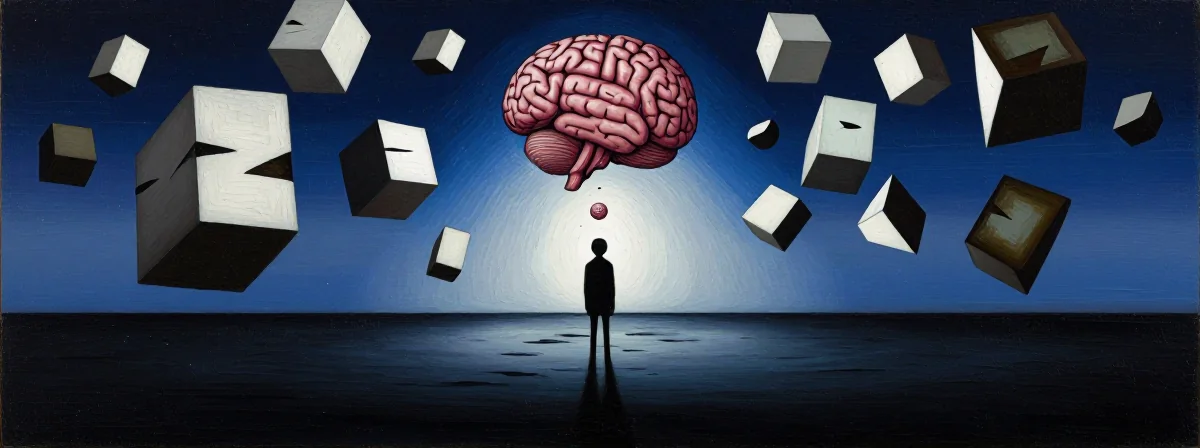
You are lying in the dark, drifting on the edge of consciousness, when suddenly the world feels wrong. Your tongue, a familiar fixture in your mouth, seems to swell until it feels like a thick, heavy carpet crowding your palate. Or perhaps you are holding a small pebble—a thing no larger than a quarter-inch—but in your mind, it possesses the density and weight of a collapsing star. It isn’t a dream. You are awake, aware, and utterly baffled by the sudden warping of reality.
For decades, people have kept these experiences to themselves, embarrassed to admit that their brains occasionally flip a switch that changes the scale of existence. It is a disconcerting feeling, a momentary glitch in the matrix where the concepts of “big” and “small” detach from their physical anchors. You might feel as though you are shrinking while the room expands into a cavernous stadium, or that the objects around you are growing at an alarming rate, pressing in on you with a terrifying intensity.
While it feels like a solitary strangeness, this phenomenon is a well-documented, if rarely discussed, neurological quirk. It usually strikes in the liminal space between wakefulness and sleep, or during the haze of a childhood fever. It is a moment where the brain’s sensory processing software stutters, leaving you with a profound sense of awe and confusion.
Why Does Reality Suddenly Zoom In and Out?
Imagine a GIF that loops endlessly, zooming in on a single point—a pencil tip, a cat’s whisker, or a texture on the wall—until the image becomes abstract and overwhelming. Now, imagine that sensation happening inside your mind. This is the essence of the distortion. It is as though your brain suddenly switches scales, making a mental image feel huge and encompassing, or tiny and sharp.
One moment, you are simply thinking about a piece of thread, and the next, your imagination has rendered it as thick as a tree trunk. The texture of your blanket between your fingers might suddenly feel impossibly coarse and thick, as if your hands are too small to hold it. These aren’t hallucinations in the psychotic sense; they are perceptual distortions. The world is still there, but your brain’s interpretation of its size and distance has momentarily gone rogue.
It is often accompanied by a specific, hard-to-articulate feeling—a “sharp thought” or a sensation of infinite smallness. Some describe it as a point forming in their mind that is infinitely sharp, a physical manifestation of a mental concept. It is a bizarre crossover where the tactile and the abstract bleed into one another, leaving you wondering if you are the only one who sees the world this way.
The Ghost of Fevers Past
For many, this is not a nightly occurrence but a haunting memory from childhood. You might recall lying sick in bed, fever high, delirious and uncomfortable. In that state, picking up a small object felt like a feat of immense strength because your brain insisted it weighed tons. The fever seemed to warp the sense of density, making the air feel heavy and the covers feel like lead.
This connection to illness is common. High fevers in children often trigger these distortions, leading to visions of giant hands approaching or faces looming in the dark. As we grow older and our fevers become less frequent, the episodes often fade, relegated to the status of a weird, half-remembered dream. Yet, for some, the ghost of that sensation lingers, capable of being summoned voluntarily in adulthood, though never with the same vivid intensity as those sick-bed nights.
The experience is so visceral that it can induce panic. When your own body parts feel foreign or the room stretches into an infinite void, the primal part of the brain kicks into high alert. It sends a jolt of fear through your system, snapping you out of the distortion and back into “normal” reality, often leaving your heart racing.
When Sleep Brings Strange Noises and Epiphanies
The transition into sleep is a vulnerable state. As your conscious mind disengages, the brain begins to free-flow. This is the domain of the hypnagogic state, where thoughts can become psychedelic and nonsensical. You might find yourself on the verge of a massive epiphany, a feeling that everything is suddenly about to make sense, only to be jolted awake by a loud bang or a voice shouting “BOO.”
This startling phenomenon, known as Exploding Head Syndrome, is a cousin to the size distortions. It is another manifestation of the brain’s auditory and visual centers misfiring as you drift off. You feel as though an outside force is interfering, preventing you from grasping some cosmic truth, but in reality, it is just your neurons settling down for the night.
These “wacky” thoughts are a sign that sleep is imminent. The logic centers of the brain are taking a break, allowing the surreal to take the wheel. While it can be unsettling to feel like you are losing control of your perceptions, it is usually a benign signal that your body is doing exactly what it needs to do to enter the dream world.
Is Your Brain Just Bad at Filtering?
There is a theory that these glitches are related to how the brain filters sensory information. If you have ever experienced visual snow—that static-like fuzz overlaying your vision—or phantom tinnitus, you might be more prone to these nightly distortions. It suggests a sensory processing style that is, for lack of a better word, leaky.
People with ADHD, in particular, often report these experiences. The “impaired filtering” hypothesis suggests that the brains of those with ADHD are more sensitive to subtle shifts in perception. As the inhibitory processes of the brain weaken before sleep, those sensory changes become more pronounced. The static becomes visible; the size distortions become tangible.
It is not a defect, but rather a different way of experiencing the machinery of the mind. Just as some people have synesthesia and taste colors, others have a heightened sensitivity to the scale and texture of their internal world when the lights go out.
The Alice in Wonderland Syndrome
If you have been nodding along to these descriptions, wondering what on earth is going on, there is actually a name for it. Neurologists call it Alice in Wonderland Syndrome (AIWS). It captures perfectly the feeling of shrinking and growing that Lewis Carroll’s protagonist experienced.
Research suggests that almost a third of teenagers will experience brief episodes of AIWS symptoms. It is generally considered harmless, a “neurological spookie” that happens as the brain develops or as it winds down. Unless it is accompanied by severe pain, seizures, or debilitating disruption to your daily life, it is usually just a quirk of biology.
Knowing there is a name for it can be incredibly validating. It transforms a terrifying, isolated experience into a shared human phenomenon. You aren’t losing your mind; you are just briefly visiting Wonderland.
Learning to Coexist with the Glitch
The next time you feel the world stretching or your tongue swelling in the dark, try to meet the sensation with curiosity rather than fear. It is a reminder that your perception of reality is constructed, not absolute. Your brain is an incredibly complex organ, and sometimes, in the quiet moments before sleep, it shows you a little bit of its wiring.
These distortions, from the heavy rocks to the infinite sharp points, are harmless blips on the radar. They are the screensaver of a resting mind, flickering through strange patterns before settling into darkness. You can close your eyes, let the zooming sensation wash over you, and trust that when you wake up, the world will be exactly the size it’s supposed to be.