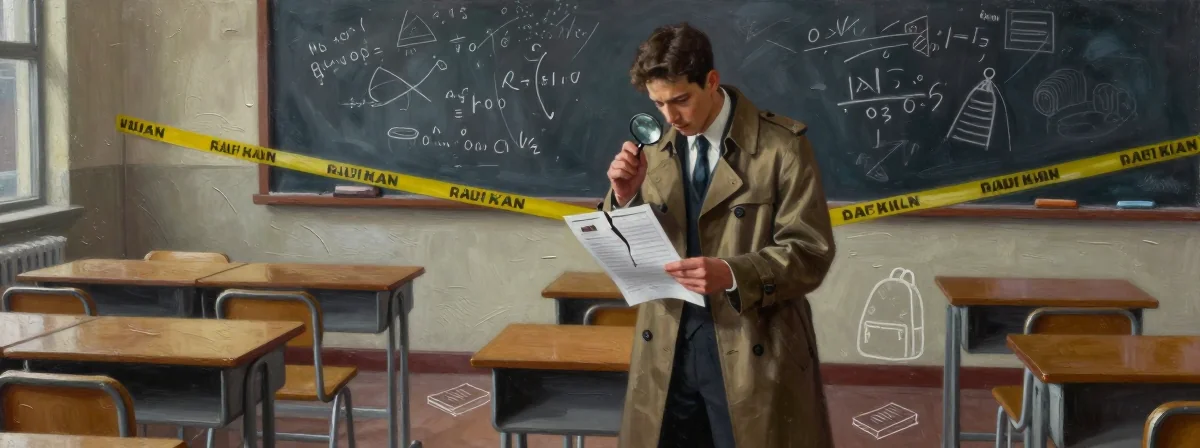
You remember high school as a time of lockers, lunch breaks, and awkward crushes, but if you examine the evidence closely, it was actually a hotbed of felony, fraud, and cover-ups. The burden of proof suggests that the hallways were less a learning environment and more a precinct for unsolved mysteries. You just didn’t have the badge to see it then.
We tend to romanticize the chaos of our teenage years, filtering out the grit and the genuine danger through the lens of nostalgia. But if you look back at the case files of your own adolescence, you’ll find a pattern of behavior that wouldn’t fly in the adult world.
The Forensic Analysis
The Case of the 31-Year-Old Freshman Evidence suggests that “DeAndre DeAngelo” was a master of forgery, falsifying records to enroll as a 17-year-old student at a school he had no business attending. He looked the part, acted the part, and said “Hello, fellow kids” with enough conviction to fool the administration entirely. The statute of limitations on this level of deception may have expired, but the audacity remains baffling.
The Student Body President, Fugitive from Justice

Tom wasn’t just leading the student council; he was leading an armed robbery crew. When an accomplice accidentally shot himself and sought medical care, the investigation led straight to Tom, who fled to Mexico. The evidence indicates he wasn’t hiding in fear—he was hosting spring break parties for classmates before America’s Most Wanted ended his political career.
The Anatomy of a False Confession A biology teacher was crucified in the court of public opinion when a student accused him of inappropriate touching. Forensic review of the facts later proved it was a wayward elbow, not a predatory hand. The girl eventually offered a chocolate bar as a settlement, but you can’t un-ring a bell—or repair a reputation destroyed by a lie.
The Wrongful Conviction of the Best Friend

A girl was raped at a party and immediately blamed her male best friend. The faculty acted as judge and jury, publicly shaming him until he transferred schools. Months later, the true perpetrator confessed at a bar: it was her own brother. The damage to the innocent friend was permanent, proving that mob rule often overrides due process.
The Thirty-Year Conspiracy of Silence For three decades, a coach operated with impunity, grooming girls who were too young to consent. When the truth finally came to light, the defense claimed a “murky memory” and a sudden religious awakening. He received a mere one-year sentence—a sentence that feels like a mistrial of justice for the victims he left behind.
The Unsolved Mystery of the Third Floor Sometimes the case isn’t a felony, but a biological anomaly. A specimen of such magnitude—complete with head and tail—appeared in a toilet, bringing the school day to a halt. The investigation yielded no suspects, only a mascot in a video reveal. The perpetrator remains at large.
The Final Judgment
We tend to look back with rose-colored glasses, forgetting that we survived a gauntlet of real danger and deceit. You weren’t just studying history; you were living through a pre-trial phase for adulthood. The verdict is in: you made it out alive, and that’s the only acquittal that matters.