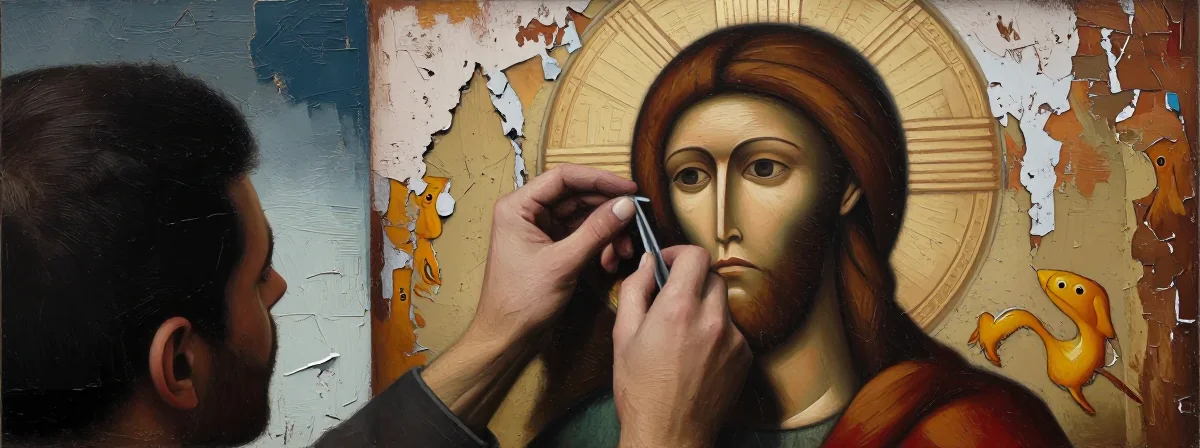
The internet has a way of turning moments into legends. Sometimes, these legends are built on misunderstandings. The story of the “Monkey Jesus” painting—officially titled “Ecce Homo”—is one such case. What started as a local restoration effort became a global meme, a symbol of amateur artistry gone wrong. But here’s the thing: the narrative we all know might be missing a crucial detail. It all makes sense now!
The painting, originally created by artist Elías García Martínez in 1930, was already in poor condition when Cecilia Giménez, an amateur artist in her 80s, decided to restore it. The fresco, located in the church of Borja, Spain, had suffered from water damage and neglect over decades. When Giménez began her work, she was only at the very beginning stages—what any artist would call “laying the groundwork.” Think about it: would you judge a house renovation when the workers have only just started tearing down walls? It’s not fair, and it’s not accurate.
What No One Told You About the Restoration Process
Art restoration isn’t like fixing a broken vase. It’s a delicate dance between preserving the original and bringing it back to life. When Giménez started working on the Ecce Homo fresco, she was following a common restoration technique: applying base layers to stabilize the damaged areas. This is exactly what professional restorers do—except they have decades of training. Giménez, while lacking formal training, was attempting to follow these principles. The result wasn’t pretty, but it wasn’t the finished product either. It was, as she later explained, “a work in progress.”
The internet, however, saw only the middle stage—a face that looked nothing like the original and certainly not like Jesus. The overpainting was heavy, the features distorted, and the overall effect comical. But here’s the kicker: this was never meant to be the final look. Giménez had planned to add details, refine the features, and bring the painting back to its intended form. She just hadn’t gotten there yet. It all makes sense now!
The Cultural Phenomenon That Wasn’t a Mistake
What if I told you that the “Monkey Jesus” painting wasn’t just a mistake—it was a cultural phenomenon waiting to happen? The moment the incomplete restoration went viral, it took on a life of its own. People didn’t just laugh at it; they embraced it. Memes spread like wildfire, articles were written, and the painting became a symbol of human imperfection and artistic ambition. The church, initially embarrassed, eventually embraced the newfound attention. They even started selling postcards of the “new” Ecce Homo.
The restoration, far from being a failure, had achieved something remarkable: it had connected with people in a way the original never did. The “Monkey Jesus” became a conversation starter, a piece of art that made us question our own judgments and expectations. And that, perhaps, was the real restoration—of perspective, not paint.
Why We All Fell for the “Unfinished” Excuse
It’s easy to see why the “unfinished” narrative didn’t stick. The painting looked like a disaster, plain and simple. The distorted features, the wrong proportions, the overall “off” quality—it seemed like a clear case of someone not knowing what they were doing. But here’s the truth: even professional restorers sometimes make bold choices that look jarring at first. The difference is that they have the training to guide those choices toward a coherent final product.
Giménez, while well-intentioned, lacked that training. Her approach was to paint over the damaged areas with new layers, a technique that can work if done carefully. The problem wasn’t the technique itself, but the execution. And while the execution was far from perfect, it wasn’t the finished work that critics claimed it was. It was a step in a process, albeit a misstep. But in the world of art, even missteps can lead to something beautiful—or at least, something memorable.
The Real Impact of the “Monkey Jesus” Phenomenon
The story of the “Monkey Jesus” painting isn’t just about a failed restoration. It’s about how we perceive art, how we judge others, and how sometimes, the most unexpected outcomes become the most meaningful. The painting, now permanently altered, has taken on a new identity—one that reflects both its original intent and its accidental transformation.
Think about it: the original Ecce Homo was meant to depict “Behold the Man,” Pilate’s words to the crowd. The restored version, with its distorted features, could be seen as “Behold the Monkey”—a playful twist on the original message. The irony is that what was meant to be a restoration became a reinvention, and in doing so, it created something new and culturally significant.
What We Can Learn From a Viral Mistake
The “Monkey Jesus” painting teaches us a valuable lesson: context matters. Without knowing that the restoration was incomplete, we judged it harshly. With that context, we can see it differently—not as a failure, but as a work in progress that took on a life of its own. This applies to more than just art restoration. In life, we often judge without knowing the full story. We see a snapshot and assume we have the whole picture.
The next time you see something that looks like a mistake, take a moment to consider what you might not know. There might be more to the story than meets the eye. And who knows? What seems like a disaster today might become a cultural icon tomorrow. After all, beauty is in the eye of the beholder—and sometimes, so is the mistake.