
You’ve stared at the back of a pasta box, maybe after a rough week when your brain feels like overcooked spaghetti itself. You see “calories per 100g” for the dry stuff and then, later, “calories per 100g” for the cooked version — and your perfectly reasonable brain goes, “Wait, what?” — and suddenly you’re facepalming so hard you worry about concussions. Sound familiar?
Yeah, that moment when you think you’ve stumbled onto some deep, hidden food conspiracy, only to realize it’s just… water. It’s one of those little “duh” moments that somehow still manages to catch us all out now and then.
The Good Stuff
Your brain is doing exactly what it’s supposed to do. Facepalming over a nutrition label isn’t a sign of ignorance — it’s a sign your brain is actually working. You noticed something wasn’t adding up, you questioned it, and you sought an explanation. That’s the scientific method, folks, minus the lab coat and questionable Bunsen burner skills. Don’t let anyone make you feel dumb for thinking.
It’s all about the water weight. Dry pasta is, well, dry. Cook it, and you’re adding water — sometimes a lot of water. That water doesn’t have calories, but it does add weight. So, when you compare 100g of dry pasta to 100g of cooked pasta, the cooked version has all that extra water making up part of that weight, meaning the actual pasta (and thus the calories) is spread out over more grams. It’s like adding packing peanuts to a box — the box gets heavier, but the peanuts aren’t the main event.
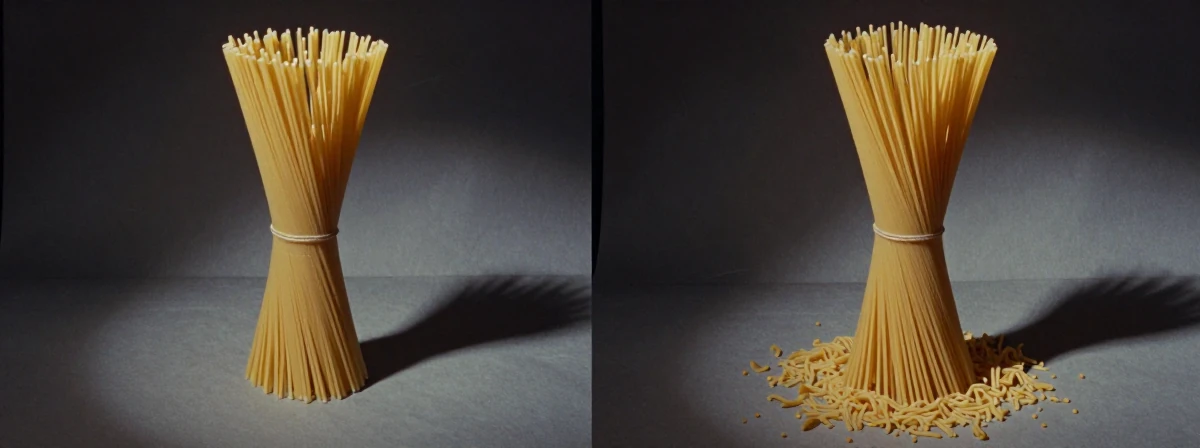
“Science-y” doesn’t have to mean complicated. Sometimes the most science-y thing you can do is look at a label, go “Huh, that’s odd,” and figure out it’s a simple unit conversion thing. It’s not about discovering a new element or proving string theory; it’s about understanding how measurements work in the real world. And that’s pretty rad. Science is just a way of making sense of the world, not a magic spell you need a secret handshake for.
Dry pasta calories: Mostly for math, not meals. Why list the calories for dry pasta at all if no one eats it that way? Good question! It’s often the standard way to list nutritional info because the water content changes so much depending on how you cook it. Think of it like the “base model” calorie count. You adjust from there based on how you prepare it — just like you wouldn’t compare the price of a car without factoring in options or gas mileage.
Your “dumb” moments are universal. Feeling like a “dumdum” for not getting it immediately? We’ve all been there. Your brain isn’t on vacation; it’s just tackling problems in the order they arrive, and sometimes the obvious ones get queued up behind “Where did I leave my keys?” or “What was that song playing in the elevator?” Cut yourself some slack. Everyone trips over the same basic facts now and then.
Even the simplest explanations are worth celebrating. The moment someone explains it simply — “You added water, which has no calories, so the calories are spread out over more weight” — and it clicks? That’s a mic drop moment. It’s the satisfaction of solving a little puzzle, and it’s something to smile about, especially if you’ve had a brain-foggy week. Celebrate those “Aha!” moments, no matter how small.
Last But Not Least
So next time you find yourself puzzled by a nutrition label or any everyday “science,” remember: questioning is a superpower, not a weakness. Your brain isn’t broken — it’s just doing its best to navigate a world full of dry pasta and confusing numbers. And hey, if figuring out calorie counts makes you smile, even better. Sometimes the little victories are the sweetest. Now go forth and question with confidence!