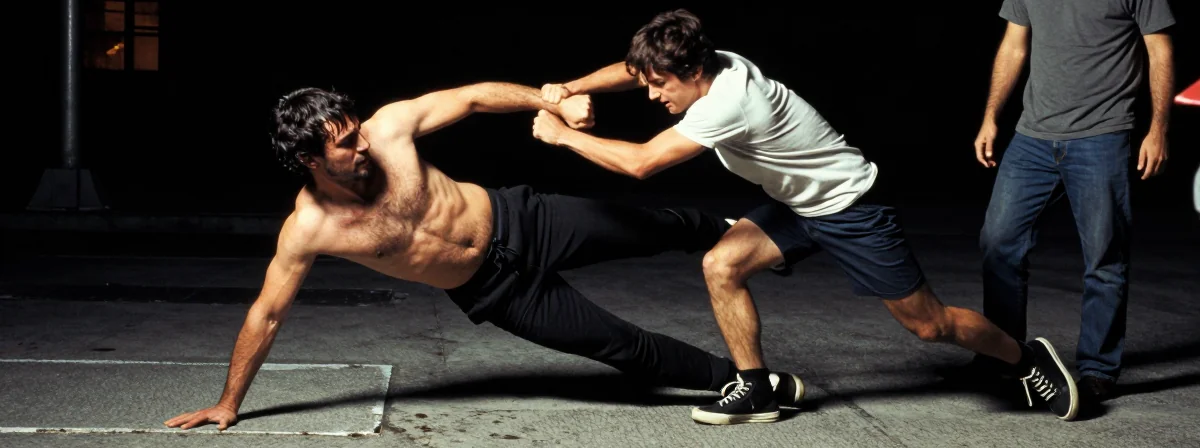
Street fights are rarely what they seem. The bravado, the chest-thumping, the “I’ll show you” attitude that leads to most brawls outside bars—these aren’t about survival. They’re about ego. About proving something that doesn’t need proving. And in this twisted social ritual, certain moves carry unspoken weight. The “nut shot,” as it’s colloquially known, is one of them. It’s the tactical nuke of fistfights—a move that promises victory but often delivers consequences far worse than defeat.
The reality of combat, stripped of Hollywood glamour, reveals something fascinating: most people who talk about fighting have never been in one. The theories, the “what I would do” scenarios, the YouTube tutorials—they’re all useless without the visceral experience of adrenaline flooding your system, your hands shaking, and the sudden awareness that another human being wants to hurt you. This is where the rubber meets the road, and where the unspoken rules of engagement become terrifyingly clear.
I’ve seen it dozens of times—the moment when one fighter realizes the other has no honor left to lose. It’s not just about the physical pain; it’s about the psychological unraveling that follows. The social contract of combat, however primitive, has been broken. And once that happens, you’re no longer fighting a person—you’re fighting a cornered animal.
Why the “Nut Shot” Isn’t the Finisher You Think It Is
The testicular strike seems like a perfect weapon on paper. High pain potential, relatively easy to execute, and instantly debilitating. But real fights aren’t happening in a vacuum. There’s movement, there’s unpredictability, there’s the fact that your opponent isn’t standing still waiting for you to land the perfect shot.
Consider the physics: to land a solid nut shot, you need timing, positioning, and precision. In a real altercation, these are luxuries. Your opponent is moving, likely angling away, and may be wearing clothing that diffuses the impact. Even if you manage to connect, the effects aren’t guaranteed. Adrenaline is a hell of a drug—it can completely override pain signals in the moment, leaving your opponent just as dangerous as before. I’ve seen it happen. The guy doubles over in agony five seconds later, but in those critical moments, he’s still trying to hit you.
And what happens when you miss? That’s when the fight truly turns ugly. You’re now off-balance, vulnerable, and your opponent knows exactly what you were attempting. The tables have turned, and now you’re the one in danger. This isn’t a movie where you can just reset and try again. In a real fight, missed opportunities compound quickly.
The Unspoken Social Contract of Combat
There’s a bizarre etiquette to street fights that most people never acknowledge. It’s not written down anywhere, but it’s understood by anyone who’s been in more than one. You’re supposed to fight fair. Not because there are rules, but because there are consequences when you break them.
When you go for the nuts, you’re not just attacking a body part—you’re attacking the social contract. You’re saying, “I don’t care about the unwritten rules.” And when you do that, something shifts in the other person. The fight stops being about ego and starts being about survival. Suddenly, they’re not just trying to win—they’re trying to hurt you as badly as possible before you can hurt them back.
I’ve seen bouncers and security professionals who work in high-risk environments talk about this. Their policy is never to fight back, but when they do have to engage, it’s with controlled force. They slap, they block, they create distance—not because they’re weak, but because they understand the dynamics of real conflict. A slap to the side of the head can disorient without escalating to lethal force. It’s a tactical choice, not a sign of weakness.
The Adrenaline Factor: Why Pain Doesn’t Work the Way You Think
Most people don’t understand adrenaline. They think of it as just “excitement,” but in combat, it’s a chemical defense mechanism that literally shuts down pain receptors. A solid shot to the testicles might register as a dull thud while the fight is happening. The real pain comes later, when the adrenaline wears off. By then, it’s too late.
This is why combat veterans and experienced fighters talk about “fighting through” certain injuries. The body has an incredible capacity to ignore pain when survival is at stake. A nut shot might make someone angry rather than incapacitated. I’ve seen it. The guy winces, but he keeps coming. The fight continues, now with far higher stakes.
What often works better is targeting the nose or the eyes. A solid hit to the nose causes immediate tearing, disorientation, and genuine pain that’s harder to ignore. It’s not honorable, but it’s effective. And in a life-or-death situation, effectiveness should be your only concern.
The Escalation Cascade: When One Bad Decision Leads to Another
Here’s where most people get it wrong: they think the nut shot is an escalation. It’s not. It’s the first step in an escalation cascade. Once you’ve broken the social contract, there’s no going back.
His friends who were previously just watching—they might now feel obligated to intervene. The fight that was once one-on-one could suddenly become a mob scene. And let’s be clear: most people don’t join fights to be fair. They join to finish them.
I’ve heard stories from bouncers about how a single cheap shot can transform a contained situation into a full-blown riot. It’s not about justice or fairness—it’s about preventing the original attacker from doing it again. Once you’ve shown you’re willing to break the rules, others feel justified in breaking them too.
And legally? You’ve just made your situation infinitely worse. Assault charges become aggravated assault. Self-defense arguments evaporate when you initiate with an underhanded move. The justice system, like the street, has its own unspoken rules.
The Real-World Difficulty of “Easy” Moves
There’s a disconnect between how fighting looks in theory and how it feels in practice. The nut shot seems easy because you see it in movies—quick, decisive, game over. In reality, it requires perfect timing, positioning, and precision. Your opponent isn’t standing still; they’re moving, angling, protecting themselves.
Consider the mechanics: to land a solid shot, you need to close the distance, which puts you at risk. You need to time your attack when their guard is down, which is rare in a real fight. You need to hit with enough force to make an impact, which requires commitment that leaves you vulnerable if you miss.
I’ve spoken with martial artists who specialize in real-world combat, not sport fighting. They all say the same thing: the moves that look impressive in theory are often the hardest to execute under pressure. The nut shot is no exception. It’s not about bravery or cowardice—it’s about practicality. Most people simply can’t execute it reliably in a high-stakes situation.
When Survival Trumps All: The Exception to the Rule
There is one scenario where the nut shot—or any other “unfair” move—becomes not just acceptable but necessary: when your life is genuinely at stake. In a true survival situation, there are no rules. There’s only winning and losing.
This is the distinction that most people miss. The ego fights at bars, the schoolyard brawls, the chest-thumping encounters—these aren’t survival situations. They’re social conflicts that have escalated beyond reason. In these cases, maintaining some semblance of order, however primitive, is actually safer for everyone involved.
But if someone is genuinely trying to kill you—if they have a weapon, if they’re overwhelming you with numbers, if they’re attacking with lethal intent—then all bets are off. Grabbing, twisting, whatever it takes. The social contract no longer applies because there is no society left to contract with.
I’ve heard stories from law enforcement and military personnel about how combat changes when survival is the only goal. The rules disappear. The hesitation vanishes. What remains is pure, unadulterated self-preservation.
The Better Alternative: De-escalation Through Non-Confrontation
Here’s the truth that most fighting discussions ignore: the best fight is the one that never happens. The most effective self-defense technique is de-escalation. Not through verbal negotiation—through non-confrontational body language.
I’ve seen it work countless times. Standing your ground without aggression. Showing you’re prepared to defend yourself without initiating. Looking someone in the eye and not backing down, but also not advancing. It’s a delicate balance, but it works.
In many cases, the person looking for a fight is looking for an easy win. They want to assert dominance without real risk. By presenting yourself as someone who won’t be easily intimidated but also won’t be an easy target, you often diffuse the situation before it begins.
This isn’t about cowardice. It’s about recognizing that most fights aren’t worth fighting. The ego damage from backing down is temporary. The physical damage from fighting can be permanent.
The Final Calculation: What’s Really at Stake
When you consider using an underhanded move in a fight, you’re making a calculation. What do I gain? What do I risk? In most cases, the calculation is flawed. The perceived gain—a quick, easy win—isn’t guaranteed. The risks—escalation, legal trouble, genuine injury—are very real.
The nut shot, like many “easy” fighting techniques, fails the reality test. It doesn’t account for the unpredictability of human beings, the effects of adrenaline, the social dynamics at play. It’s a theory that falls apart in practice.
Real fighting wisdom comes from those who’ve been there—not from armchair theorists. It comes from understanding human nature, not just human anatomy. It comes from recognizing that most conflicts have solutions other than violence.
The next time you find yourself on the brink of a confrontation, remember this: the most respected fighters are rarely the ones who resort to cheap shots. They’re the ones who know when to fight, when not to fight, and when to end it quickly without unnecessary escalation. That’s the true measure of skill—not how much damage you can do, but how little damage you need to do to resolve the situation.