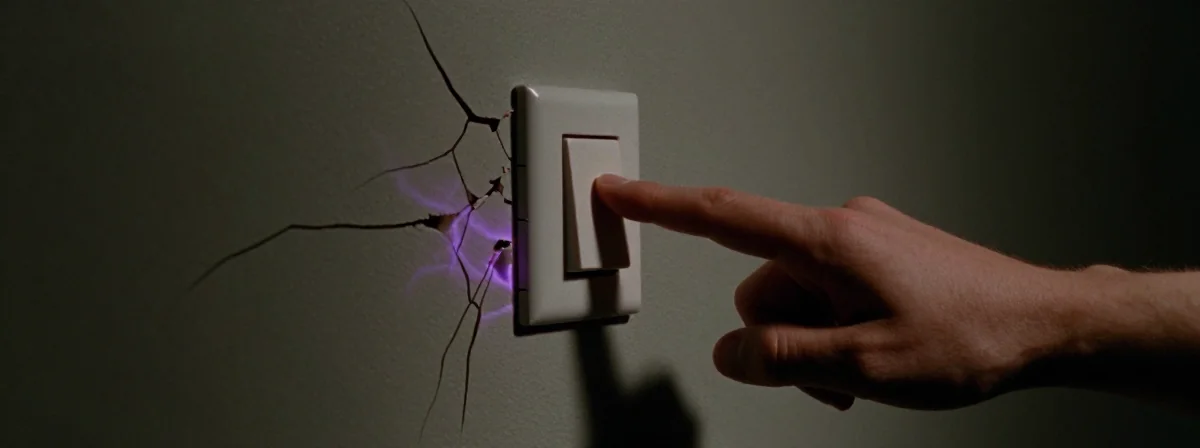
Imagine this: You’re in a playful mood and decide to turn your living room lights on and off in rapid succession, creating a makeshift disco. It seems harmless, right? After all, light switches are built to last. But what if I told you that this simple act could be quietly damaging your home’s electrical system in ways you never imagined? The truth about light switches and their components is far more complex than most homeowners realize.
The physics behind electrical switches involves miniature arcs of electricity, thermal stress on delicate components, and mechanical wear that accumulates over time. When you flick a switch, you’re not just completing or breaking a circuit—you’re initiating a series of physical and electrical events that can gradually degrade both the switch itself and connected lighting components. Let’s explore what really happens when you repeatedly toggle your lights on and off.
Can Flicking a Light Switch Really Damage It?
Yes, but the extent depends entirely on how you’re using it. Every time you operate a light switch, tiny electrical arcs form between the contacts as they separate. These arcs, though minuscule, create heat that gradually erodes the metal contacts over thousands of operations. Think of it like tiny sparks slowly wearing away at metal—each one insignificant alone, but cumulatively creating noticeable damage.
Modern light switches are engineered to handle this wear, often rated for 30,000 to 250,000 operations depending on quality. A typical household might only use a switch 1,000-2,000 times per year, meaning even a moderate-quality switch should last decades under normal use. However, if you’re toggling a switch 20 times in rapid succession multiple times a day, you’re accelerating this wear dramatically. It’s not unlike how a door hinge will last years with normal use but might fail prematurely if someone repeatedly slams the door.
The real damage comes from arcing, not mechanical friction. When you flip a switch, the contacts separate rapidly, but electricity tries to continue flowing, creating a brief arc across the gap. This arc heats the contacts, causing oxidation and micro-erosion with each operation. Over thousands of cycles, this gradually increases contact resistance, eventually leading to poor connections, intermittent operation, or complete failure.
Why Older Bulbs Were Especially Vulnerable
If you grew up in a home with incandescent bulbs, you probably noticed they often burned out right when you turned them on. This wasn’t a coincidence—it was physics in action. Incandescent bulbs contain a thin tungsten filament that operates at extreme temperatures (around 2,700°C or 4,900°F) when lit.
Here’s the fascinating part: when cold, that filament has much lower electrical resistance than when hot. In fact, it can draw 10-15 times its normal operating current during the first milliseconds after being turned on. This sudden electrical surge creates tremendous thermal stress as the filament rapidly heats from room temperature to its operating temperature in just milliseconds.
Repeated on/off cycling prevents the filament from reaching thermal equilibrium. Each time you turn it on, the filament experiences this thermal shock, gradually weakening its structure. It’s like repeatedly bending a paperclip back and forth—the material fatigues until it eventually breaks. For incandescent bulbs, this is why they typically fail at the moment of being turned on rather than during operation.
Fluorescent bulbs faced a different challenge. Their ballast required high voltage pulses to initiate the gas discharge, and each startup pulse gradually degraded the components. Modern LED bulbs have their own vulnerabilities, though different from their predecessors.
The Modern LED Paradox
You might assume LED bulbs are immune to switching damage since they’re so efficient and durable. And you’d be partially right—they don’t suffer from filament thermal shock like incandescents. However, LEDs contain complex electronic components that do have vulnerabilities.
Standard LED bulbs include an AC-to-DC power supply that converts your home’s 115V AC electricity to the low-voltage DC needed by the LED. This power supply contains capacitors and inductors that can be sensitive to rapid on/off cycling. When you switch off an LED, these components discharge, and rapid cycling can stress them beyond their design limits.
The real surprise comes from the inductors in LED drivers. Inductors naturally resist changes in current flow. When you suddenly open a circuit (by turning off the light), the inductor tries to maintain that current, creating voltage spikes that can cause arcing in the switch contacts. While a single operation is negligible, thousands of rapid cycles can gradually degrade both the LED driver and switch contacts.
Many modern smart lights add another layer of complexity. These bulbs often contain microcontrollers and memory that can be reset by rapid on/off cycling. If you have a smart lighting system configured just the way you like it, discovering all your settings have reset because someone was playing with the switch can be incredibly frustrating.
How Much Is “Too Much” Switching?
The threshold for damaging a light switch depends on several factors: switch quality, electrical load, and switching frequency. A high-quality switch rated for 250,000 operations might last 68 years with 10 toggles per day, but only 8 months with 1,000 toggles daily.
For perspective, a person flicking a switch 20 times in rapid succession occasionally won’t cause measurable damage. However, if someone were to repeatedly toggle switches 100 times per minute for hours at a time, they could definitely shorten the switch’s lifespan. The damage isn’t immediate—it’s cumulative, like the way constant small stresses eventually lead to structural failure in bridges.
Interestingly, AC power has a natural advantage here. Because AC voltage crosses zero 120 times per second (in a 60Hz system), any arc that forms during switching will naturally extinguish at these zero-crossing points. This is why AC systems generally handle switching better than DC systems would under similar conditions.
Practical Tips to Protect Your Electrical System
If you want to maximize the lifespan of your light switches and bulbs, consider these simple strategies:
- Avoid rapid, repeated switching of the same light. Occasional playfulness is fine, but don’t make it a habit.
- When replacing bulbs, choose high-quality LED bulbs with robust power supplies. Cheaper bulbs may have components more sensitive to switching.
- If you notice a switch becoming less responsive or making arcing sounds, replace it promptly.
- For smart lighting systems, consider placing switches where they won’t be accidentally bumped or played with.
- Remember that the energy savings from turning off lights briefly often outweighs any potential wear on components.
It’s also worth noting that in most cases, the cost of a light switch (often under $10) makes replacement a minor expense compared to potential fire hazards from worn switches. If you’re concerned about a switch’s condition, replacing it is always the safer option.
The Bigger Picture: Electrical Systems as Living Organisms
When you step back, it’s fascinating to realize that your home’s electrical system behaves somewhat like a living organism—it has components with varying lifespans, stress points, and failure modes. Light switches, bulbs, and wiring all experience wear and tear in ways that aren’t immediately visible.
Understanding these subtle interactions helps demystify why electrical components fail and how to prevent premature failure. It also highlights why electricians follow specific installation practices and why building codes exist—they’re based on decades of experience observing how electrical systems age and fail under various conditions.
Next time you flick a light switch, you might pause for a moment to appreciate the miniature electrical ballet taking place inside that small plastic housing. And if you happen to be in a playful mood, remember that an occasional burst of rapid switching won’t cause lasting harm, but making it a habit could quietly shorten the lifespan of both your switch and connected lighting components over years of use.
The real takeaway? Electrical components are designed to last, but like everything else, they respond to how we treat them. A little awareness goes a long way toward maintaining a safe, reliable electrical system in your home.