Ever wonder why your old plastic skateboard from the ’80s shattered the first time you tried a kickflip, while modern decks feel like they could survive an apocalypse? The answer isn’t just better tricks—it’s in the wood itself. Laminated wood isn’t just a fancy term; it’s a hidden engineering marvel that’s stronger, cheaper, and more flexible than solid wood. But how? Let’s peel back the layers and uncover the truth.
Skateboards, grand staircases, and even skyscrapers are all built with this secret weapon. The clues are everywhere: laminated strips resist warping, snap less often, and can be shaped into curves that solid wood would never dream of. But the real kicker? The way woodworkers and engineers manipulate grain direction and glue layers to create something far tougher than nature intended. This isn’t just wood anymore—it’s a composite material born from clever design.
Why Does Laminated Wood Never Split Like Solid Wood?
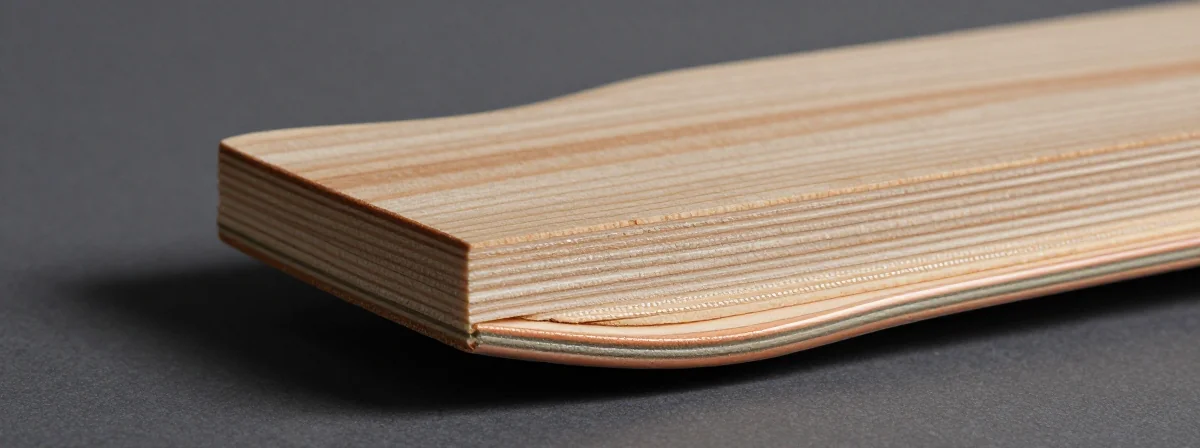
Solid wood is like a bundle of steel wires (cellulose) held together by soft caramel (lignin). Pull the caramel apart, and the bundle splits. That’s why a single board snaps so easily—its grain runs in one direction, and any impact along that line is a death sentence. But laminated wood? It’s a chessboard of grain directions. Each layer fights the other’s weaknesses. Try splitting a bundle of sticks all at once—it’s nearly impossible. The same principle applies here.
The glue isn’t just holding layers together; it’s creating a new kind of structure. Think of it like reinforcing concrete with rebar. The adhesive seeps into the wood, locking it in a matrix that resists splitting, warping, and bending. This is why laminated wood can take diagonal forces—like the stress of a skateboard landing—that would shatter solid wood. It’s not just stronger; it’s multidirectional strength.
The Skateboard That Feels Like a Spring—Thanks to Layers
Ever ride a longboard and feel it “pop” under your weight? That’s laminated magic. More layers mean more spring. Skateboard manufacturers discovered this decades ago: layering thin strips of wood with alternating grain directions creates a flex that absorbs shock and returns energy. It’s like a trampoline for your feet.
Longboard makers like Loaded Boards take this to extremes, designing decks that flex like snowboards. The glue planes between layers transfer load across the entire board, not just at the point of impact. Step on a solid board, and one spot bears your weight. Step on a laminated one, and the load spreads like a wave. This is why you don’t see karate experts chopping plywood—they’d break their hand. The layers make it absurdly tough.
Cross Laminated Timber: The Construction Industry’s Dirty Secret
Skateboards aren’t the only ones benefiting. Builders are going wild for Cross Laminated Timber (CLT). It’s like plywood on steroids—layers of wood stacked perpendicular, glued, and pressed into beams that outperform steel in strength and fire resistance. A mansion’s spiral staircase, once a nightmare of supports, can now stand alone thanks to laminated wood.
The construction world gets it: laminated wood is lighter than steel, cheaper than concrete, and renewable. It doesn’t warp in humidity because alternating grain directions lock the wood in place. It’s dimensional stability on steroids. No wonder high-end cabinets are plywood—they last longer and resist warping. The same logic applies to skateboards: durability isn’t a luxury; it’s a necessity.
The Cheap, Strong, and Shapely Advantage
Finding a solid board of the exact thickness you need? Nearly impossible. Laminating lets you stack thin strips to achieve any dimension. It’s easier, cheaper, and more precise. Want a curved skateboard deck? Steam bending a solid board is risky; laminating thin veneers into a mold is far more reliable. This is why laminated wood dominates everything from furniture to skateboards—it’s the Swiss Army knife of materials.
The construction industry calls it “cross power strength.” Skateboarders call it “pop.” Both are right. By layering wood at angles, you eliminate the single-direction weakness of solid wood. The result? A material that’s stronger, more flexible, and easier to work with. It’s why even the cheapest laminated wood in furniture is tougher than you think—though high-end versions with thinner slices are far superior.
Why Your Old Skateboard Couldn’t Survive Today’s Tricks
Your ’80s plastic skateboard and your friend’s 1990s wood deck would both break long before a modern laminated deck even budged. The difference isn’t just nostalgia—it’s engineering. Laminated wood resists sudden impacts, distributes stress, and flexes to absorb energy. A solid board? It’s a single point of failure.
This is why skateboard shops use hydraulic presses to layer wood (watch this press in action). They’re building a composite material, not just a board. The layers, the glue, the grain orientation—it’s all part of a system designed to outlast you. And it works. The evidence is in every skate park: laminated decks don’t just survive; they thrive.
The Final Layer: Why Laminated Wood Is the Future
Solid wood has its place, but laminated wood is the dark horse. It’s stronger, more stable, and more versatile. Builders use it for skyscrapers, skateboarders for their decks, and furniture makers for longevity. The key? Understanding that wood isn’t just a natural material—it’s a canvas for engineering.
Next time you land a trick or walk into a modern building, think about the layers beneath. They’re not just wood; they’re a carefully designed system that bends the rules of physics. Laminated wood isn’t just an upgrade—it’s a revolution hiding in plain sight. And now you know.