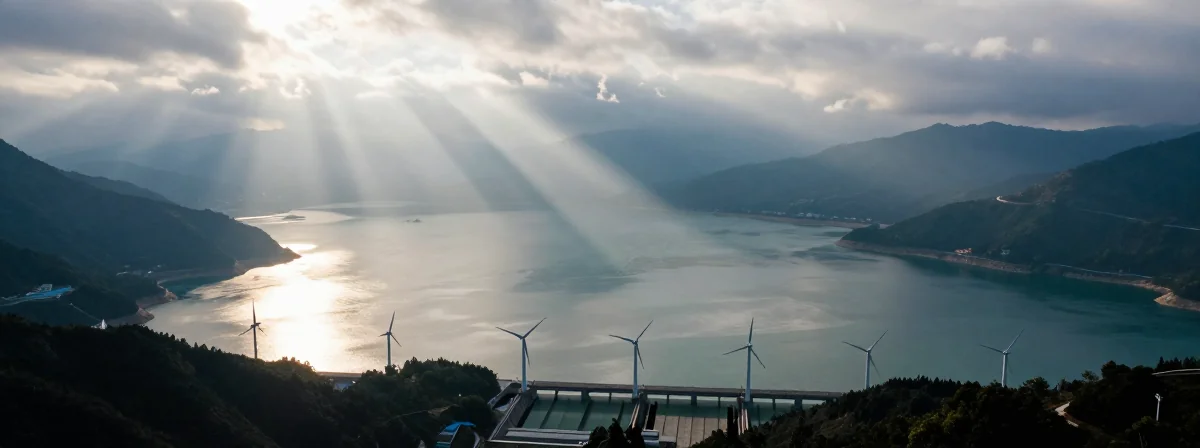
Some people just can’t stop talking about water. Seriously. You ask them what they want for lunch, and they’re suddenly explaining how the local reservoir is the backbone of our energy grid. It’s annoying, until you realize they’re right. And not just a little right — completely right. The way we store energy on a massive scale is, in essence, just moving water up and down hills. It sounds absurd until you actually think about it.
Beyond the Hype
Batteries Are Just Electrical Water Reservoirs.
Think about it. A chemical battery stores energy in ions, right? A pumped hydro system stores energy in water lifted to a height. Both convert electrical energy into potential energy (chemical bonds or gravitational height) and back. The difference? One uses chemicals, the other uses water. Both lose energy in the process — around 80% efficiency per cycle for either method. The real genius isn’t the efficiency; it’s the scale. Water reservoirs can store terawatt-hours of energy, not just kilowatt-hours. That’s the difference between charging your phone and keeping a city running through the night.94% of U.S. Energy Storage Is Just… Water.
Yeah, you read that right. Of all the energy we actively store in the U.S., nearly all of it is in the form of water lifted to a higher elevation. It’s not some newfangled tech; it’s been the workhorse since the 1970s. Why? Because it works. When solar and wind produce more power than we need, we pump water uphill. When demand spikes or the sun sets, we let it flow back down through turbines. It’s the original “green” battery, and it’s still the cheapest, most reliable way to store massive amounts of energy.
Efficiency Isn’t the Whole Story.
People love to talk about how “inefficient” pumped hydro is compared to lithium batteries. Sure, you lose about 20% of the energy in each cycle. But here’s the thing: sunlight and wind are free. If you can capture 80% of free energy and use it later, that’s still way better than not capturing it at all. Efficiency matters for small-scale, high-value applications. But for grid-scale storage, the question isn’t “How much do we lose?” It’s “How much can we store, and how much does it cost?” Pumped hydro wins on both.Pumped Storage Is the Original Smart Grid Hack.
Before lithium batteries were a thing, utilities were already using excess nighttime power to pump water uphill. Then, during peak demand, they’d release it. It’s the original “smart grid” solution — balancing supply and demand without wasting energy. Today, we’re doing the same thing with solar and wind. When the sun’s out, we pump water. When it’s dark, we generate. It’s not glamorous, but it’s effective. And yes, some plants even get “free” energy from rain filling their reservoirs. One plant manager I know calls it “pennies from heaven.”Batteries Are Catching Up, But They’re Not Replacing Water.
Lithium-ion batteries have exploded in the last decade. California recently set a record, with batteries meeting 44% of the state’s demand after sunset. That’s impressive. But here’s the catch: most grid batteries are paired with solar farms and are designed for short-term storage (2-4 hours). They’re not replacing pumped hydro anytime soon. Why? Because batteries are still expensive for multi-day storage, and they degrade over time. Water, on the other hand, doesn’t degrade. You can store it for decades and use it when you need it.The Future Is Both Water and Batteries.
This isn’t an either/or situation. The best grids will use both. Batteries for quick response and short-term storage, water for long-term, massive-scale storage. And yes, some innovative setups are combining solar farms with pumped hydro — using excess solar power to pump water uphill, then generating power when the sun goes down. It’s not a new idea, but it’s becoming more common as we push to integrate more renewables.It All Comes Down to Potential Energy.
At the end of the day, every energy storage method is about converting energy into a form that can be retrieved later. Chemical batteries use chemical potential. Flywheels use kinetic potential. And water reservoirs use gravitational potential. There’s a reason almost every major grid in the world relies on water storage. It’s simple, reliable, and scalable. Until we find something better, water will remain the gravitational battery that keeps the lights on.
Bottom Line
The next time someone starts talking about water reservoirs like they’re the future of energy, don’t roll your eyes. They’re not just being weird — they’re pointing out the most practical, proven solution we have. Efficiency is overrated when you’re dealing with free energy sources like the sun and wind. What matters is storage capacity and cost. And for now, water wins. The grid of the future won’t be battery-only or water-only. It’ll be both, working together. Because the truth is, we need all the tools in the box to keep the lights on. And yes, that includes gravitational batteries.