
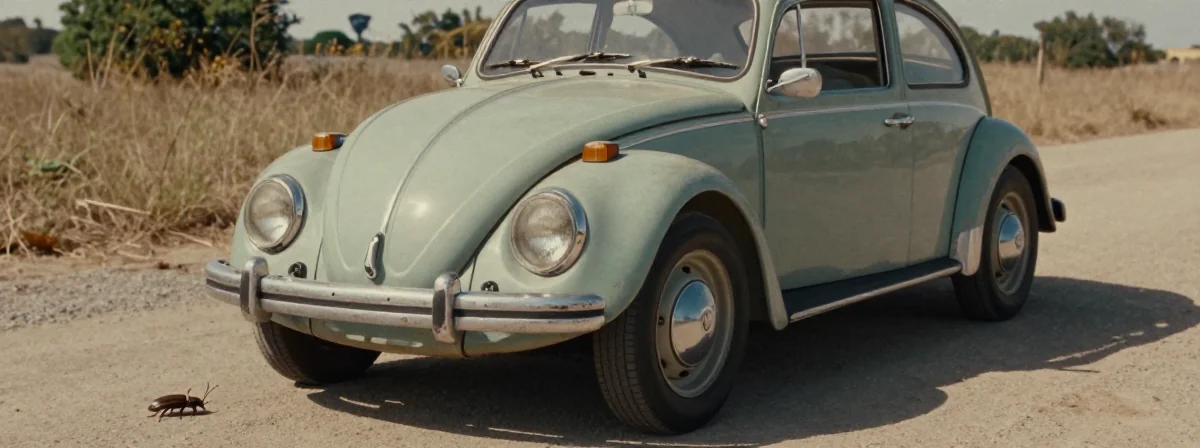
Some species carry the ghost of evolution in their very DNA. The telephone-pole beetle is one such creature—a wood-boring insect that lives its entire life in larval form, reproducing asexually, yet still retains the instinct to seek and compete for mates. This contradiction isn’t a glitch; it’s a testament to how evolution doesn’t always clean up its work.
What the data shows is that these beetles are locked in a kind of biological limbo: their adult form exists only as a vestigial memory, while their larval stage has become the primary reproductive vehicle. The pattern here is clear—evolution favors what works, not what makes sense.
The telephone-pole beetle’s name comes from its larvae, which tunnel through wooden structures like utility poles. Taxonomists named it based on what they could see, not what they couldn’t. The adult form, rare and non-reproductive, was an afterthought—until now.
Why Would a Sterile Beetle Still Seek Mates?
The answer lies in vestigial instincts. Just as humans retain the urge to bite even though our canines are no longer weapons, these beetles carry the drive to mate long after their reproductive system has been bypassed. This anomaly suggests that evolution doesn’t always prune away unnecessary behaviors—it sometimes just lets them fade into the background.
Consider the axolotl, a salamander that remains in its larval form (neoteny) throughout life. Scientists can force it to mature into an adult with a hormone injection, but in nature, it never needs to. The telephone-pole beetle is similar—its “adult” phase is a phantom limb of its evolutionary past.
The Messy Beauty of Asexual Reproduction
Asexual reproduction isn’t just a fallback; for some species, it’s a superpower. These beetles produce clones of themselves, eliminating the need to find a mate. But isn’t that bad for genetic diversity? Yes and no. While asexual reproduction can lead to slower adaptation and vulnerability to diseases, it also ensures survival in stable environments. For the telephone-pole beetle, dead trees are abundant, and predators are manageable—so why change a winning formula?
What the data shows is that asexual species often thrive in niches where sexual reproduction is a liability. Think of shipworms, which evolved to eat wood in semi-salty waters and spread globally thanks to human shipping. Evolution doesn’t care about elegance; it cares about persistence.
Evolution’s Unfinished Business
The telephone-pole beetle’s lifecycle raises a fascinating question: What happens when a species “forgets” to finish developing? Some salamanders in Mexico lack the gene to produce a hormone that triggers adulthood. In labs, scientists can force them to mature, but in the wild, they remain in their juvenile form. Could this be an evolutionary shortcut—or a glitch?
The pattern here is that evolution often works by repurposing existing systems rather than inventing new ones. The beetle’s sterile adults aren’t a failed experiment; they’re a reminder that some traits stick around long after their original purpose has vanished.
The Half-Life Connection
For fans of science fiction, the telephone-pole beetle echoes the lore of Half-Life’s Advisors. These creatures live for millennia underground, communicating through psychic connections and creating complex societies. They dread maturing into mindless, reproductive adults—their psychic vulnerability made them easy targets for the Combine.
While the beetle’s story is grounded in biology, the metaphor is striking: what if our own species carries vestigial instincts we no longer understand? Could there be a “trigger” that would unlock a dormant part of our biology?
The Human Parallel
Humans, too, have vestigial traits. Our appendix once aided digestion; our tailbone is a remnant of our primate ancestors. But we also reproduce for pleasure, a trait rare in the animal kingdom. Could this be an evolutionary holdover—or something new?
The telephone-pole beetle teaches us that survival isn’t about perfection; it’s about what works now. Its sterile adults, its cloned offspring, its phantom mating drive—all are pieces of a puzzle that evolution never bothered to solve.
The Eternal Juvenile
In the end, the telephone-pole beetle isn’t broken; it’s optimized. Its lifecycle is a reminder that evolution doesn’t care about our expectations. It cares about persistence. And sometimes, the most successful species are the ones that never grow up.