
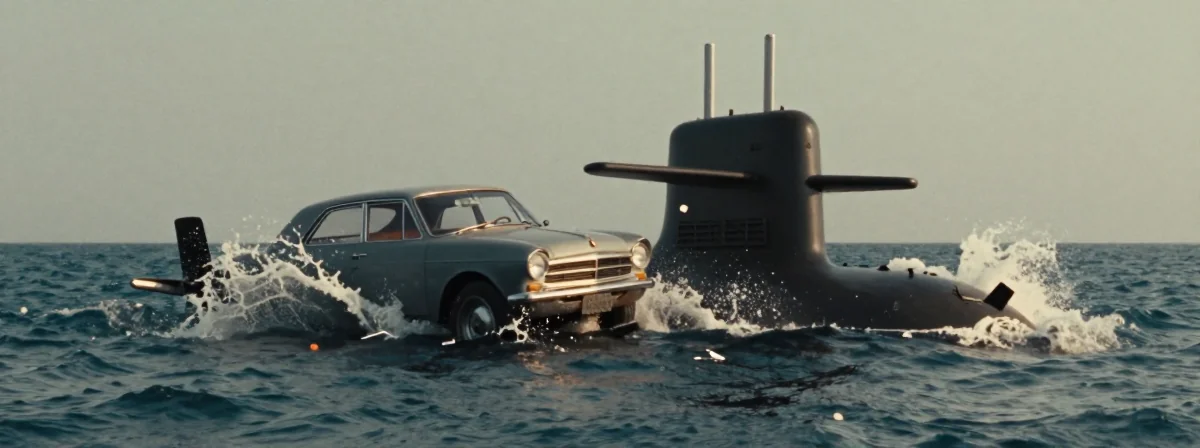
Imagine driving your car and suddenly realizing you’ve just hit a submarine. Sound like something from a Hollywood script? It’s not. This bizarre event actually happened, and it’s packed with fascinating insights about engineering, physics, and even insurance claims. The collision between a Volvo and a submarine isn’t just a random accident—it’s a window into how unexpected events can reveal the hidden strengths and weaknesses of everyday technology.
Volvo, known for its reputation as a “tank with seat warmers,” found itself in an unusual situation when its vehicle came face-to-face with a submarine. The submarine, named Bävern (which means “Beaver” in Swedish), wasn’t even moving at the time. Yet, the physics of the encounter and the aftermath are enough to make any engineer or car enthusiast sit up and take notice. Here’s what makes this story so extraordinary.
Why Did a Car and a Submarine Even Meet in the First Place?
The intersection between land vehicles and naval vessels is incredibly small. Think about it: cars operate on roads, submarines in the depths of the ocean. For these two to collide is like a fish leaping out of water to hit a bird in mid-air—it’s almost impossible. Yet, this happened because of a rare set of circumstances: the submarine was surfaced, and the car was driving on a coastal road in Sweden. The road was so close to the water that the car’s trajectory intersected with the submarine’s position at just the wrong moment.
This collision highlights how our engineered world sometimes creates unexpected overlaps. It’s a reminder that even in our carefully designed systems, anomalies can occur. The fact that this is the only recorded collision between a car and a submarine underscores just how rare—and bizarre—this event truly is.
What Happens When a Volvo Hits a Submarine?
Volvo has a reputation for building sturdy vehicles, but even the toughest cars aren’t designed to collide with submarines. Submarines, on the other hand, are built to withstand immense pressure underwater. So, which one came out on top? The surprising answer is that the submarine likely suffered minimal damage. Submarines are constructed with thick, reinforced hulls to handle deep-sea conditions, making them surprisingly resilient to surface-level impacts.
The Volvo, however, probably fared worse. While it’s known for safety features, a direct hit on a submarine’s hull would likely result in significant damage to the car. Reports even mention a “Volvo-shaped dent” on the submarine, which is a testament to the car’s impact. This collision serves as a real-world physics lesson: when two objects of vastly different design purposes collide, the one less prepared for the encounter usually loses.
The Insurance Claim That Makes You Scratch Your Head
Imagine being the insurance adjuster who has to process a claim for a car that hit a submarine. The sheer absurdity of the situation is enough to make anyone question their career choice. “Yes hello, my car sank a sub…” is not a phrase you expect to hear in an insurance office. The claim would have to navigate unprecedented territory: whose fault was it? How do you assess damage to a submarine? And perhaps most importantly, how do you explain this to the CEO of the insurance company?
This scenario is a perfect example of how real-world events can outpace our systems for handling them. Insurance companies are designed to deal with car accidents, house fires, and natural disasters—but a car-submarine collision? That’s territory no adjuster is prepared for. It’s a reminder that while we build complex systems to manage risks, life has a way of throwing curveballs that test those systems to their limits.
The Volvo’s Secret Weapon: Engineering That Goes Beyond the Road
Volvo’s reputation for safety isn’t just marketing—it’s backed by decades of innovation. Did you know that Volvo introduced concepts like driverless cars way back in 1961? That’s 65 years ahead of its time! While today’s tech giants are still struggling with autonomous driving, Volvo was experimenting with it decades ago. This forward-thinking approach is part of why Volvo cars are often seen as “unstoppable objects”—they’re built to endure.
In this collision, the Volvo’s robust construction likely played a role in how the impact was distributed. Even though the submarine probably won the physical contest, the Volvo’s design would have absorbed and redirected energy in ways that could have minimized harm to passengers. This isn’t just about surviving crashes—it’s about understanding how engineering choices can create vehicles that are safe in ways we don’t even realize.
The Bizarre Language Twist: Volvo vs. Bävern
Language lovers might find this detail particularly amusing. The submarine’s name, Bävern, means “Beaver” in Swedish. Meanwhile, “Volvo” is Latin for “I roll.” There’s a playful irony in a car named after movement hitting a submarine named after an animal known for building dams. To some, it’s almost as if the names were destined for this collision. And for those with a penchant for wordplay, the similarity between “Volvo” and a certain anatomical term adds another layer of humor to the situation.
This linguistic coincidence isn’t just a funny aside—it’s a reminder that even in the most technical and serious of situations, there’s often a human element that adds color. Engineers design machines, but it’s humans who name them, and sometimes those names tell a story all their own.
The Unspoken Hero: The Herring That Passed By
In the chaos of a car hitting a submarine, it’s easy to overlook the small details. But some details are worth noting because they add to the absurdity of the situation. Before the Volvo made contact with the submarine, it reportedly passed a shipment of herring floating in the water. Why is no one talking about the herring? It’s a quirky detail that perfectly encapsulates how life often throws in unexpected elements when we least expect them.
This isn’t just about a random fish; it’s about perspective. In the grand scheme of things, a car-submarine collision is a headline-grabbing event. But the herring reminds us that there are always smaller stories unfolding in the background. It’s a gentle nudge to appreciate the little things, even when something extraordinary is happening.
What This Collision Teaches Us About Motion and Reference Frames
Physics enthusiasts might appreciate this deeper insight: was this even a collision if the submarine was stationary? By definition, a collision involves two bodies exerting force on each other. If one is stationary, does that still count? The answer is yes—and no. From the car’s perspective, it was a collision. From the submarine’s perspective, it was an impact. But from the perspective of the Earth, both were moving at incredible speeds as part of its orbit around the sun.
This philosophical twist isn’t just academic—it’s a reminder that reality is relative. What we perceive as stationary or moving depends entirely on our frame of reference. The Volvo-submarine collision is a perfect illustration of how our understanding of events can shift based on how we choose to view them. It’s a lesson in humility, reminding us that our perceptions are just one way of looking at a complex world.
The Aftermath: Both Insurance Rates Went Up
Even in the most bizarre accidents, some things remain constant. After the Volvo hit the submarine, both vehicles likely saw their insurance rates go up. Why? Because insurance companies assess risk based on events, not just fault. A car that hits a submarine is statistically unusual, but the fact remains that it was involved in an accident. Similarly, a submarine that gets hit by a car, even if stationary, has now been involved in an event that could be classified as damage.
This outcome is a sobering reminder that in the world of insurance, anomalies don’t matter as much as the fact that something happened. It’s a system built on probabilities, and every accident, no matter how strange, contributes to those calculations. For the owners of both vehicles, the lesson is clear: sometimes, the most unexpected events have the most predictable consequences.
The Final Takeaway: Engineering, Anomalies, and the Unbreakable Laws of Physics
The collision between a Volvo and a submarine isn’t just a funny story to tell at parties—it’s a profound lesson in engineering, physics, and human ingenuity. It shows us that even the most robust designs can encounter situations they weren’t built for, and that sometimes, the most unlikely events reveal the hidden strengths of our technology. The Volvo’s resilience, the submarine’s durability, and the insurance claim that defied categorization all come together to paint a picture of a world where anomalies aren’t just exceptions; they’re opportunities to learn.
Next time you’re driving your car, remember this story. Think about the layers of engineering that went into its design, the systems in place to protect you, and the countless variables that keep everything running smoothly. And if you ever find yourself near a submarine, maybe give it a wide berth. After all, you never know when physics might decide to throw you a curveball.