
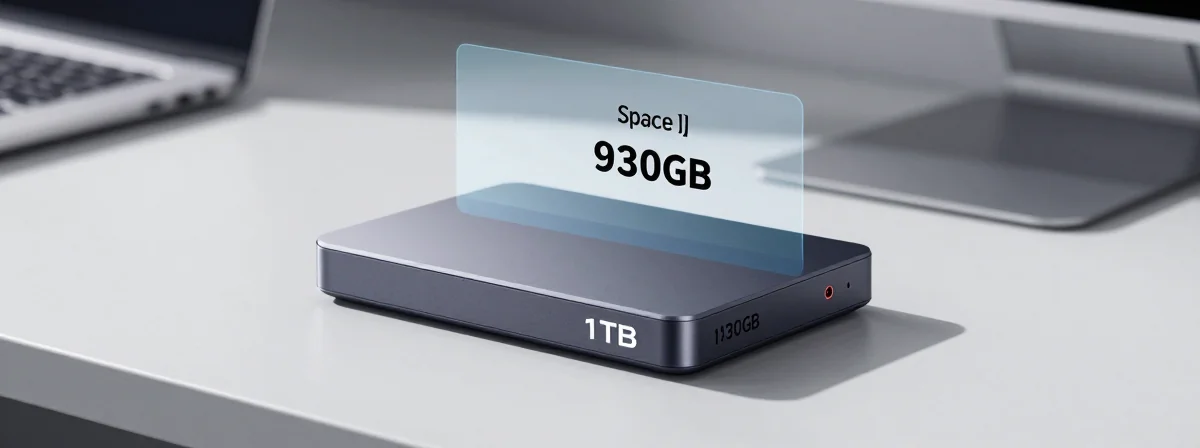
You just bought a shiny new 1TB SSD. You plug it in, and your computer says it’s only 930GB. What the heck? Don’t feel dumb — you’ve just fallen into the oldest trap in tech: the battle between binary and decimal. This isn’t just some marketing gimmick; it’s a clash of history, engineering, and human psychology that’s been going on since before you were born. Let’s unpack this mess.
Reality Check
The First Hard Drives Didn’t Even Speak Bytes
Think the binary/decimal fight is new? The IBM 350 disk system from 1956 stored 5,000,000 characters — not bytes, because bytes weren’t even standardized yet. These early machines were built for big iron, where decimal made sense because storage was measured by physical dimensions (tracks, sectors, cylinders). Binary only became important when memory addressing took center stage in personal computing. So when your drive says “1TB,” it’s echoing decisions made before you could even imagine computers in your home.Engineers Didn’t “Steal” Kilo/Mega — They Borrowed It
Computer scientists didn’t invent kilobytes as 1024 out of spite. They used existing SI prefixes (kilo=1000, mega=1,000,000) as the closest approximation for 1024, because 2^10 is remarkably close to 10^3. It was a practical shortcut, not a declaration of war. The real confusion came later when storage manufacturers decided to stick with the original SI meaning while memory manufacturers kept using the binary approximation. Now we’re all paying the price.SSDs Make It Even Weirder Now
Flash memory is technically more like RAM than a spinning drive — it uses binary addressing. But then engineers added wear leveling and over-provisioning, meaning the number your OS sees isn’t the physical capacity at all. So just when you think we should finally standardize on binary units, the hardware itself is lying to you. At this point, I kinda want to give up too.
The Kibi/Mebi/Gibi Solution? Mostly for Lawyers
Yes, there are official binary prefixes (KiB, MiB, GiB) that solve the problem. But who uses them? Mostly people dealing with legal compliance or ultra-precise technical documentation. In real life, even computer scientists default to KB/MB/GB because that’s what everyone understands. The marketers didn’t invent the decimal standard — they just exploited a pre-existing ambiguity that engineers never bothered to fix.The Gap Keeps Getting Bigger
The difference between decimal and binary units grows with scale:
- 1 GiB is 4.9% larger than 1 GB
- 1 TiB is 10% larger than 1 TB
So that 1TB drive? It’s not just “a little off” — it’s actually 70GB smaller than you expect. And when we hit petabytes, that percentage will keep climbing. At some point, we’ll all wonder why we let this confusion persist for so long.
You’re Already Thinking in Decimal Anyway
Let’s be honest: when you budget 4GB of memory, do you think “2^32 addresses” or “roughly 4 billion”? Base-10 is hardcoded into our brains from childhood. Even when the underlying tech is binary, decimal is often more practical for human communication. The real problem isn’t that we use decimal for storage — it’s that we inconsistently apply it while pretending the binary units are the “real” ones.This Isn’t Just About Drives — It’s About Everything Digital
The same confusion exists in networking (Mbps vs. MBps), RAM marketing, even screen sizes (measured diagonally, not usable area). We’ve normalized accepting marketing numbers at face value because correcting them feels like nitpicking. But that 1TB SSD? It’s a perfect microcosm of how tech industries prioritize marketing convenience over user clarity. And until we demand better, we’ll keep getting drives that are “full” the second you plug them in.
You’ll never get that missing 70GB back — but now you know why it’s missing. The next time you see a storage number, pause for a second. What you’re seeing isn’t just a technical detail; it’s a legacy of engineering shortcuts, marketing opportunism, and the eternal struggle between human intuition and machine reality. And maybe, just maybe, you’ll start demanding more honesty in the numbers we all rely on.