
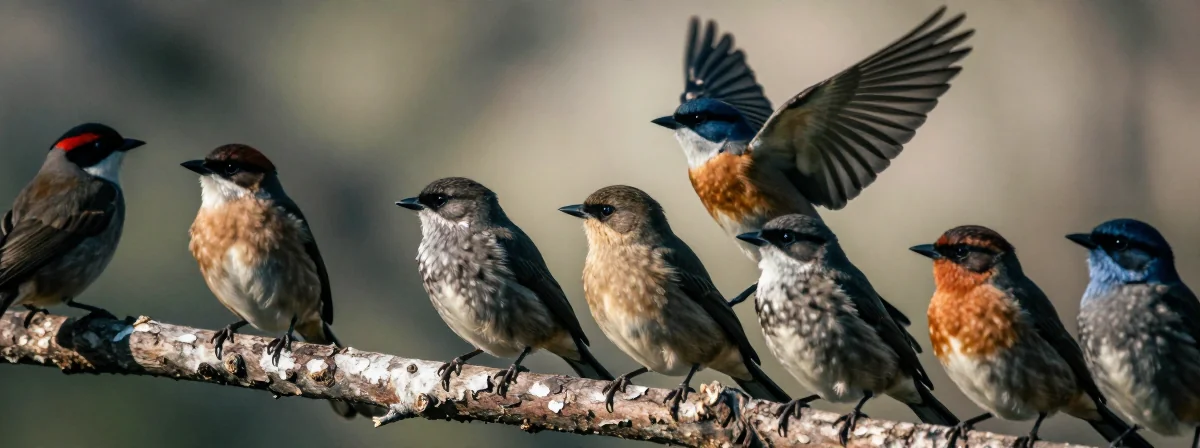
Have you ever watched a crow meticulously bend a wire into a hook to retrieve food from a jar, or heard a parrot not just mimic words but use them in context? These aren’t isolated anomalies—they’re glimpses into a sophisticated intelligence that challenges our understanding of consciousness itself. For too long, we’ve confined intelligence to human parameters, missing the forest for the trees when it comes to the remarkable cognitive abilities of our feathered neighbors.
The natural world speaks in whispers we’re only beginning to hear. Birds, particularly corvids and parrots, demonstrate problem-solving skills, tool use, and even what might be called emotional intelligence that rivals our own. Consider the crow that drops nuts onto crosswalks, waits for cars to crush them, then retrieves the contents—this isn’t instinct; it’s strategic thinking that accounts for traffic patterns and human behavior. These aren’t just clever tricks; they’re evidence of a mind that plans, reasons, and adapts in ways we’ve traditionally reserved for ourselves.
Can Birds Truly Understand Language?
We tend to dismiss parrots as mere mimics, but the truth is far more complex. African Grey parrots like the famous Alex (and his successor Griffin) have demonstrated an understanding of concepts far beyond simple mimicry. They can identify objects by color, shape, and material, and even understand abstract concepts like “same” and “different.” When Apollo the Parrot describes objects by their color and composition, he’s not just repeating sounds—he’s applying categorical thinking that forms the basis of human language.
This raises profound questions about what we mean by “understanding.” If a bird can learn hundreds of words and apply them correctly in context, what exactly is happening in that avian brain? Perhaps language isn’t uniquely human after all, but rather a cognitive capacity that can emerge in different forms across species. The parrot that says “I’m going to die” isn’t just stringing words together—it’s expressing a complex awareness of its own existence and impending end.
Why Do We Underestimate Animal Intelligence?
There’s something deeply uncomfortable about recognizing intelligence in other species. When we discover that crows can recognize human faces and pass warnings about “dangerous” people to their offspring, or that ravens form symbiotic relationships with humans and wolves to hunt more effectively, we’re forced to confront uncomfortable truths about our place in the natural order.
Part of this resistance comes from our cultural narrative that positions humans as the pinnacle of evolution. But what if intelligence isn’t a linear progression but a diverse landscape? The crow that plans three steps ahead to hide surplus food isn’t failing to be human—he’s succeeding at being crow. His intelligence is adapted to his ecological niche, just as ours is to ours. The mistake lies in measuring all intelligence by our own standards rather than recognizing the multiple forms consciousness can take.
What Can We Learn From Bird Communication?
Birds communicate in ways we’re only beginning to decode. Crows have been observed holding “funerals” for their dead, with family members gathering around, squawking, and avoiding the area for days. Parrots develop regional accents and use different calls for different family members. These aren’t simple signals but complex social communications that maintain group cohesion and transmit knowledge across generations.
Consider the raven that learned to guide a wildlife keeper to deer, anticipating not just the presence of meat but the human’s likely behavior. This isn’t just clever—it’s a form of interspecies understanding that suggests birds may possess a theory of mind, the ability to recognize that other beings have thoughts and intentions different from their own. When that same raven then expects a reward, it’s engaging in reciprocal altruism, a behavior once thought unique to humans.
How Does Bird Intelligence Challenge Human Exceptionalism?
The most profound lesson from bird intelligence isn’t just that they’re smart, but that intelligence itself comes in many forms. The crow that remembers a face for five years and warns its community isn’t just storing a memory—he’s making moral judgments about trustworthiness. The parrot that combines words in novel ways isn’t just learning syntax—he’s engaging in creative expression. These behaviors aren’t just interesting—they’re transformative for how we understand consciousness itself.
Perhaps the most unsettling realization is that intelligence doesn’t necessarily lead to moral behavior. As one observer noted about Hermann Göring at Nuremberg, intelligence can be directed toward evil as readily as toward good. This suggests that intelligence itself isn’t inherently valuable—what matters is how it’s applied. The same cognitive abilities that allow birds to solve problems can be marshalled for deception and manipulation, as we see in the crow that waits until humans are distracted to steal food.
What Does Bird Intelligence Reveal About Evolution?
If birds, descendants of dinosaurs, can develop such sophisticated cognitive abilities, what does that say about the potential for intelligence in other evolutionary paths? Some scientists speculate that had the dinosaurs not gone extinct, we might be sharing the planet with intelligent dinosaur descendants today. This isn’t just speculation—it’s a reminder that intelligence isn’t a rare accident but a potential outcome of evolutionary pressure in certain ecological niches.
The parallel evolution of intelligence in birds and mammals suggests that complex cognition isn’t dependent on specific biological structures but can emerge from different neural architectures when faced with similar environmental challenges. This challenges the notion that human intelligence is somehow predetermined or inevitable, instead suggesting it’s one possible solution among many to the problems of survival and adaptation.
How Should We Relate to Animals After Discovering Their Intelligence?
The recognition of animal intelligence forces a fundamental rethinking of our relationship with other species. When we understand that the dog that learns to open doors by manipulating handles understands cause and effect in the same way a human does, or that the cat that learns to open doors lives by its own rules rather than ours, we’re faced with an ethical imperative to reconsider our treatment of animals.
This isn’t just about giving animals rights—it’s about recognizing them as fellow travelers on this planet with their own forms of consciousness, communication, and problem-solving. The crow that holds a grudge against a human who threw a rock isn’t just exhibiting a primitive emotion—he’s demonstrating a form of justice that recognizes transgressions and their consequences. To dismiss this as “just animal behavior” is to miss the profound truth that consciousness exists in many forms, all worthy of our respect.
The unspoken language of birds isn’t just fascinating—it’s a mirror reflecting back to us our own assumptions about intelligence, consciousness, and our place in the natural world. In learning to listen to these voices, we may discover not just more about birds, but more about ourselves.