
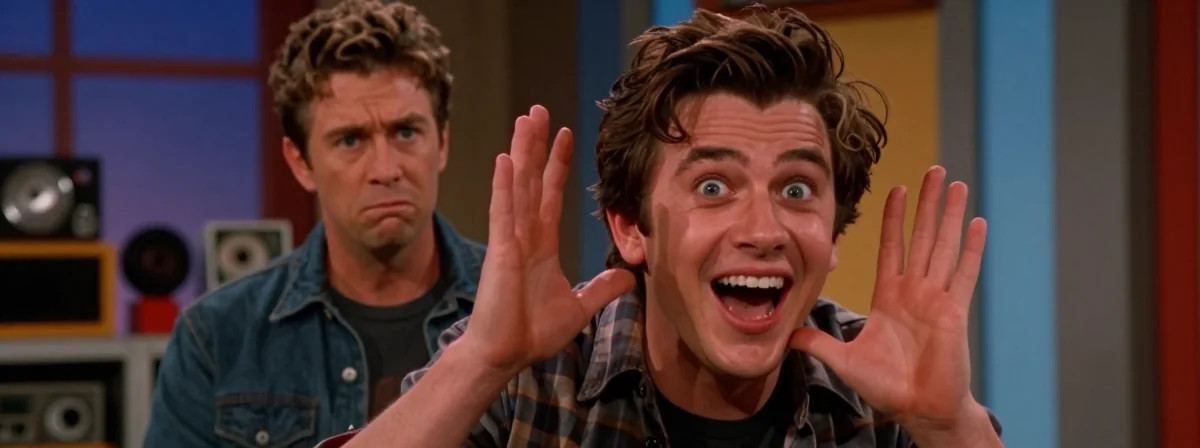
Some shows are like software—designed with a clear user interface (the main character) but secretly powered by a rogue background process (the sidekick) that ends up running everything. You think you’re watching the hero, but the real story is the one quietly rewriting the code in the background.
This isn’t just about fan favorites—it’s about how some characters break the system, how they glitch their way from background to center stage, and why we never see it coming.
System Analysis
- Niles Crane wasn’t just a side character—he was the hidden variable in Frasier’s equation.

The show was marketed as Frasier’s intellectual journey, but Niles’ arc is the real mathematical proof. From his disastrous marriage to his financial ruin, Niles’ character went through more dramatic transformations than a transformer in a hardware update. David Hyde Pierce didn’t just play a character—he wrote a whole new operating system for the show, one where physical comedy was the kernel and emotional depth was the API.
When the guest star becomes the mainframe. Think about Steve Urkel. He started as a minor glitch in Family Matters, then suddenly the entire show’s architecture shifted to accommodate him. People weren’t tuning in for the Winslows—they were waiting for the Urkel. It’s like your phone suddenly runs smoother after a random app update because some third-party developer figured out a better algorithm.
The Janitor wasn’t just background noise—he was the hidden boss level. Scrubs’ Janitor wasn’t just funny—he was a character so unpredictable they had to write “Neal says something funny” into the script. It’s like when a game’s AI starts outsmarting the developers, forcing them to patch in new behaviors just to keep up. The fact that he was mostly ad-libbing is the ultimate testament to this: the system couldn’t contain him.
Jesse Pinkman: The variable that saved Breaking Bad.
Originally supposed to be a one-season throwaway character, Jesse became the moral anchor in a show about moral decay. Aaron Paul didn’t just act—he rewrote the narrative source code. Without Jesse, Walter White would just be a villain, not a tragic figure whose descent we actually care about. He was the control group in a human experiment gone wrong.
Spike wasn’t just a vampire—he was the game’s DLC. Buffy’s Spike started as a villain, became a recurring threat, then somehow ended up as one of the show’s most beloved characters. It’s like when a DLC character becomes more popular than the original roster—except this was happening in real-time, episode by episode. James Marsters didn’t just play a character; he inserted himself into the narrative firmware.
Creed Bratton: The perfect background process. The Office’s Creed wasn’t a main character—he was the undocumented feature that made the show work. Used just enough to be mysterious, never enough to break the system. It’s like that one utility app on your phone that you never use but can’t delete because the whole ecosystem depends on it.
Omar Little: The antivirus that the system couldn’t kill. The Wire’s Omar wasn’t just a character—he was a narrative virus that the show’s world couldn’t contain. His theme music wasn’t just music; it was the sound of the system being hacked. “Omar comin’” wasn’t a warning—it was a system alert that the rules had changed.
Titus Andromedon: The side character who became the show’s soul. Unbreakable Kimmy Schmidt’s Titus didn’t just add humor—he became the emotional core of the show. It’s like when a plugin you installed for one feature ends up becoming essential to the entire application. “I’ll be your huckleberry” might be a famous line, but Titus was the whole damn show.
The Fonz: The viral marketing campaign that became the product. Happy Days was supposed to be about Richie Cunningham, but the Fonz became the reason people watched. It’s like when a company’s viral marketing campaign becomes more popular than the actual product. The Fonz wasn’t just a character—he was the brand.
Vigilante: The character they couldn’t contain. Peacemaker’s Vigilante started as a minor role, then somehow became the character people were talking about. The fact that they had to reshoot scenes and replace voice lines just to get his portrayal right shows how the system tried to contain him—and failed. Freddie Stroma didn’t just play a character; he became the character the show needed him to be.
None of these characters were supposed to be the main event. They were supposed to be background processes, minor functions in a larger program. But sometimes, the sidekick writes the main story. Sometimes, the supporting character becomes the reason we keep watching. And that’s when you know a show has truly succeeded—not when it follows the script, but when it allows its characters to write their own.