
Imagine holding a magnifying glass to a candle miles away and telling exactly what fuel is burning inside it. That sounds impossible, right? But that’s exactly what modern astronomers are doing every single day! They aren’t just guessing; they’re using math and light to peek into the atmospheres of worlds that are light-years away. It’s mind-boggling! You have to wonder, how do they actually do it? Is it magic, or is there a system behind it?
Think about the sheer scale of it. We are looking at light that has traveled for thousands, maybe millions of years just to hit our telescopes. And yet, we can deduce the composition of a planet’s atmosphere by seeing how that light behaves when it passes through it. It’s a brilliant framework of information transfer, and it all starts with a simple observation: the planet passes in front of its star.
How Do We See a Planet That’s Millions of Miles Away?
It sounds like science fiction, but it’s actually just really, really good detective work. The primary way astronomers find these distant worlds is by watching them transit, or pass in front of, their host stars. When a planet moves between us and its star, it blocks a tiny fraction of the light. That dip in brightness—the “light curve”—is the first clue. It tells us the planet is there!
But the real magic happens when we combine that with the “wobble.” Gravity is a two-way street! The planet pulls on the star just as much as the star pulls on the planet. By measuring how much the star wobbles, astronomers can figure out the planet’s mass and distance. It takes years of precise calculation to work all that out, but we’ve been refining these techniques for literally hundreds of years. It’s a testament to human ingenuity!
The “Light Curve” Trick That Changes Everything
Once we know a planet is there and how big it is, we can start looking closer at the light. This is where it gets really exciting. When the planet passes in front of the star, we get a brief, tiniest glimpse of the star’s light passing through the planet’s atmosphere. The star’s spectrum gets modified! It’s like reading a fingerprint in the light.
We know exactly how different materials absorb and reflect specific wavelengths. By analyzing those wavelengths, we can identify the chemical makeup of the atmosphere. If we see nitrogen and oxygen, we might be looking at an Earth-like world. But what if we see something else?
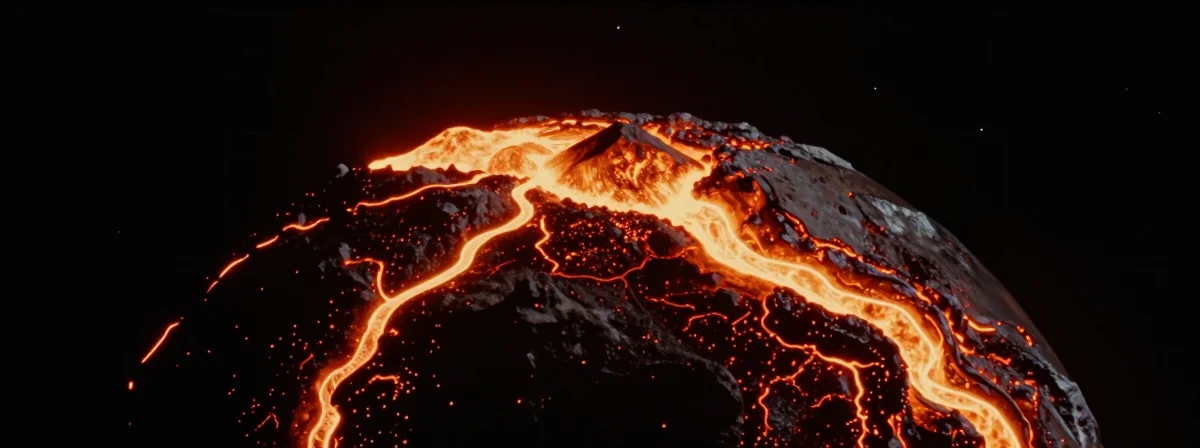
What If the Atmosphere Is Made of Lava?
This is where the conversation gets wild. What if we detect silicon and iron in the atmosphere? Holy shit! That would mean the planet’s atmosphere contains minerals! Such a thing could only happen if the planet was made of molten rock. It’s a terrifying thought, but the data would be screaming it at us.
We can back that up by observing the temperature change as the planet traverses the star. The star’s surface temperature is known based on its mass and chemical makeup. If the planet is a big ice ball, the dimming looks different than if it’s a hot ball of magma. When you put all that data, math, and logic together, you realize just how accurate these measurements can be. It’s not just a guess; it’s a convergence of evidence!
It’s All Just an Educated Guess (But a Good One!)
There’s a lot of talk about “educated guesses,” and people often dismiss them. But let’s look at the system! It’s not random. It’s based on how hot the star is estimated to be, how far away it is, and what the planet seems to be made of. We know how different things behave at different temperatures, so we use that knowledge to predict what we should see.
It’s similar to the engineers you might work with—high intelligence doesn’t always mean high wisdom, but it means you have the tools to solve the puzzle. We use automation systems to compute new data, feed it back into the machine, and extract conclusions. It’s a feedback loop of pure logic!
The Irony of the System
Here’s the kicker: we are all part of this system. The same way we wobble our stars, the stars wobble us. We are constantly being pulled and pushed by gravity, and we are constantly observing light that has traveled through the ages. It’s an irony inherent in the system!
We might feel small looking up at the night sky, but we are actually incredibly powerful. We can look at a distant world, analyze its light, and tell you if it’s made of water, ice, or molten lava. It all makes sense now. The universe is communicating with us, and we are finally learning how to listen.