
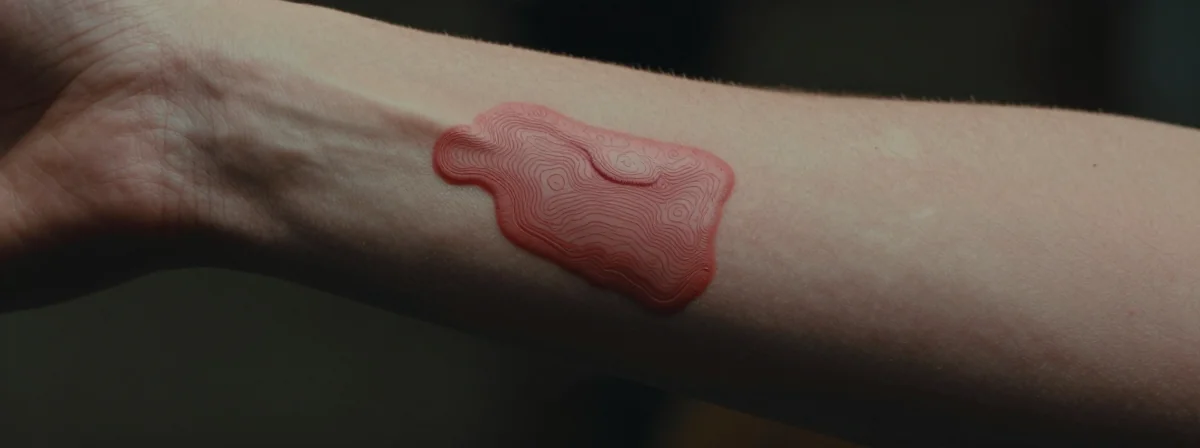
You might think your scar is just damaged skin trying to heal itself back to normal. You’re wrong. That raised, textured line on your arm isn’t skin at all—it’s a biological patch job. It’s a clever, fast, but temporary solution that your body installs to keep you from bleeding out.
When you look at a scar, you’re looking at a protein patch. It’s not made of cells. It’s made of collagen, a structural protein that attaches to nearby cells. While the surrounding skin cells eventually get replaced, the collagen just sits there, holding the wound shut.
The “Library Book” Blueprint
Here is where it gets interesting. Your body is constantly replacing its cells, right? You’ve heard the “seven-year-old you” myth. But think about a library book with a torn page. The librarian can’t find the original page, so they tape a blank sheet over the tear to keep the book readable. The book is fixed, but it’s not “whole” anymore.
Your body does the exact same thing. When skin cells die and need to be replaced, they check the “blueprint” of the area. If the blueprint is scar tissue, the new cells copy the scar tissue. They don’t know the original blueprint exists elsewhere on your body. They just see a gap and fill it with the closest available material—which happens to be more scar tissue.
A “Quick and Dirty” Patch
Scar tissue is essentially a “bandaid.” It’s a fast-healing technique. The body realizes a wound is severe enough that it can’t afford to take the time to grow perfect, complex skin cells. It needs a solution now.
So, it builds a collagen composite. It’s a “quick and dirty” replacement. It’s functional, but it lacks the complexity of real skin. It can’t regulate temperature like normal skin, it doesn’t have hair follicles, and it won’t tan. It’s just there to keep you from falling apart.
The “Tape” Lets Go
Because scar tissue is just protein holding things together, it’s not permanent. Your body actually does replace that collagen over time, slowly remodeling the scar. But here is the scary part: if you lack Vitamin C, your body can’t produce collagen.
This is where scurvy comes in. Without Vitamin C, the “tape” holding your wounds shut rots away. Old wounds don’t just heal; they reopen. This is why scurvy was so deadly for sailors. It wasn’t just bleeding gums; it was the slow, agonizing reopening of every injury they had ever sustained.
We Have an Evolutionary Edge
You might wonder why our bodies are programmed to make such imperfect tissue. It seems like a flaw. But from an evolutionary standpoint, it’s a massive advantage.
Many other species heal with very little scarring, but they take much longer to recover. Our ability to slam a protein patch over a wound in days—rather than weeks—gave our ancestors a serious competitive edge. We could survive injuries that would have killed a rival species. It’s a trade-off: we have permanent reminders of our past battles, but we survive them.
The Myth of Regeneration
Finally, there is the myth that we can regenerate our tissues endlessly. We can’t. Once the basal cell layer of the skin is disrupted and replaced by scar tissue, that area is permanently marked. The cells there will never grow back into normal skin again.
This is why spinal cord injuries are permanent. We don’t have a mechanism to “undo” a scar. We are biological machines with hard limits, programmed by evolution to survive immediate threats, not to stay pristine forever.
What This Means
Your scars are proof of your survival, not a defect. They are the mark of a body that chose to patch you up rather than let you bleed out. Appreciate the biology that keeps you together, even if it leaves you with a few “library books” on your skin.
tags: [biology, anatomy, skin-health, evolution, history, scurvy]