
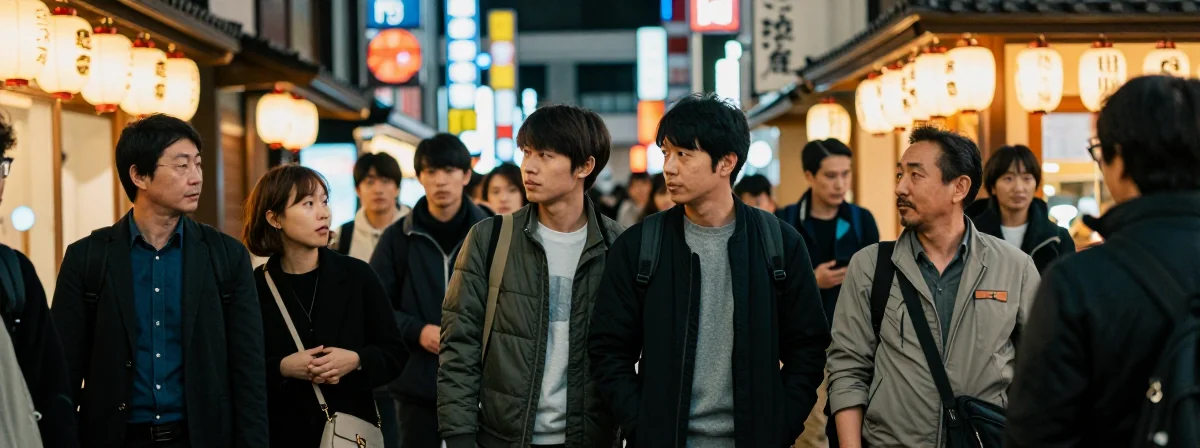
Japan’s reputation for politeness often masks a complex social hierarchy that operates beneath the surface. While the country welcomes millions of visitors each year with its famous hospitality, there’s an unspoken system of acceptance that divides foreigners into subtle categories. This isn’t about overt hostility but rather the cumulative effect of countless micro-interactions that create vastly different experiences depending on how you look and where you’re from.
The Japanese concept of “fitting in” runs deep in their culture, creating expectations that extend beyond language barriers into physical appearance and perceived social status. What begins as innocent curiosity can quickly evolve into preferences that favor certain foreign profiles over others. These preferences aren’t always malicious but they create a landscape where some visitors glide through interactions while others face invisible barriers at every turn.
In my conversations with dozens of expatriates across different backgrounds, a consistent pattern emerges—one that reveals how Japan’s social dynamics operate on multiple levels, often unnoticed by casual visitors but acutely felt by those who live there long-term.
Why Do Japanese People Favor Lighter Skin?
The preference for lighter skin in Japan has ancient roots that trace back to feudal class structures. When the majority of the population worked in agricultural fields under the sun, those with lighter skin were typically from upper classes who worked indoors. This historical association created a lasting aesthetic preference that persists today, even as the original context has disappeared.
Modern Japanese people often don’t even realize they’re carrying this bias. You’ll frequently see locals wearing long-sleeved clothing and using parasols during sunny days—not just to protect from sunburn but to maintain their skin tone. This practice, while practical, subtly reinforces the cultural value placed on paler skin. The contrast is striking when visiting modern areas like Roppongi where fashion trends might favor tanned skin, yet the underlying preference remains unchanged in everyday interactions.
What makes this particularly challenging is how it intersects with race. While a white person might be seen as simply “foreign,” a person of color immediately confronts this historical bias. The result is a dual-layered judgment that can make navigating social situations feel like walking through invisible minefields.
Height Matters More Than You’d Think
In a country where the average male height is about 5'7", standing taller can create unexpected advantages. Taller individuals, particularly those who are also white, often receive more positive attention and fewer social barriers. This isn’t about admiration for height itself but rather how height correlates with perceived status and approachability.
The phenomenon creates some interesting dynamics. Black men who are tall might find themselves treated more favorably than shorter white men, though the advantages don’t typically match those of taller white men. These differences aren’t always conscious on the part of Japanese people—they’re more like reflexive responses to visual cues that align with cultural ideals of authority and approachability.
Shorter individuals, especially those who are also of color, often report feeling invisible or even actively avoided in social settings. This isn’t malicious intent but rather the cumulative effect of a society that values certain physical attributes as markers of status and trustworthiness.
The Privilege of Being White in Japan
While it’s uncomfortable to acknowledge, there’s a distinct hierarchy among foreigners in Japan, with white individuals typically at the top. This isn’t about race in the American sense but rather about how appearance aligns with Japanese aesthetic preferences. White people are often perceived as more approachable, trustworthy, and even attractive without needing to conform to Japanese beauty standards.
The advantages can be subtle but significant. Job applications from white candidates might receive more consideration, while those from black candidates might be “instantly tossed into the trash can,” as one long-term resident described. Restaurants might pull out English menus with higher prices for white customers, while offering more substantial discounts to those who appear to be of color.
What’s particularly telling is how even Japanese citizens who appear foreign face similar treatment. A Japanese person with lighter features might be treated with English menus or approached with simplified language, simply because their appearance triggers assumptions about their foreign status. This reveals how deeply appearance-based judgments are embedded in daily interactions.
Beyond Race: The Foreigner Tax
Being foreign in Japan carries its own set of challenges regardless of race, though the specifics vary. The “gaijin seat” phenomenon, where foreigners are subtly directed to sit in specific areas, is just one example of how non-conformity is managed in public spaces. Rental discrimination remains rampant, with many landlords refusing to rent to foreigners regardless of their background.
The most insidious aspect isn’t overt discrimination but the countless micro-exclusions that accumulate over time. These might include being ignored in shops, receiving less patient service, or having conversations deliberately conducted in English even when you’re speaking fluent Japanese. Each small incident might seem negligible on its own, but together they create a persistent background noise of otherness.
Interestingly, some foreigner-specific challenges actually work in favor of white individuals. The infamous “foreigner card” that grants special attention or privileges at certain establishments is rarely extended to non-white foreigners, creating another layer of differential treatment that operates entirely outside formal systems.
The Double Life of Foreigners in Japan
Many long-term foreign residents develop a kind of social split personality—adjusting their appearance, behavior, and even language based on the situation. This might mean wearing certain clothes to appear more approachable, deliberately speaking with an accent to trigger specific responses, or even changing topics of conversation to avoid scrutiny.
The most successful foreigners learn to navigate this landscape not by conforming, but by understanding the underlying dynamics. This doesn’t mean pretending to be something you’re not, but rather recognizing how appearance-based judgments work and adjusting expectations accordingly. It’s a delicate balance between authenticity and strategic adaptation.
What becomes clear after spending time in Japan is that these biases aren’t necessarily malicious—they’re more like cultural reflexes that operate beneath conscious awareness. The same person who might be friendly and welcoming to a white foreigner might unconsciously treat a black foreigner with suspicion, without realizing they’re doing anything different.
The Hidden Cost of Japan’s Politeness
Japan’s famous politeness can sometimes mask deeper issues. The passive-aggressive interactions, the subtle looks of disapproval, and the carefully worded comments that carry hidden meanings can be more exhausting than overt conflict. This “polite racism” creates a social environment where discrimination feels less like a violation and more like a gentle nudge to conform.
The most damaging aspect isn’t the occasional rude comment but the systemic nature of these biases. They’re not isolated incidents but patterns that repeat across different contexts and institutions. From job applications to social invitations, the cumulative effect creates a landscape where certain groups consistently face higher barriers to acceptance.
What makes this particularly challenging is how it contradicts Japan’s international image. The country that hosts the Olympics and promotes itself as a global leader in technology and culture simultaneously maintains these subtle but significant barriers to full participation by non-Japanese people.
Reimagining Acceptance in Japan
The good news is that Japan is changing, albeit slowly. Younger generations are more open-minded, and the increasing diversity in urban centers is gradually eroding some of these outdated preferences. International events and increased global connectivity are forcing conversations about these issues in ways that were impossible just a generation ago.
For foreigners living in Japan, the key isn’t to fight these biases head-on but to understand them and develop strategies for navigating them. This might mean seeking out communities where appearance-based judgments are less significant, focusing on building relationships rather than transactions, or simply accepting that some doors will remain closed regardless of effort.
Ultimately, the experience of being foreign in Japan reveals something profound about how we all navigate social spaces. The biases that foreigners face aren’t unique to Japan—they exist in every culture, just expressed differently. What makes Japan distinctive is how these biases have been codified into a system of unspoken rules that even the most well-intentioned locals struggle to see.
Understanding these unspoken tiers of acceptance doesn’t require judgment—it simply requires awareness. And awareness, as countless expatriates have discovered, is the first step toward creating more inclusive spaces in any culture.